


ASTM D1494: Diffuse Light Transmission Factor Testing Services
ASTM D1494 Diffuse Light Transmission Factor Testing measures the percentage of incident light transmitted as scattered radiation through translucent plastic films, sheets, and panels — used for material qualification, QC, and performance validation across agricultural, architectural, automotive, and lighting applications.
TRUSTED BY


Get ASTM D1494 compliant results — request your diffuse light transmission factor testing quote
- Overview
- Scope, Applications, and Benefits
- Test Process
- Specifications
- Instrumentation
- Results and Deliverables
What Is ASTM D1494 Diffuse Light Transmission Factor?
ASTM D1494 provides engineers with a reliable, reproducible method for measuring the diffuse light transmission properties of transparent and translucent plastic materials under controlled laboratory conditions. The standard covers everything from specimen preparation and conditioning to optical measurement setup, instrument calibration, and reporting of diffuse transmission values. The method specifically measures the portion of transmitted light that is scattered within the material, helping manufacturers evaluate light diffusion performance rather than only total transparency.
The test is commonly performed using integrating-sphere photometric equipment or equivalent optical systems designed to measure the ratio of diffusely transmitted to incident light. Results are reported as diffuse light transmission factor percentages, allowing direct comparison between materials, coatings, surface finishes, and product designs. Proper specimen preparation, surface cleanliness, and environmental conditioning are critical because scratches, haze, inclusions, or contamination can significantly affect optical performance and measurement accuracy.
ASTM D1494 is widely used across lighting, electronics, automotive, architectural, and consumer product industries where controlled light diffusion and visual appearance are critical performance requirements. Materials tested under this standard are commonly used in LED diffusers, translucent panels, display films, privacy glazing, automotive lenses, and optical covers, where uniform illumination, glare reduction, and visual comfort are essential. The standard also supports product qualification, supplier validation, quality control, and research and development activities in which consistent optical performance data are required for material selection and product reliability.

Applications and Benefits of ASTM D1494 Diffuse Light Transmission Factor Testing
Scope
ASTM D1494 applies to flat translucent plastic materials — films, sheeting, and rigid panels — where diffuse scattering is the primary mode of light transmission. The method is designed for materials that neither transmit light as a coherent beam nor are fully opaque. It quantifies the diffuse transmission factor as a percentage of incident light and is used for material qualification, lot-to-lot comparison, and performance specification against defined acceptance criteria.
The standard has defined boundaries on what it covers and does not cover. It is not interchangeable with ASTM D1003, which addresses haze and luminous transmittance for essentially transparent materials. Selecting the wrong method for a given material type will produce results that are technically incorrect or misleading.
- Applicable forms: flat films, sheets, and rigid panels in translucent form only
- Measured property: diffuse light transmission factor (%) — not haze, total transmittance, or specular transmittance
- Material requirement: scattering must be the dominant optical mechanism; a direct transmitted beam should be largely absent
- Excluded materials: opaque plastics, highly absorptive materials, and fully transparent specimens
- Not a substitute for D1003: the two standards serve different material types and should not be used interchangeably
- Documented variables: specimen thickness, surface condition, and colorant content must be recorded alongside results
- Specimen quantity: minimum five specimens recommended; higher count required for heterogeneous materials
Applications
ASTM D1494 is used wherever controlled light diffusion, glare reduction, and optical consistency are critical for product performance and appearance:
- Lighting & LED systems — evaluation of diffuser panels, LED covers, light guides, and lamp housings where uniform illumination and hotspot reduction are essential
- Automotive components — testing of translucent lenses, dashboard lighting covers, interior light diffusers, and optical plastic parts used in automotive lighting systems
- Electronics & displays — characterization of optical films, screen diffusers, touch panel layers, and display covers used in consumer electronics and display technologies
- Architectural & building materials — assessment of skylight panels, translucent glazing, decorative partitions, and privacy panels designed to diffuse natural or artificial light
- Consumer products & packaging — measurement of optical diffusion properties in translucent containers, cosmetic packaging, appliance covers, and decorative plastic components where visual appearance matters
- R&D and material development — comparative diffuse transmission analysis across polymer formulations, additives, coatings, textures, and processing conditions during new material development
Benefits
- Measures the optical behavior that matters most — ASTM D1494 specifically evaluates the scattered component of transmitted light, helping manufacturers optimize glare reduction, lighting uniformity, and visual comfort better than total transmission measurements alone.
- Supports consistent optical quality control — standardized specimen preparation, calibration procedures, and photometric measurement methods ensure reproducible results across laboratories, suppliers, and production batches.
- Enables material and surface optimization — diffuse transmission data helps engineers optimize fillers, coatings, surface textures, and polymer formulations for targeted optical performance and appearance.
- Improves product appearance and illumination efficiency — materials with controlled diffuse transmission reduce visible hotspots, improve aesthetic quality, and enhance lighting performance in end-use applications.
- Supports product validation and material qualification — documented ASTM D1494 results are commonly used by lighting manufacturers, electronics companies, and industrial OEMs as evidence of optical material performance.
- Early-stage QC — identifies variations in haze, surface quality, transparency, or optical diffusion performance before materials are integrated into finished products.
Our ASTM D1494 Testing Procedure
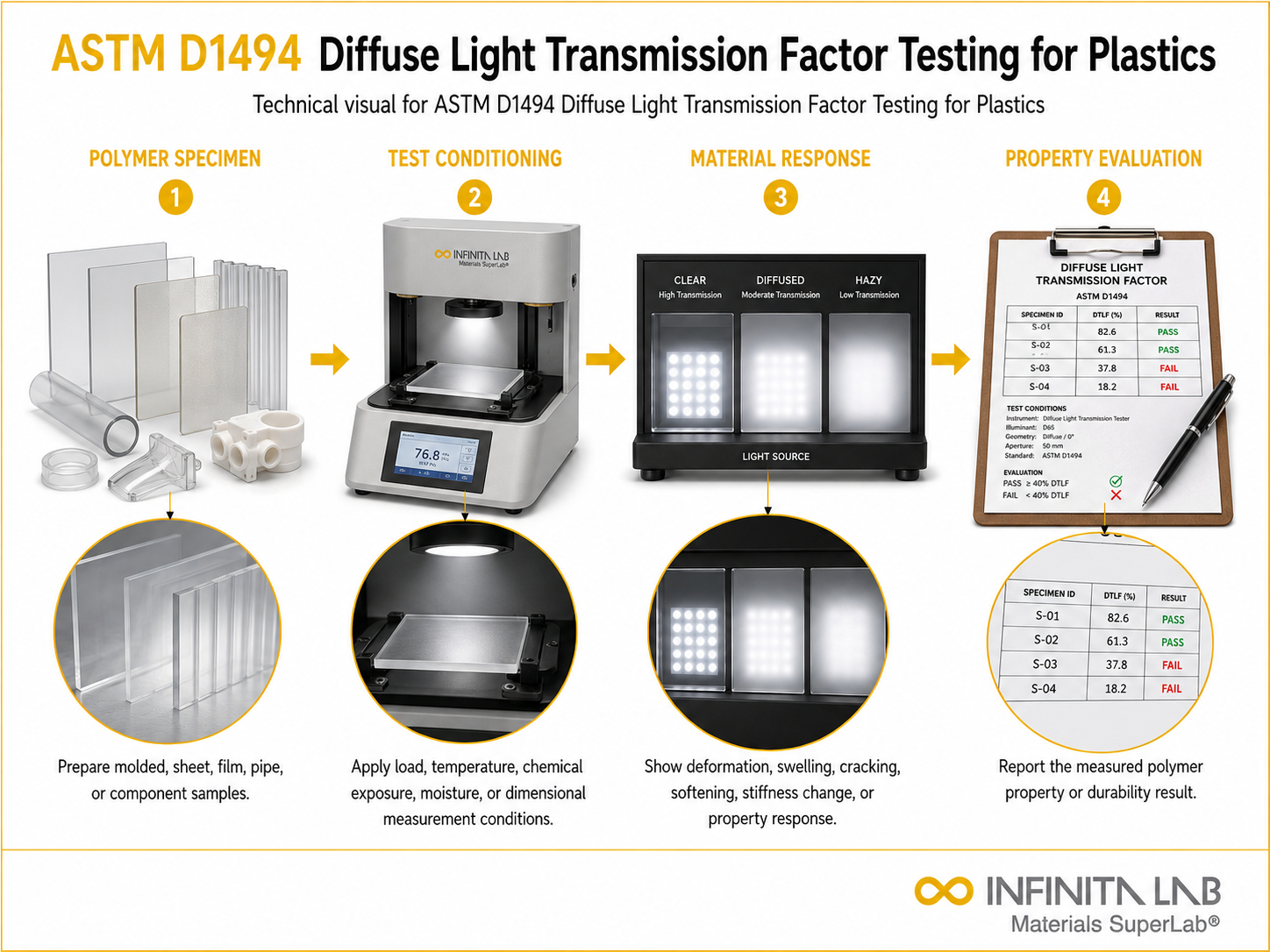
Sample Conditioning
Test specimens are conditioned at 23 ± 2 °C and 50 ± 5 % relative humidity before testing.
1Specimen Placement
The panel specimen is placed inside the test cabinet, fully covering the specified test area.
2Light Exposure
A fluorescent light source is used to illuminate the specimen under controlled conditions.
3Data Reading
Diffuse light transmission is measured and recorded as a percentage.
4ASTM D1494 Test Parameters and Requirements
| Parameter | Details |
|---|---|
| Applicable Materials | Translucent reinforced plastic panels |
| Minimum specimen size | Sufficient to cover integrating sphere port; typically 50 × 50 mm or per lab instrument aperture |
| Conditioning Environment | 23 ± 2 °C and 50 ± 5 % relative humidity |
| Test Area | Approximately 610 × 610 mm |
| Light Source | Fluorescent tube |
| Measured Outputs | Diffuse light transmission factor (%) |
| Specimen form | Flat film, sheet, or panel — no curvature |


- ASTM D1494 diffuse light transmission apparatus
- Fluorescent light source
- Enclosed test cabinet
- Light measurement instrument
- Sample holding fixtures
- Calibration and verification equipment
Equipment and Instrumentation Used for ASTM D1494 Testing
What You Receive: Test Report, Data, and Certification
- Test report — diffuse light transmission factor values for all specimens tested
- Statistical summary — mean diffuse transmission values, standard deviation, and variability analysis
- Optical performance analysis — comparison of light diffusion behavior across materials, coatings, or specimen configurations
- Transmission curves — raw optical transmission data and response plots for each specimen
- Surface quality assessment — optical observations identifying scratches, haze, inclusions, contamination, or surface defects affecting light diffusion performance
- Specimen dimension records — thickness and specimen measurements confirming conformance to testing requirements
ASTM D1494 Diffuse Light Transmission Factor FAQs
The diffuse light transmission factor of translucent plastic panels is measured by ASTM D1494 to determine the percentage of light transmitted after scattering, which is a measure of daylighting efficiency for architectural roofing, skylight, and cladding materials.
D1003 measures haze and luminous transmittance for transparent or near-transparent plastics where most light passes in a direct beam. D1494 is for translucent materials where scattering dominates and a direct beam is largely absent. Using D1003 on a highly scattering material will not produce reliable results - D1494 is the correct method for such materials.
In the ASTM D1494 test, a fluorescent light source and an integrating sphere are employed to distinguish the total transmitted light from the diffuse components in order to provide a consistent assessment of scattering characteristics among translucent materials.
A minimum of five specimens is recommended. For heterogeneous materials — such as films with non-uniform additive distribution or sheeting with visible texture — specimens should be taken from multiple positions across the roll or sheet to capture variability.
The transmission of diffuse light enhances interior lighting, and it also reduces glare and harsh shadows. ASTM D1494 assists designers in material selection, which considers the efficiency of natural lighting, comfort, and energy conservation in architectural daylighting systems.
Why Choose Infinita Lab for Diffuse Light Transmission Factor Testing?
At the core of this breadth is our network of 2,000+ accredited laboratories across the USA, offering access to over 10,000 testing methods and analytical services. From advanced materials characterization (SEM, TEM, RBS, XPS) to mechanical, chemical, environmental, biological, and standardized ASTM/ISO-compliant testing, we deliver unmatched flexibility, specialization, and scale. You are never limited by geography, facility, or methodology — Infinita Lab connects you to the right expertise and testing solution, every time.

Looking for an Accredited Partner for ASTM D1494 Diffuse Light Transmission Factor Testing?
Send query us at hello@infinitalab.com or call us at (888) 878-3090 to learn more about our services and how we can support you.



Request a Quote
Submit your material details and receive testing procedures, pricing, and turnaround time within 24 hours.
 Quick Turnaround and Hasslefree process
 Confidentiality Guarantee
 Free, No-obligation Consultation
 100% Customer Satisfaction
