

Overview
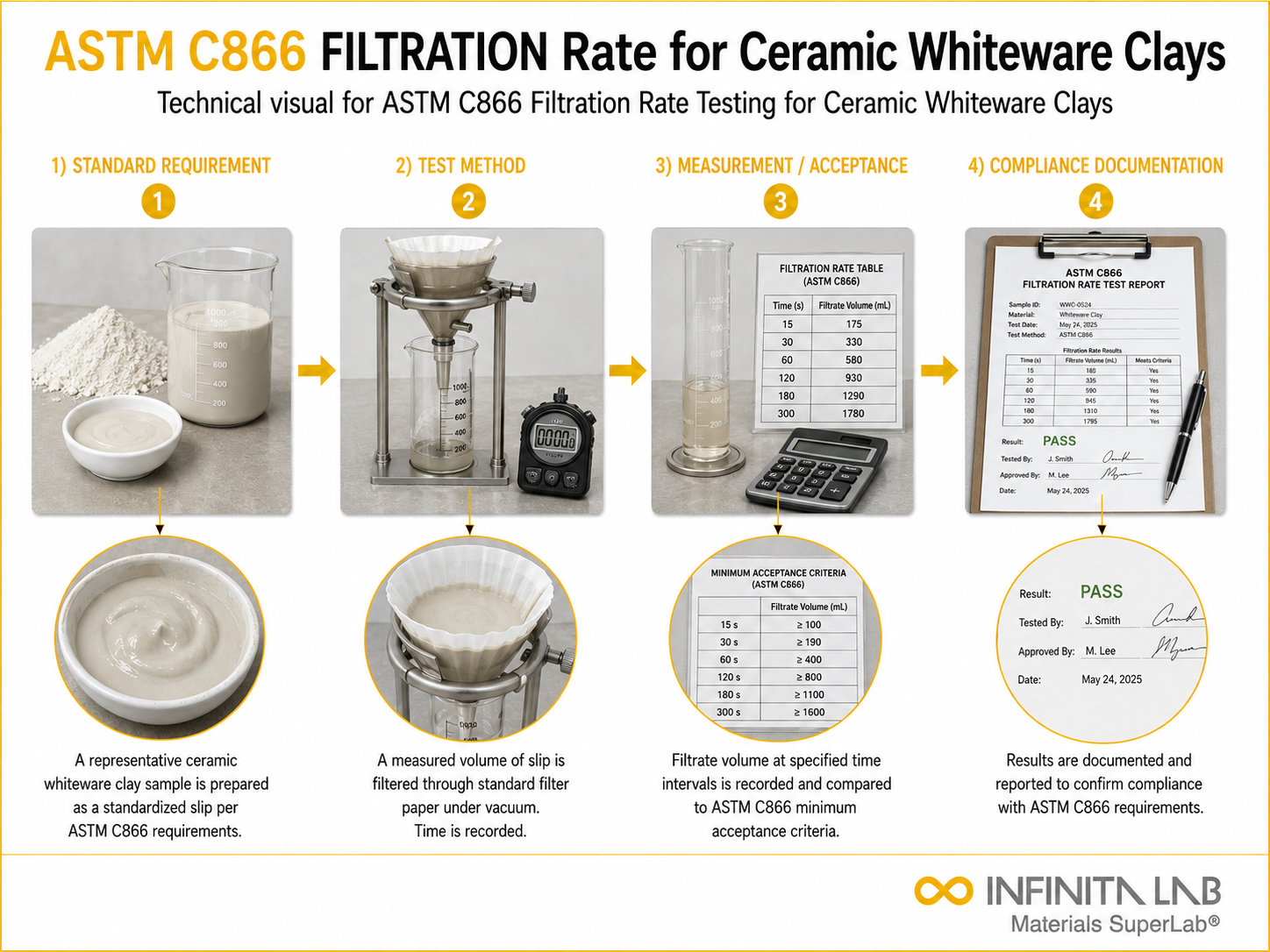
ASTM C866 is a standard test method for determining the filtration rate of ceramic whiteware clay slips and bodies. The test measures the rate at which water is removed from a clay suspension under applied pressure through a filter medium, providing a quantitative measure of the clay’s filtration and dewatering behavior.
This method is essential for ceramic manufacturers who process clay slips through filter pressing operations. Filtration rate directly influences production efficiency, cycle times, and the moisture content of filter-pressed clay cakes. Understanding and controlling filtration rate helps optimize raw material selection, slip formulation, and processing parameters in whiteware ceramic manufacturing.

Scope, Applications, and Benefits
Scope
ASTM C866 applies to clay slips and ceramic whiteware body suspensions prepared at defined solids content and tested under controlled pressure and temperature conditions. The test quantifies the volume of filtrate collected over time through a standardized filter setup.
- Applies to ceramic whiteware clay slips and body suspensions
- Covers kaolin, ball clay, and blended ceramic body slips
- Requires specimen preparation at specified solids content or consistency
- Conducted under controlled applied pressure through a standard filter medium
- Suitable for raw material evaluation and slip formulation development
- Applicable to production quality control of incoming clay batches
- Covers single-specimen and comparative multi-sample testing
Applications
- Evaluation of raw clay materials for filter press processing suitability
- Quality control of incoming kaolin and ball clay batches
- Optimization of ceramic slip formulations for improved dewatering efficiency
- Comparative assessment of clay sources from different suppliers or deposits
- Process development for filter press cycle time reduction
- Research into the effect of deflocculants and additives on clay filtration behavior
- Troubleshooting poor filter press performance in production environments
- Benchmarking clay batches for consistency in filtration behavior across production runs
Benefits
- Provides direct, quantitative measure of clay dewatering performance
- Simple and reproducible test procedure with minimal equipment requirements
- Helps identify clays with poor filtration behavior before production use
- Supports raw material qualification and supplier evaluation
- Enables optimization of deflocculant and additive dosage for filtration improvement
- Reduces production downtime caused by slow or inconsistent filter pressing
- Low specimen volume requirement — suitable for laboratory-scale evaluation
- Useful for both incoming material inspection and process troubleshooting
Test Process
Slip Preparation
Clay slip is prepared at specified solids content and conditioned to ensure uniform suspension before testing.
1Filtration Setup
Prepared slip is placed in the filtration cell and a controlled pressure is applied through a standard filter medium.
2Filtrate Collection
Volume of filtrate passing through the filter is recorded at defined time intervals under constant applied pressure.
3Filtration Rate Calculation
Filtration rate is calculated from the volume of filtrate collected per unit time and reported as specified in the standard.
4Technical Specifications
| Parameter | Details |
|---|---|
| Applied Pressure | Controlled and specified per test conditions |
| Filter Medium | Standard filter paper or membrane as specified |
| Measurement Parameter | Volume of filtrate collected over time |
| Reporting Unit | mL/min or as specified in standard |
| Test Temperature | Ambient unless otherwise specified |
| Key Variables | Solids content, pressure, deflocculant type and dosage |


- Filtration cell or pressure filter apparatus
- Compressed air or nitrogen supply for pressure application
- Pressure regulator and gauge
- Graduated cylinder for filtrate volume measurement
- Stopwatch or timer for interval recording
- Analytical balance for solids content determination
- Standard filter paper or filter membrane
Instrumentation Used for Testing
Results and Deliverables
- Filtrate volume collected at each recorded time interval
- Filtration rate expressed as volume per unit time
- Filter cake moisture content if measured post-test
- Graphical plot of filtrate volume versus time
- Slip solids content and preparation conditions used
- Test report compliant with ASTM C866 reporting requirements
- Comparative summary if multiple clay samples are tested
Frequently Asked Question
ASTM C866 measures the rate at which water is removed from a ceramic clay slip under applied pressure through a filter medium, quantifying the dewatering and filtration behavior of the clay suspension.
Filtration rate determines how efficiently water is removed from clay slips during filter pressing. Poor filtration rate leads to longer press cycles, higher moisture in filter cakes, and reduced production throughput.
Deflocculants disperse clay particles and alter the structure of the filter cake formed during pressing. Incorrect deflocculant type or dosage can significantly reduce filtration rate and dewatering efficiency.
A filter cake is the compressed clay mass remaining after filtration. Its moisture content affects subsequent forming operations — excessively wet cakes cause forming defects and increase drying energy requirements.
Yes. The test is well suited for evaluating how different deflocculants, flocculants, or processing additives influence the filtration and dewatering behavior of ceramic clay slips.
Why Choose Infinita Lab for Advanced Materials Testing and Characterization?
At the core of this breadth is our network of 2,000+ accredited laboratories across the USA, offering access to over 10,000 testing methods and analytical services. From advanced materials characterization (SEM, TEM, RBS, XPS) to mechanical, chemical, environmental, biological, and standardized ASTM/ISO-compliant testing, we deliver unmatched flexibility, specialization, and scale. You are never limited by geography, facility, or methodology — Infinita Lab connects you to the right expertise and testing solution, every time.

Looking for a Trusted Partner for Accurate and Reliable Testing Services?
Send query us at hello@infinitalab.com or call us at (888) 878-3090 to learn more about our services and how we can support you.





