


ASTM C679: Elastomeric Sealant Tack Free Time Testing Services
Accredited ASTM C679 elastomeric sealant tack free time testing from Infinita Lab, performed to the exact standard requirements - accurate, reproducible results with full documentation for compliance, R&D, and quality control programs.
TRUSTED BY


Get ASTM C679 compliant results - request your elastomeric sealant tack free time testing quote
- Overview
- Scope, Applications, and Benefits
- Test Process
- Specifications
- Instrumentation
- Results and Deliverables
What Is ASTM C679 Elastomeric Sealant Tack Free Time?
ASTM C679 is the standard test method used to determine the tack-free time of elastomeric sealants – the point at which a freshly applied sealant surface stops being sticky to the touch. It’s a deceptively simple measurement with outsized practical value. Once a sealant crosses that tack-free threshold, it’s much less likely to pick up dust, insects, or fingerprints, and it can typically withstand a light rain shower without washing out or losing its finish. For manufacturers and specifiers, that single data point becomes a shorthand for how a formulation behaves during the early, vulnerable stage of cure.
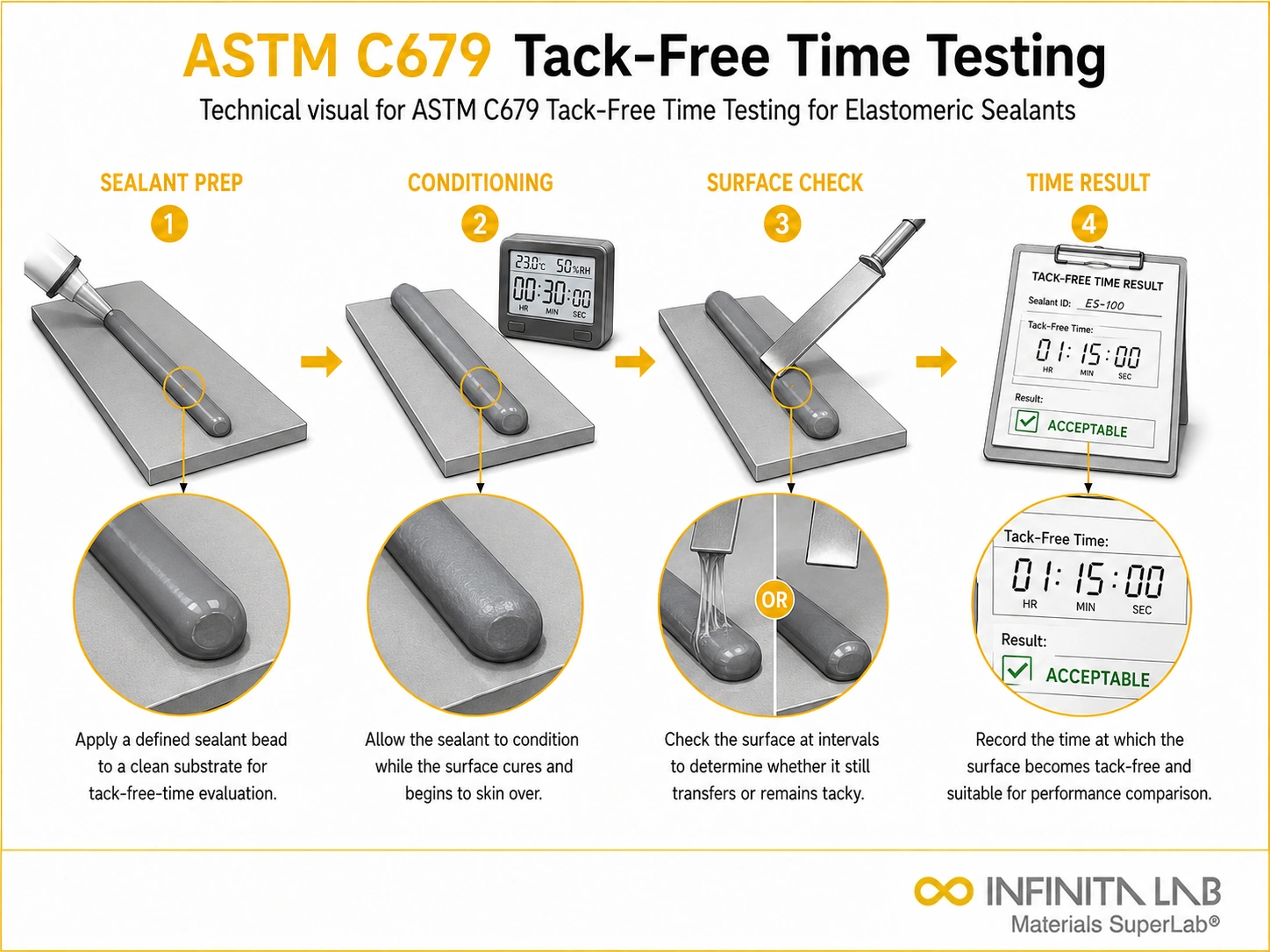
The test itself is straightforward in concept: a bead of sealant is applied to a clean substrate under controlled laboratory conditions, then checked at regular intervals by lightly pressing a piece of polyethene film against the surface. As long as the film picks up sealant residue or leaves a visible mark when lifted away, the material is still tacky. The clock stops the moment the film releases cleanly, and that elapsed time – measured from initial application – is reported as the tack-free time.
At Infinita Lab, we run ASTM C679 testing for sealant manufacturers, contractors, and specifiers who need a defensible, apples-to-apples cure-rate number for quality control, product comparison, or job-site scheduling. Because tack-free time varies meaningfully with sealant chemistry, environmental conditions, and formulation changes, having it measured consistently – under controlled temperature and humidity, by trained technicians, on calibrated equipment – matters more than it might seem. We route every project to an accredited partner lab equipped for this specific method, so results come back reliable, traceable, and ready to support your documentation.

Applications and Benefits of ASTM C679 Elastomeric Sealant Tack Free Time Testing
Scope
ASTM C679 evaluates the surface curing behaviour of elastomeric sealants by determining the time required to reach a tack-free state under controlled conditions.
The test evaluates:
- This method applies to single-component and multi-component elastomeric sealants used for sealing, caulking, and glazing in buildings and related construction work.
- Both self-levelling (pourable) and non-sag (gun-grade) sealant formulations fall within the test’s coverage.
- Sealants that require slight heating to facilitate extrusion from a cartridge or gun are also accommodated by the procedure.
- Tack-free time is measured from the moment of application to the point where a test film no longer adheres to or marks the sealant surface.
- The method is chemistry-agnostic, so silicone, polyurethane, polysulfide, and hybrid sealant systems can all be evaluated using the same basic procedure.
- Testing is generally conducted at standard laboratory conditions, though the method allows testing to be run at conditions representative of a sealant’s intended service climate when that differs substantially from standard.
- A clean, uniform substrate and consistent bead geometry are essential to getting a repeatable result, since surface irregularities can skew when tack loss is first observed.
- Results are reported as a single elapsed-time value, typically expressed in minutes or hours, corresponding to the specific formulation and test conditions used.
- Because this is a surface-level assessment, it characterises early-stage cure behaviour rather than full-depth or ultimate cure, which other test methods address separately.
- The standard is maintained under ASTM Committee C24, the group responsible for building seals and sealants standards more broadly.
Applications
- Sealant manufacturers rely on this data during formulation development to compare how additive packages, catalysts, or cure systems affect early surface cure.
- Quality control teams use tack-free time as a routine batch-release check to confirm production consistency lot to lot.
- Specifiers and architects reference tack-free time when writing project specifications that call for a defined cure window before adjacent work proceeds.
- General contractors and glazing crews use the reported value to plan when it’s safe to schedule follow-on trades, protective wrapping, or site clean-up around freshly sealed joints.
- Building envelope consultants and forensic investigators sometimes request this testing when troubleshooting field complaints tied to dirt pickup or surface tackiness that persisted longer than expected.
- Weatherproofing and exterior finishing contractors use the data to time work around anticipated rain events during installation.
- Product data sheet development teams draw on this testing to publish accurate, defensible tack-free time claims for marketing and technical literature.
Benefits
- Provides a standardised, repeatable number that’s comparable across different sealant products and manufacturers.
- Helps construction schedules run more smoothly by giving crews a realistic window for when sealed joints can be safely handled or covered.
- Supports formulation R&D by isolating how changes to a sealant recipe shift early-stage cure speed.
- Reduces the risk of costly rework caused by dirt, debris, or rain damage to sealant that wasn’t actually cured yet.
- Strengthens technical documentation and product claims with third-party, standards-based test data.
- Gives quality teams an early warning system for batch-to-batch inconsistency before a product ships.
Our ASTM C679 Testing Procedure
Sample Preparation
Sealant is applied on a standard substrate in a uniform layer.
1Environmental Conditioning
Specimen is maintained under controlled temperature and humidity.
2Tack Assessment
Surface is periodically touched using a standard probe or film.
3Data Recording & Evaluation
Time required to reach tack-free condition is recorded.
4ASTM C679 Test Parameters and Requirements
| Parameter | Details |
|---|---|
| Applicable Materials | Elastomeric sealants |
| Test Temperature | ~23°C ± 2°C |
| Relative Humidity | ~50% ± 5% |
| Film Thickness | ~1.5 mm to 3 mm |
| Test Duration | ~10 minutes to 24 hours |
| Measured Outputs | Tack-free time (minutes or hours) |


- Environmental Test Chamber – Maintains controlled temperature and humidity so conditioning stays consistent across the entire test duration.
- Calibrated Substrate Panels – Provide a clean, uniform application surface so results aren’t skewed by substrate variability.
- Polyethylene Test Film – The contact medium technicians use at each timed interval to check whether the sealant surface still transfers residue.
- Precision Timers – Track elapsed time from initial application through each tack assessment to the final tack-free reading.
- Sealant Application Tools – Cartridge guns, spatulas, or draw-down applicators used to lay down a consistent, repeatable bead or film of sealant.
- Laboratory Balances – Used where mixing ratios for multi-component sealant systems need to be verified before application.
- Data Logging Equipment – Records chamber conditions and timestamps throughout the test to support a traceable, auditable result.
Equipment and Instrumentation Used for ASTM C679 Testing
What You Receive: Test Report, Data, and Certification
- A detailed test report stating the measured tack-free time along with the test conditions, substrate, and sealant identification used.
- Raw interval-by-interval observations documenting when tack was still present versus when it cleared, supporting transparency in how the endpoint was determined.
- Photographic documentation of the test setup and, where relevant, the film contact assessment at key intervals.
- A summary suitable for inclusion in technical data sheets, submittal packages, or specification compliance documentation.
- Guidance on how the reported value compares to typical ranges for similar sealant chemistries, where useful context is available.
- A signed certificate of testing from the accredited partner lab that performed the work, ready to support your project or product records.
ASTM C679 Elastomeric Sealant Tack Free Time FAQs
ASTM C679 determines the tack-free time of elastomeric sealants. It measures the time required for the surface to lose stickiness. This helps evaluate curing behavior and handling properties.
Key parameters include temperature, humidity, exposure time, and application thickness. Test conditions are controlled to ensure repeatability. These factors influence curing rate and surface drying.
The test measures time required for the sealant surface to become tack-free. This is determined by light contact without adhesion. Results indicate curing speed and usability.
ASTM C679 is used for elastomeric sealants. This includes silicone, polyurethane, and other construction sealants. These materials are used in joints and sealing applications.
ASTM C679 is conducted under controlled laboratory conditions. Results may vary with environmental conditions and application methods. It may not fully represent curing behavior in field conditions.
ASTM C679 is the Standard Test Method for Tack-Free Time of Elastomeric Sealants. It determines how long a sealant takes to develop a non-tacky surface after application under specified conditions. ASTM C679 determines the tack-free time of elastomeric sealants by lightly pressing polyethylene film against the sealant at regular intervals until the film peels away cleanly, indicating that the surface is no longer tacky.
Why Choose Infinita Lab for Elastomeric Sealant Tack Free Time Testing
When your Elastomeric Sealant Tack Free Time results have to hold up - for compliance, a customer audit, or an engineering decision - ASTM C679 accuracy and an unbiased third-party report matter more than price. Infinita Lab routes your ASTM C679 elastomeric sealant tack free time testing to ISO/IEC 17025-accredited U.S. partner labs with hands-on method experience, so you get defensible data, transparent reporting, and turnaround times built around your project deadline - not ours.

Need ASTM C679 Elastomeric Sealant Tack Free Time Testing You Can Rely On?
Send query us at hello@infinitalab.com or call us at (888) 878-3090 to learn more about our services and how we can support you.



Request a Quote
Submit your material details and receive testing procedures, pricing, and turnaround time within 24 hours.
 Quick Turnaround and Hasslefree process
 Confidentiality Guarantee
 Free, No-obligation Consultation
 100% Customer Satisfaction
