


ASTM C623: Glass Ceramic Elastic Properties Resonance Testing Services
ASTM C623 is used to determine elastic properties (Young's Modulus, Shear Modulus, and Poisson's Ratio) for Glass and Glass-Ceramics by Resonance. The resonance frequencies of test bars of suitable geometry is measured by exciting them at continuously variable frequencies.
TRUSTED BY


What Is ASTM C623 Glass Ceramic Elastic Properties Resonance?
- Overview
- Scope, Applications, and Benefits
- Test Process
- Specifications
- Instrumentation
- Results and Deliverables
Applications and Benefits of ASTM C623 Glass Ceramic Elastic Properties Resonance Testing
ASTM C623 determines the elastic properties of glass and glass-ceramic materials using the resonance method. The test measures natural vibration frequencies to calculate elastic modulus, shear modulus, and Poisson’s ratio.
This method is widely used in glass, optics, and advanced materials industries. It provides non-destructive evaluation of mechanical stiffness and helps ensure material performance in structural and functional applications.

Applications and Benefits of ASTM C623 Glass Ceramic Elastic Properties Resonance Testing
Scope
ASTM C623 evaluates the elastic behavior of glass materials by exciting specimens into vibration and measuring resonance frequencies. The test provides accurate mechanical property data without damaging the sample.
The test evaluates:
- Elastic modulus (Young’s modulus)
- Shear modulus of materials
- Poisson’s ratio
- Material stiffness and rigidity
- Dynamic mechanical behavior
Applications
- Glass and glass-ceramic products
- Optical and precision components
- Electronic and display glass
- Structural glass applications
- Research and material development
- Quality control in glass manufacturing
Benefits
- Non-destructive testing method
- Provides accurate elastic property data
- Supports material design and engineering
- Helps predict mechanical performance
- Enables comparison of material stiffness
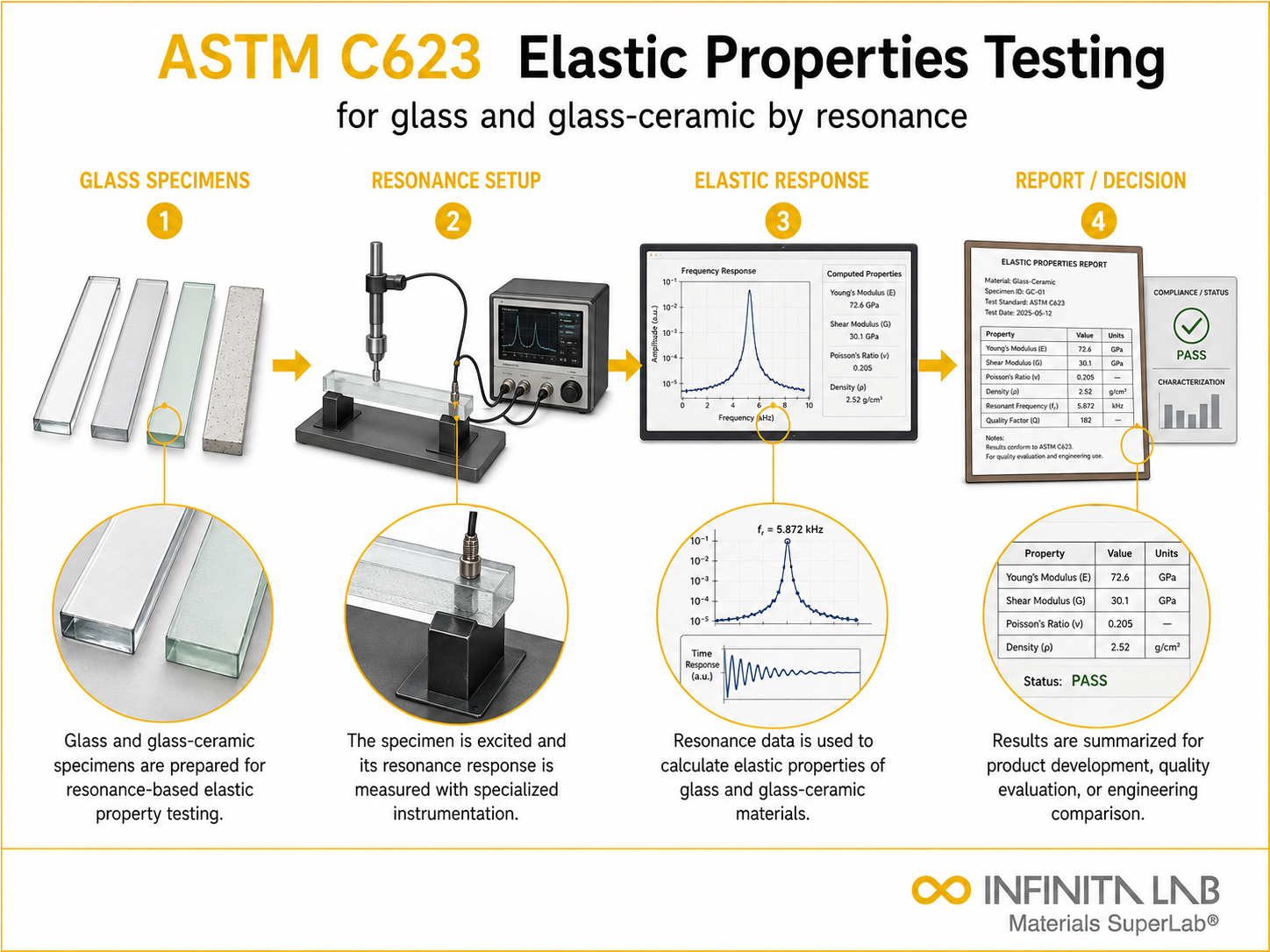
Our ASTM C623 Testing Procedure
Sample Preparation
Specimens are prepared with precise geometry and smooth surfaces.
1Excitation Setup
Samples are excited mechanically or acoustically to induce vibration.
2Resonance Measurement
Natural frequencies are measured using sensors and detection systems.
3Data Recording & Evaluation
Elastic properties are calculated based on resonance frequency data.
4ASTM C623 Test Parameters and Requirements
| Parameter | Details |
|---|---|
| Applicable Materials | Glass and glass-ceramic materials |
| Frequency Range | ~1 kHz to 100 kHz |
| Specimen Shape | Rectangular or cylindrical bars |
| Measurement Accuracy | ±1% to ±3% |
| Temperature Range | ~20°C to 300°C |
| Measured Outputs | Elastic modulus, shear modulus, Poisson’s ratio |


- Resonance testing system
- Vibration excitation device
- Frequency analyzer
- Sensors (accelerometers or microphones)
- Sample support fixtures
- Data acquisition system
Equipment and Instrumentation Used for ASTM C623 Testing
What You Receive: Test Report, Data, and Certification
- Elastic modulus (Young’s modulus) values
- Shear modulus and Poisson’s ratio
- Resonance frequency data
- Material stiffness evaluation
- Test condition summary
- ASTM compliance report
ASTM C623 Glass Ceramic Elastic Properties Resonance FAQs
ASTM C623 determines elastic properties of glass and glass-ceramics using resonance techniques. It measures natural vibration frequencies of specimens. This helps evaluate stiffness and mechanical behavior of materials.
Key parameters include specimen dimensions, resonance frequency, vibration mode, and material density. Proper support and excitation conditions are required. These factors influence accuracy of elastic property measurements.
The test calculates elastic modulus, shear modulus, and Poisson’s ratio. These values are derived from resonance frequencies. They indicate stiffness and structural performance of the material.
ASTM C623 is used for glass and glass-ceramic materials. This includes optical glass, structural glass, and advanced ceramic-glass composites. These materials require precise elastic characterization.
ASTM C623 requires precise specimen preparation and controlled conditions. Results may be affected by geometry, defects, or damping effects. It may not fully represent behavior under complex loading conditions.
Why Choose Infinita Lab for Glass Ceramic Elastic Properties Resonance Testing
At the core of this breadth is our network of 2,000+ accredited laboratories across the USA, offering access to over 10,000 testing methods and analytical services. From advanced materials characterization (SEM, TEM, RBS, XPS) to mechanical, chemical, environmental, biological, and standardized ASTM/ISO-compliant testing, we deliver unmatched flexibility, specialization, and scale. You are never limited by geography, facility, or methodology — Infinita Lab connects you to the right expertise and testing solution, every time.

Looking for an Accredited Partner for ASTM C623 Glass Ceramic Elastic Properties Resonance Testing?
Send query us at hello@infinitalab.com or call us at (888) 878-3090 to learn more about our services and how we can support you.



Request a Quote
Submit your material details and receive testing procedures, pricing, and turnaround time within 24 hours.
 Quick Turnaround and Hasslefree process
 Confidentiality Guarantee
 Free, No-obligation Consultation
 100% Customer Satisfaction
