


Acoustic Resonance ART Testing Services
TRUSTED BY


Get compliant results — request your acoustic resonance ART testing quote
- Overview
- Scope, Applications, and Benefits
- Test Process
- Specifications
- Instrumentation
- Results and Deliverables
What Is Acoustic Resonance ART?
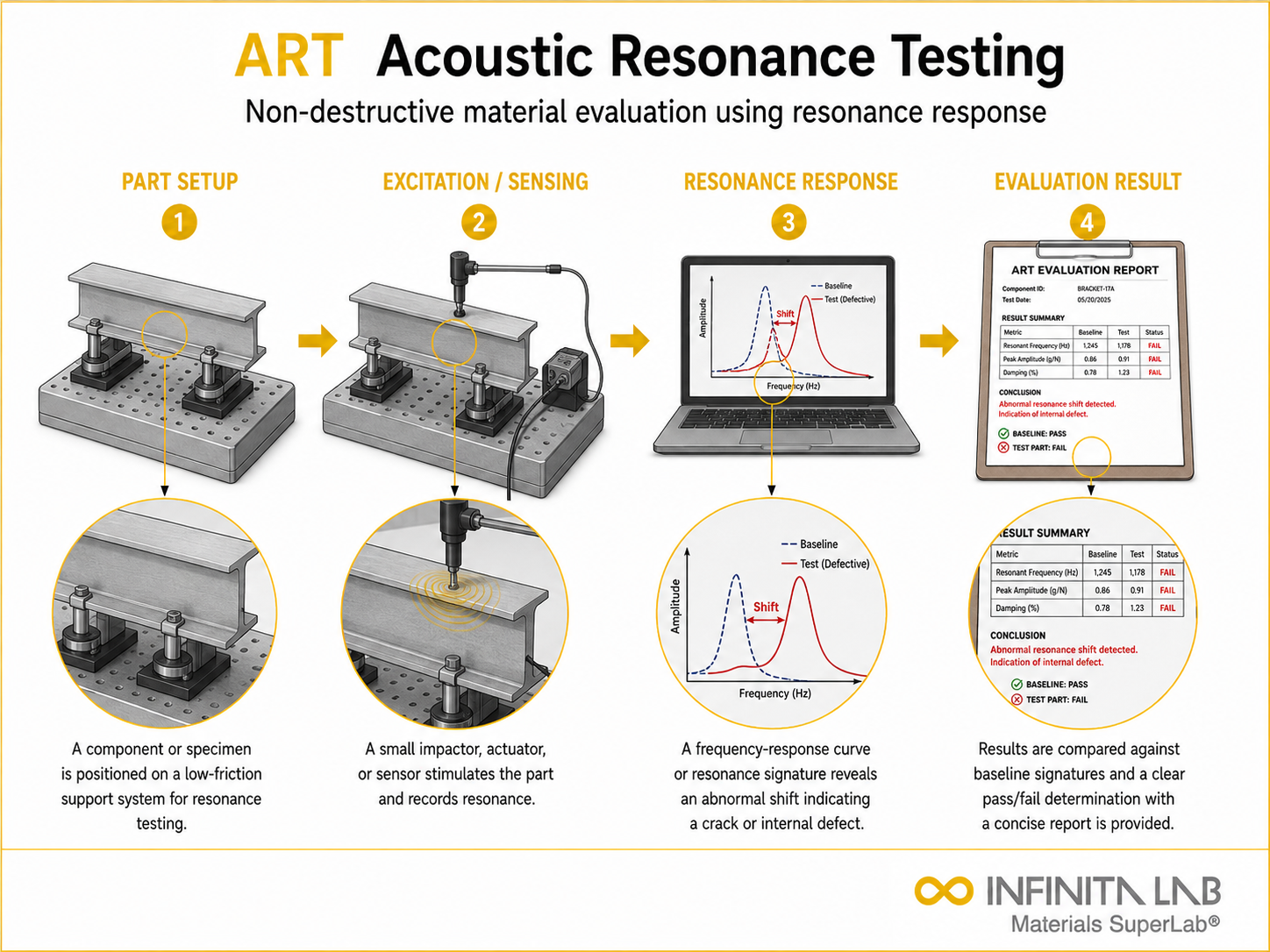
Acoustic Resonance Testing (ART) is a non-destructive testing method used to evaluate the integrity and mechanical properties of materials and components by analyzing their natural vibration frequencies. The test detects internal defects such as cracks, voids, or inconsistencies based on changes in resonance behavior.
ART is widely used in manufacturing and quality control for metals, ceramics, composites, and finished components. It enables rapid inspection of parts without causing damage, making it suitable for high-throughput production environments.

Applications and Benefits of Acoustic Resonance ART Testing
Scope
Acoustic Resonance Testing evaluates the structural integrity of materials by measuring their resonant frequency response under mechanical or acoustic excitation. The test identifies defects and variations in material properties.
The test evaluates:
- Natural frequency and resonance characteristics of components
- Detection of internal defects such as cracks and voids
- Variations in material density and stiffness
- Structural uniformity and integrity
- Quality consistency in manufactured parts
Applications
- Metal and alloy components
- Ceramic and composite materials
- Automotive and aerospace parts
- Precision mechanical components
- Additively manufactured parts
- Quality control in production lines
Benefits
- Non-destructive and rapid testing method
- Enables 100% inspection in production environments
- Detects internal defects not visible externally
- Reduces inspection time and cost
- Supports automated quality control systems
Our Testing Procedure
Sample Preparation
Components are cleaned and positioned to ensure consistent excitation and measurement.
1Excitation
The specimen is excited using mechanical impact or acoustic stimulation.
2Signal Measurement
Resonance frequencies are captured using sensors such as microphones or accelerometers.
3Data Recording & Evaluation
Frequency patterns are analyzed to detect defects or deviations from expected behavior.
4Test parameters and requirements
| Parameter | Details |
|---|---|
| Applicable Materials | Metals, ceramics, composites, and finished components |
| Frequency Range | ~1 kHz to 100 kHz |
| Excitation Method | Mechanical impact or acoustic excitationExcitation Method |
| Measurement Sensors | Microphones or accelerometers |
| Test Duration | Few seconds per component |
| Measured Outputs | Resonant frequency, damping, defect indication |


- Acoustic resonance testing system
- Impact hammer or acoustic excitation device
- Microphones or accelerometers
- Signal processing unit
- Automated handling system (optional)
- Data acquisition and analysis software
Equipment and Instrumentation Used for Testing
What You Receive: Test Report, Data, and Certification
- Resonant frequency measurements
- Defect detection and classification
- Material integrity assessment
- Comparative analysis with reference standards
- Test condition summary
- ASTM compliance report
Acoustic Resonance ART FAQs
Acoustic Resonance Testing includes excitation frequency range, vibration modes, resonance response, damping characteristics, and sensor placement, evaluating structural integrity by detecting changes in natural frequencies of components under controlled conditions.
ART detects internal defects such as cracks, voids, inclusions, and structural inconsistencies by identifying shifts in resonance frequencies compared to reference signatures of defect-free components.
ART is commonly applied to metals, ceramics, composites, and mechanical components used in automotive, aerospace, and manufacturing industries requiring nondestructive evaluation.
ART requires excitation systems, sensors such as microphones or accelerometers, data acquisition systems, and analysis software to measure and interpret resonance behavior.
ART relies on comparison with baseline signatures and may be affected by geometry variations, material inconsistencies, or external noise, requiring calibration and controlled conditions for accurate defect detection.
Why Choose Infinita Lab for Acoustic Resonance ART Testing?
At the core of this breadth is our network of 2,000+ accredited laboratories across the USA, offering access to over 10,000 testing methods and analytical services. From advanced materials characterization (SEM, TEM, RBS, XPS) to mechanical, chemical, environmental, biological, and standardized ASTM/ISO-compliant testing, we deliver unmatched flexibility, specialization, and scale. You are never limited by geography, facility, or methodology — Infinita Lab connects you to the right expertise and testing solution, every time.

Looking for an Accredited Partner for Acoustic Resonance ART Testing?
Send query us at hello@infinitalab.com or call us at (888) 878-3090 to learn more about our services and how we can support you.



Request a Quote
Submit your material details and receive testing procedures, pricing, and turnaround time within 24 hours.
 Quick Turnaround and Hasslefree process
 Confidentiality Guarantee
 Free, No-obligation Consultation
 100% Customer Satisfaction
