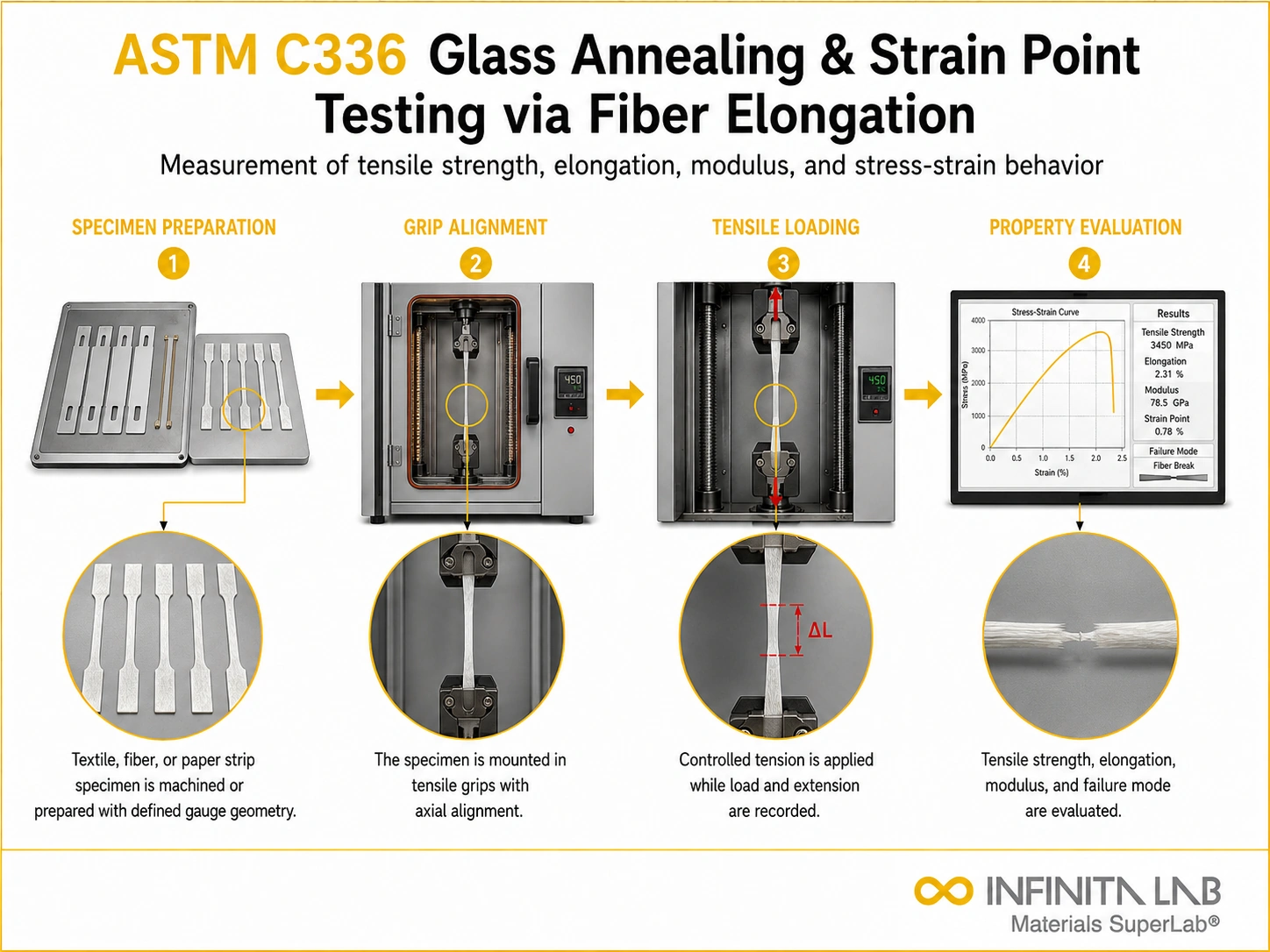


What Is ASTM C336 Glass Annealing Strain Point?
ASTM C336, officially titled “Standard Test Method for Annealing Point and Strain Point of Glass by Fiber Elongation,” is the standard glass manufacturers and materials laboratories turn to for two viscosity-defined reference temperatures: the annealing point and the strain point. Together, these describe how a glass composition behaves as it cools from a softened state. The method itself is fairly direct. Draw the test glass into a thin fiber, suspend it vertically in a precisely controlled furnace, then measure how fast that fiber elongates under its own weight. In contrast, the furnace holds, or steps through, a narrow temperature range. Viscosity at a given temperature dictates how quickly the suspended fiber stretches, so the elongation rate can be converted into the two reference points the standard defines. The annealing point sits near a viscosity of 10^13 poise, the temperature at which internal stresses in glass are substantially relieved within roughly fifteen minutes. The strain point is lower, near 10^14.5 poise. Below that, stress relief becomes impractically slow, and the glass behaves essentially as a rigid solid. Apparatus and procedure get checked against standard reference glass fibers with certified annealing and strain points, such as those issued by the National Institute of Standards and Technology, so results stay traceable and comparable across laboratories. ASTM Subcommittee C14.04 maintains the method on Glass and Glass Products and sits within Book of Standards Volume 15.02. It’s closely related to ASTM C598, which determines the same two points using beam bending rather than fiber elongation; C598 is the preferred alternative for glasses that don’t lend themselves to flame-drawing into fiber form.

Applications and Benefits of ASTM C336 Glass Annealing Strain Point Testing
Scope
ASTM C336 covers determining the annealing point and strain point of glass using the fiber elongation technique. A drawn glass fiber is suspended under a standard load in a controlled furnace, and the elongation rate is measured as the temperature varies.
The scope includes:
- ASTM C336 establishes a laboratory procedure for determining the annealing point and the strain point of a glass by measuring the viscous elongation rate of a glass fiber under prescribed furnace conditions.
- It applies only to glass compositions that can be drawn into a continuous fiber suitable for mounting in the test apparatus.
- Results come out as temperatures tied to defined viscosity levels, not as direct viscosity measurements at arbitrary temperatures.
- Annealing point: a viscosity near 10^13 poise, marking the upper boundary of the practical annealing range.
- Strain point: lower, near 10^14.5 poise, marking the bottom of that same range.
- Calibrating the furnace and measuring system against reference glass fibers with certified annealing and strain point values is required before testing.
- What it doesn’t cover: chemical composition, optical properties, or mechanical strength of the glass under test.
- It functions as a companion method to ASTM C598, which measures the same two characteristic points by a beam-bending procedure instead of fiber elongation.
- Labs running this test need furnace equipment capable of fine, stable temperature control over the relevant softening range.
- Test specimens are prepared directly from the glass under evaluation, so results reflect the specific composition and thermal history of the sample submitted.
Applications
- Establishing annealing schedules for flat, container, and specialty glass
- Thermal stress analysis and residual stress control in glass products
- Optical glass characterization for precision lens and prism manufacturing
- Quality control of glass composition consistency during production
- Research and development of new glass formulations and compositions
- Validation of glass thermal properties after compositional modifications
- Process optimization for glass tempering and heat-strengthening operations
- Comparative evaluation of glass types for high-temperature applications
- Failure analysis of glass products fractured due to thermal stress
- Academic and industrial research on glass viscosity-temperature relationships
Benefits
- Directly determines two critical thermal reference points from a single test
- Applicable to virtually any drawable glass composition
- Requires only a small fiber specimen, minimizing material consumption
- Provides viscosity-correlated temperature data for process engineering
- Supports accurate design of annealing lehrs and furnace profiles
- Enables early detection of compositional drift affecting thermal properties
- Highly reproducible results with properly drawn and conditioned fibers
- Foundational data for glass viscosity curve development
- Supports compliance with optical and technical glass product specifications
Our ASTM C336 Testing Procedure
Fiber Drawing
A uniform glass fiber of specified diameter is drawn from the bulk glass sample for testing.
1Furnace Loading
Fiber is suspended vertically in a calibrated furnace with a standardized load attached to its lower end.
2Elongation Measurement
Furnace temperature is raised and lowered; fiber elongation rate is continuously recorded as a function of temperature.
3Reporting
Annealing and strain point temperatures are determined from elongation rate data and reported in °C.
4ASTM C336 Test Parameters and Requirements
| Parameter | Details |
|---|---|
| Parameters Determined | Annealing point and strain point temperatures |
| Measurement Principle | Fiber elongation under constant load vs. temperature |
| Annealing Point Viscosity | ~10¹³ poise |
| Strain Point Viscosity | ~10¹⁴·⁵ poise |
| Fiber Diameter | Typically 0.5–1.0 mm |
| Applied Load | Standardized dead weight per ASTM specification |
| Furnace Type | Vertical tube furnace with controlled atmosphere |
| Reporting Units | Temperature in °C |


- Elongation Furnace – Provides precise, stable temperature control across the annealing and strain-point range during the test.
- Fiber-Drawing Equipment – Produces a uniform glass fiber specimen from the sample material.
- Elongation Measuring System – Tracks how fast the suspended fiber stretches at each controlled temperature.
- Reference Glass Fibers – Certified standard fibers used to calibrate and check the apparatus before and during use.
- Temperature Controllers and Recorders – Maintain and log furnace temperature throughout each run.
- Specimen Mounting Fixtures – Hold the fiber vertically and consistently within the furnace chamber.
- Data Acquisition System – Captures elongation and temperature data for later reduction and reporting.
Equipment and Instrumentation Used for ASTM C336 Testing
What You Receive: Test Report, Data, and Certification
- Reported annealing point temperature for the submitted glass specimen.
- Strain point temperature for the same specimen, reported alongside it.
- Documentation of apparatus calibration against certified reference glass fibers.
- A complete test report suitable for specification compliance or engineering records.
- Supporting data on furnace conditions and elongation behavior observed during testing.
- Guidance correlating results to annealing schedule design or seal-setting applications, available on request.
ASTM C336 Glass Annealing Strain Point FAQs
ASTM C336 determines the annealing point and strain point of glass by measuring fiber elongation under a defined load across a temperature range, providing critical thermal reference points for stress relief and annealing schedule design.
The annealing point is the temperature at which glass viscosity reaches approximately 10¹³ poise, where internal stresses relax within minutes. It defines the upper boundary of the annealing range used during controlled glass cooling.
The annealing point defines the temperature at which stress relief occurs efficiently. Accurate knowledge allows manufacturers to design correct lehr temperature profiles, preventing residual stress that causes spontaneous breakage or optical distortion in finished products.
Higher silica and alumina content generally raises both points, while increased alkali oxide content lowers them. Compositional changes during manufacturing directly shift these temperatures, making routine testing essential for process consistency.
A wider gap allows more flexibility in the annealing schedule, giving more time for stress relief across the glass cross-section. A narrow gap requires more precise temperature control during cooling to avoid locking in residual stress.
Strain point is determined by heating a glass beam and measuring its rate of viscous bending under a controlled load. The strain point is identified from the bending behavior and represents the temperature at which internal stresses in the glass are substantially relieved over several hours. ASTM C598 uses the beam-bending method to determine the strain point and annealing point of glass.
Why Choose Infinita Lab for Glass Annealing Strain Point Testing
When your Glass Annealing Strain Point results have to hold up - for compliance, a customer audit, or an engineering decision - ASTM C336 accuracy and an unbiased third-party report matter more than price. Infinita Lab routes your ASTM C336 glass annealing strain point testing to ISO/IEC 17025-accredited U.S. partner labs with hands-on method experience, so you get defensible data, transparent reporting, and turnaround times built around your project deadline - not ours.

Looking for an Accredited Partner for ASTM C336 Glass Annealing Strain Point Testing?
Send query us at hello@infinitalab.com or call us at (888) 878-3090 to learn more about our services and how we can support you.





