


ASTM C1273: Monolithic Ceramic Ambient Tensile Testing Services
The ASTM C1273 test method is used to identify the tensile strength of monolithic advanced ceramics under uniaxial stress at ambient temperatures. This test method is intended for advanced ceramics that have isotropic, homogeneous, continuous behavior macroscopically.
TRUSTED BY


Get ASTM C1273 compliant results — request your monolithic ceramic ambient tensile testing quote
- Overview
- Scope, Applications, and Benefits
- Test Process
- Specifications
- Instrumentation
- Results and Deliverables
What Is ASTM C1273 Monolithic Ceramic Ambient Tensile?
ASTM C1273 is a standardized test procedure for measuring the tensile strength of monolithic advanced ceramics under uniaxial tensile loading at room temperature. This test procedure is used for measuring the tensile strength of brittle ceramics.
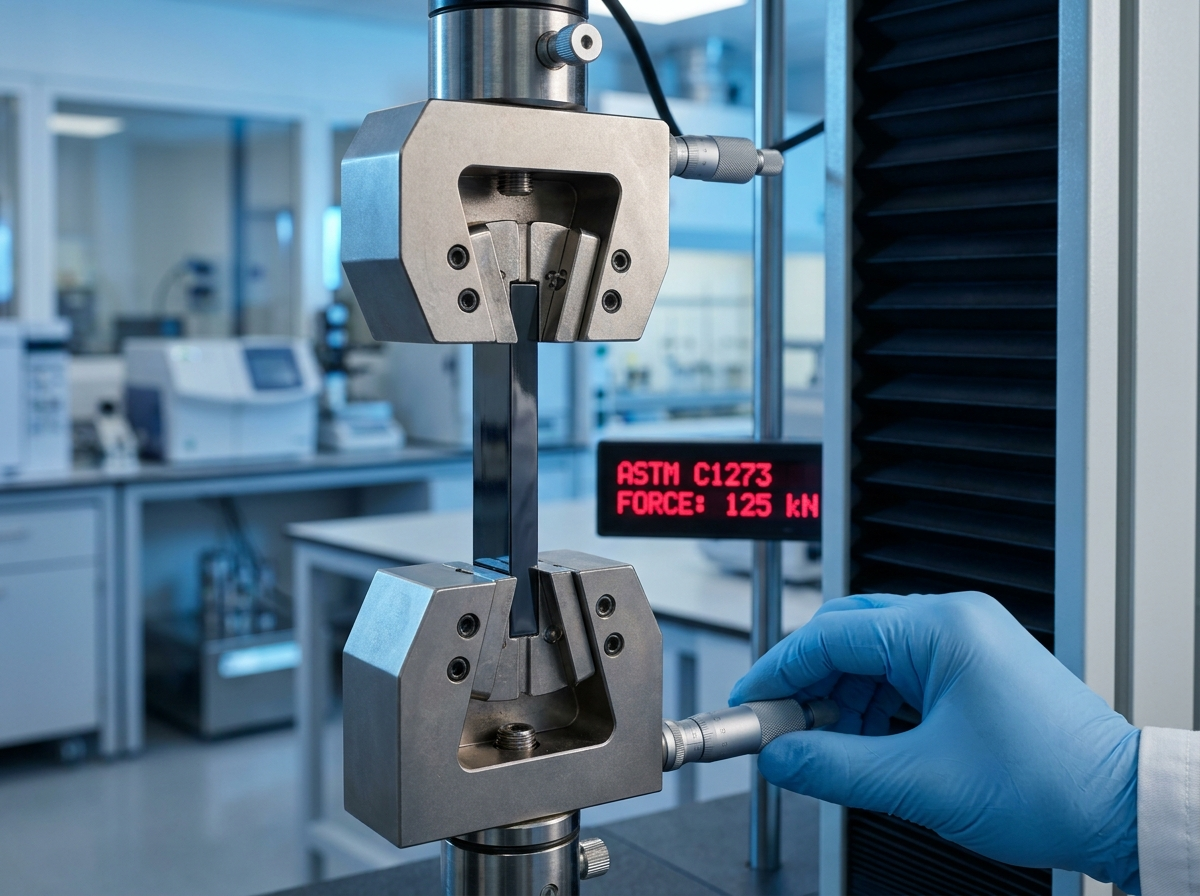
The test procedure involves using a universal testing machine (UTM) equipped with an extensometer to measure elongation and calculate the ultimate tensile strength. The tensile strength is calculated using the maximum load at which the specimen breaks and the original cross-sectional area of the specimen.
Applications and Benefits of ASTM C1273 Monolithic Ceramic Ambient Tensile Testing
Scope
ASTM C1273 addresses monolithic advanced ceramics, including both flat and cylindrical tensile specimens. This standard is used to determine the behavior of ceramics under controlled- and ambient-temperature loading conditions.
ASTM C1273 evaluates:
- Tensile strength of monolithic advanced ceramics
- Fracture behavior under uniaxial tension
- Strength variability and reliability
- Effect of surface flaws and defects
- Material performance under controlled loading
Applications
- Mechanical characterisation of advanced ceramics
- Quality control of ceramic components
- Evaluation of structural ceramic materials
- Research and development of ceramic formulations
- Aerospace ceramic components
- Automotive ceramic parts
- Electronic and semiconductor ceramic materials
- High-temperature engineering ceramics
Benefits
- Provides direct measurement of tensile strength
- Suitable for brittle ceramic materials
- Ensures reliable material comparison
- Supports structural design validation
- Helps prevent unexpected brittle failure
- Standardised and repeatable methodology
- Improves quality assurance in ceramic manufacturing
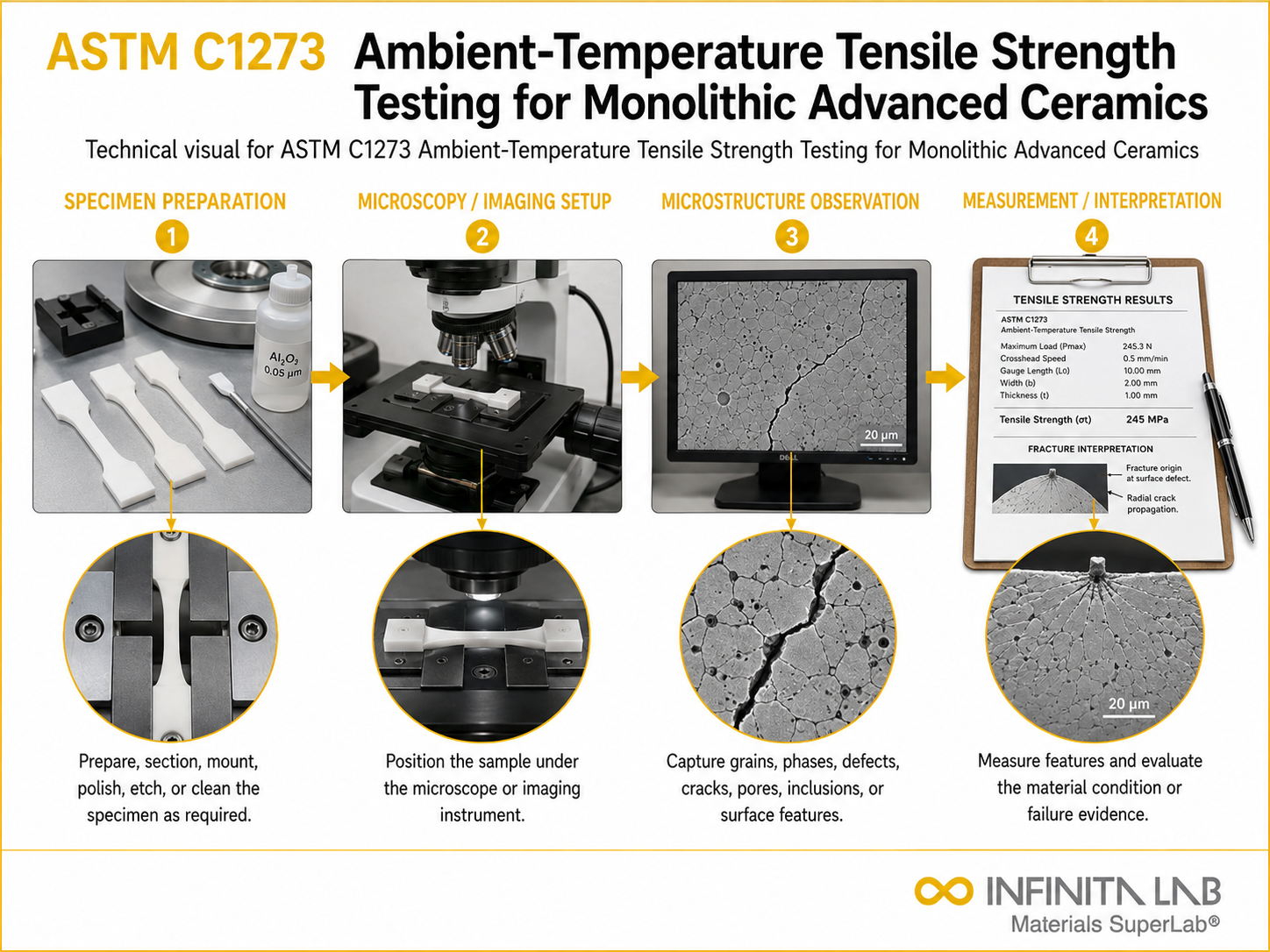
Our ASTM C1273 Testing Procedure
Specimen Preparation & Mounting
Flat or cylindrical ceramic specimen with enlarged shoulders is machined and securely mounted in a universal testing machine.
1Extensometer Setup
An extensometer is attached to accurately measure gauge length changes during loading.
2Tensile Loading
Uniaxial tensile load is applied at a controlled rate until the specimen fractures.
3Data & Calculation
Maximum load (Pmax) is recorded and tensile strength is calculated using Su = Pmax / A.
4ASTM C1273 Test Parameters and Requirements
| Parameter | Details |
|---|---|
| Applicable Materials | Monolithic advanced ceramics |
| Specimen Types | Dog-bone or cylindrical specimen |
| Gauge Length | ~25–50 mm (standard range) |
| Diameter Tolerance | ±0.025 mm |
| Formula Used | Su = Pmax / A |
| Grip Type | Self-aligning grips to reduce bending stresses |
| Cross-head Speed | Constant displacement rate (standard controlled rate) |
| Temperature Range | Ambient (~20–25°C) |
| Breaking Load (Pmax) | Maximum load at fracture |
| Output Units | MPa (Megapascal) |


- Universal Testing Machine (UTM)
- Extensometer
- Precision grips and fixtures
- Load cell
- Dimensional measurement tools (micrometre/calliper)
- Data acquisition and analysis software
Equipment and Instrumentation Used for ASTM C1273 Testing
What You Receive: Test Report, Data, and Certification
- Ultimate tensile strength (MPa)
- Breaking load data
- Stress–strain behavior
- Fracture analysis report
- Comparative material evaluation
- Compliance reports
ASTM C1273 Monolithic Ceramic Ambient Tensile FAQs
ASTM C1273 determines the ambient temperature tensile strength of monolithic advanced ceramics by pulling a solid specimen until it breaks, giving the maximum tensile stress that the brittle material can resist without deforming plastically.
Ceramics fail without plastic deformation and are very sensitive to misalignment. ASTM C1273 specifies precise specimen machining and self-aligning grips to eliminate bending stresses, ensuring that the measured failure point represents actual tensile strength only.
ASTM C1273 is applied in aerospace, medical, semiconductor, and energy sectors where monolithic ceramics are required for heat resistance, wear resistance, or electrical insulation and are subjected to tensile stresses during severe service conditions.
ASTM C1273 employs dog-bone specimens or cylindrical rods. The specimens need to be diamond-ground to very close tolerances since surface irregularities or scratches can become stress concentrators, leading to brittle fracture.
Test results depend on surface finish, specimen alignment, grip friction, cross-head speed, and ambient humidity, all of which affect stress distribution and fracture behavior in brittle ceramic materials.
Why Choose Infinita Lab for Monolithic Ceramic Ambient Tensile Testing?
At the core of this breadth is our network of 2,000+ accredited laboratories across the USA, offering access to over 10,000 testing methods and analytical services. From advanced materials characterization (SEM, TEM, RBS, XPS) to mechanical, chemical, environmental, biological, and standardized ASTM/ISO-compliant testing, we deliver unmatched flexibility, specialization, and scale. You are never limited by geography, facility, or methodology — Infinita Lab connects you to the right expertise and testing solution, every time.

Need ASTM C1273 Monolithic Ceramic Ambient Tensile Testing You Can Rely On?
Send query us at hello@infinitalab.com or call us at (888) 878-3090 to learn more about our services and how we can support you.



Request a Quote
Submit your material details and receive testing procedures, pricing, and turnaround time within 24 hours.
 Quick Turnaround and Hasslefree process
 Confidentiality Guarantee
 Free, No-obligation Consultation
 100% Customer Satisfaction
