


ASTM A677: Nonoriented Electrical Steel Core Loss Testing Services
Accredited ASTM A677 nonoriented electrical steel core loss testing from Infinita Lab, performed to the exact standard requirements - accurate, reproducible results with full documentation for compliance, R&D, and quality control programs.
TRUSTED BY


Get ASTM A677 compliant results - request your non-oriented electrical steel core loss testing quote
- Overview
- Scope, Applications, and Benefits
- Test Process
- Specifications
- Instrumentation
- Results and Deliverables
What Is ASTM A677 Nonoriented Electrical Steel Core Loss?
ASTM A677 is the Standard Specification for Nonoriented Electrical Steel Fully Processed Types, covering low-carbon, silicon-iron, and silicon-aluminium-iron sheet and strip that has been fully annealed at the mill and is ready for punching and stacking into laminations without further heat treatment. Unlike grain-oriented electrical steel, which is engineered to concentrate its best magnetic performance along a single rolling direction for use in transformer cores, nonoriented material is processed so its magnetic properties are relatively uniform in every direction within the plane of the sheet. That characteristic makes it the material of choice for rotating equipment, where the direction of magnetic flux inside the core changes continuously as the rotor turns.
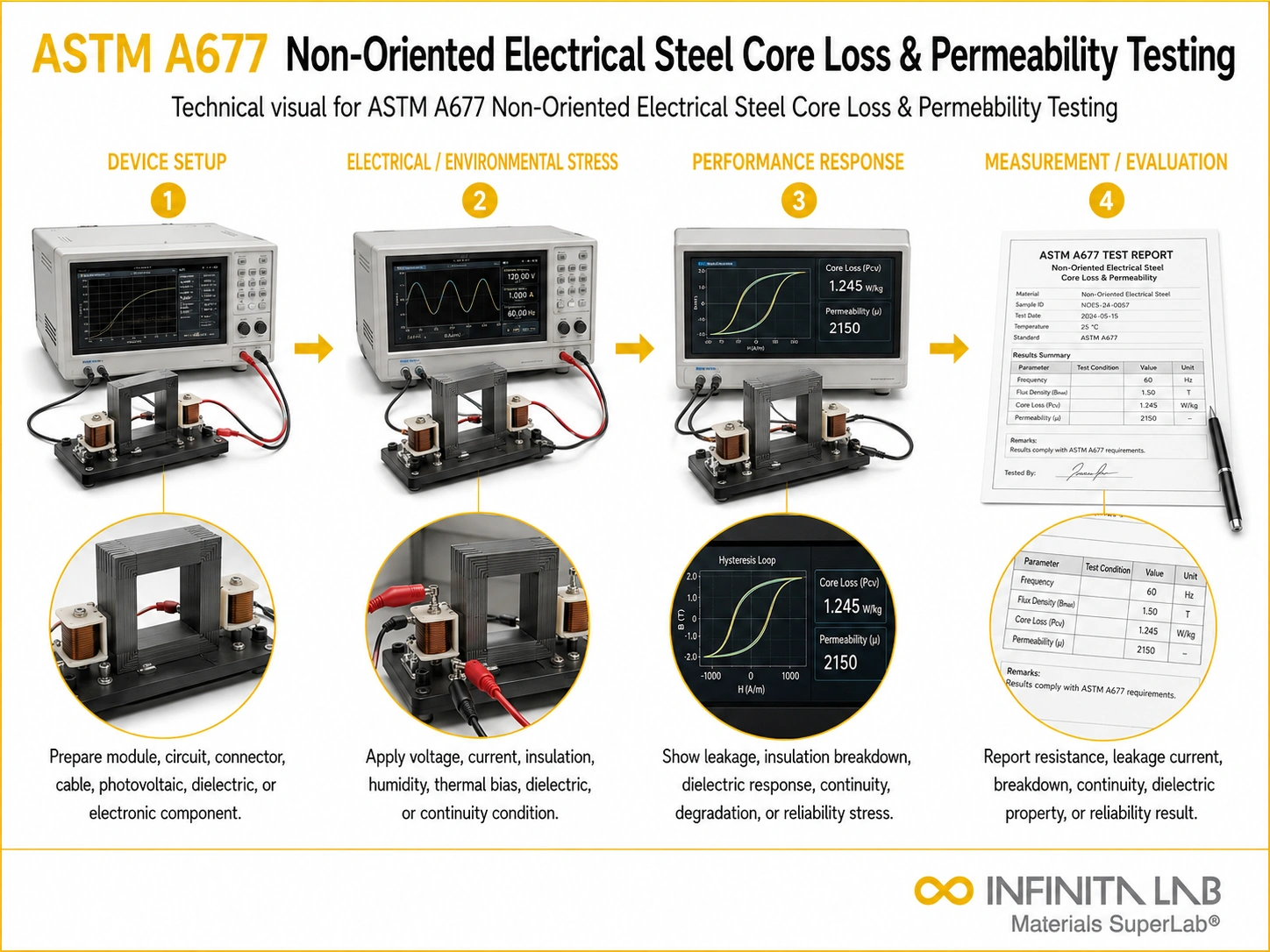
At a high level, core loss testing under ASTM A677 evaluates how much energy a nonoriented electrical steel sample dissipates as heat while it is repeatedly magnetised and demagnetised. Test specimens are cut into strips and assembled into a standard 25 cm Epstein test frame, or alternatively mounted in a single sheet tester, forming a closed magnetic circuit. The sample is then excited with alternating current at a specified frequency and driven to a specified peak magnetic flux density, reproducing the magnetisation cycling the material will experience in service. Precision wattmeter-ammeter-voltmeter instrumentation, per the referenced ASTM A343/A343M methodology, captures the real power consumed by the sample and converts it into a core loss value expressed in watts per kilogram or watts per pound.
Core loss testing matters because it has a direct, measurable effect on the efficiency, heat generation, and service life of the motors, generators, and other electromagnetic devices the steel is destined for. Verifying core loss and permeability against ASTM A677 grade requirements gives manufacturers, mills, and end users objective, third-party confirmation that incoming material will perform as specified once it is built into a finished core.

Applications and Benefits of ASTM A677 Nonoriented Electrical Steel Core Loss Testing
Scope
- ASTM A677 specifies fully processed nonoriented electrical steel sheet and strip produced from low-carbon, silicon-iron, or silicon-aluminium-iron alloys.
- Testing under this specification measures core loss (the energy dissipated as heat during a magnetisation cycle) at specified test frequency and peak magnetic flux density.
- Testing also evaluates permeability, the material’s ability to support magnetic flux, which governs how efficiently the core can be magnetised.
- The standard organizes material into grade designations tied to maximum permissible core loss at defined thickness, frequency, and flux density combinations.
- Typical nonoriented electrical steel thicknesses addressed by the specification fall in the range of roughly 0.35 mm to 1.0 mm.
- Core loss and related AC magnetic property testing is performed in accordance with the methodology of ASTM A343/A343M, using the 25 cm Epstein frame or an equivalent single sheet tester.
- Materials covered include fully annealed, “as-sheared” ready-to-use laminations intended for direct use without additional customer-side heat treatment.
- Industries relying on ASTM A677 testing include electric motor and generator manufacturing, industrial equipment, appliance manufacturing, and power conversion equipment production.
- Typical use cases include incoming material qualification, mill certification verification, lamination stack design, and supplier-to-manufacturer quality agreements.
- Testing to this specification supports quality assurance programs, material substitution decisions, and engineering evaluations tied to motor and generator efficiency targets.
Applications
- Electric motor stator and rotor lamination manufacturing.
- Generator core manufacturing for power generation equipment.
- Small and fractional-horsepower appliance motor production.
- Industrial rotating machinery and pump/compressor drive motors.
- Electric vehicle traction motor core material qualification.
- Transformer and inductor components where nonoriented material is specified.
- Incoming material inspection at motor and generator OEMs.
Benefits
- Confirms that nonoriented electrical steel meets the core loss and permeability limits specified for its designated grade.
- Provides objective, third-party data to support supplier qualification and mill certification review.
- Helps manufacturers correlate material performance with expected motor or generator efficiency before committing to production.
- Supports engineering decisions around material substitution, cost optimisation, and grade selection.
- Reduces the risk of field efficiency shortfalls or excess heat generation traced back to out-of-specification core material.
- Generates documented, traceable test records suitable for supplier audits and customer quality submissions.
Our ASTM A677 Testing Procedure
Material Identification
Electrical steel grade and thickness are verified according to ASTM A677.
1Magnetic Testing
Core loss and magnetic properties are measured using standard test methods.
2Dimensional Inspection
Thickness and surface condition are evaluated for compliance.
3Data Recording & Evaluation
Results are compared with ASTM A677 specifications for acceptance.
4ASTM A677 Test Parameters and Requirements
| Parameter | Details |
|---|---|
| Applicable Materials | Nonoriented electrical steel sheets and strips |
| Thickness Range | ~0.35 mm to 1.0 mm |
| Core Loss | ~1.0 W/kg to 10 W/kg (frequency dependent) |
| Magnetic Flux Density | ~1.5 T to 2.0 T |
| Test Frequency | 50 Hz to 400 Hz |
| Surface Coating | Insulated coating for electrical performance |


- Epstein test frame – Provides the standard 25 cm closed magnetic circuit used to hold strip specimens for AC core loss and permeability measurement.
- Single sheet tester – Serves as an alternative fixture for measuring core loss and permeability directly on a full sheet specimen.
- Wattmeter-ammeter-voltmeter instrumentation – Captures real power, current, and voltage during magnetisation cycling to calculate core loss per the ASTM A343/A343M method.
- AC power supply/excitation source – Delivers controlled alternating current at the specified test frequency and drives the specimen to the required peak flux density.
- Precision shearing and specimen preparation equipment – Cuts test strips to the dimensions and orientation required for consistent, repeatable specimen assembly.
- Thickness and dimensional gauges – Verify specimen thickness, width, and mass, which are required inputs for accurate core loss calculation.
- Data acquisition system – Records excitation, power, and flux measurements throughout the test cycle for calculation and reporting.
Equipment and Instrumentation Used for ASTM A677 Testing
What You Receive: Test Report, Data, and Certification
- Detailed test report identifying the ASTM A677 grade evaluated and the ASTM A343/A343M test method basis used.
- Measured core loss values in watts per kilogram or watts per pound at the specified test frequency and flux density.
- Measured permeability data corresponding to the tested flux density conditions.
- Specimen identification, dimensional data, and mass records supporting the reported calculations.
- Pass/fail evaluation against the applicable ASTM A677 grade requirements when specified by the client.
- Digital and/or hard-copy documentation suitable for supplier qualification files, mill certification review, and customer quality submissions.
ASTM A677 Nonoriented Electrical Steel Core Loss FAQs
ASTM A677-16 includes core loss, magnetic permeability, thickness, density, chemical composition, and surface insulation, ensuring nonoriented electrical steels meet performance requirements for magnetic applications under specified operating conditions.
ASTM A677-16 covers fully processed nonoriented electrical steels used in laminations for electrical equipment requiring uniform magnetic properties in all directions.
ASTM A677-16 defines core loss values, magnetic flux density, and electrical resistivity, ensuring efficient magnetic performance.
ASTM A677-16 materials are used in motors, generators, transformers, and electrical machinery requiring low energy loss and efficient magnetic behavior.
ASTM A677-16 defines properties under controlled conditions and may not account for fabrication processes, stresses, or operating conditions influencing magnetic performance in real applications.
Why Choose Infinita Lab for Nonoriented Electrical Steel Core Loss Testing
When your Nonoriented Electrical Steel Core Loss results have to hold up - for compliance, a customer audit, or an engineering decision - ASTM A677 accuracy and an unbiased third-party report matter more than price. Infinita Lab routes your ASTM A677 nonoriented electrical steel core loss testing to ISO/IEC 17025-accredited U.S. partner labs with hands-on method experience, so you get defensible data, transparent reporting, and turnaround times built around your project deadline - not ours.

Looking for an Accredited Partner for ASTM A677 Nonoriented Electrical Steel Core Loss Testing?
Send query us at hello@infinitalab.com or call us at (888) 878-3090 to learn more about our services and how we can support you.



Request a Quote
Submit your material details and receive testing procedures, pricing, and turnaround time within 24 hours.
 Quick Turnaround and Hasslefree process
 Confidentiality Guarantee
 Free, No-obligation Consultation
 100% Customer Satisfaction
