


Thermal Properties Testing: A Complete Guide for Material Engineers
Thermal property testing includes testing a material’s thermal resistance, thermal resistivity, thermal conductivity, specific heat capacity, and thermal effusivity
TRUSTED BY


Precision-driven testing for dimensional accuracy and compliance
- Overview
- Scope, Applications, and Benefits
- Test Process
- Specifications
- Instrumentation
- Results and Deliverables
Overview
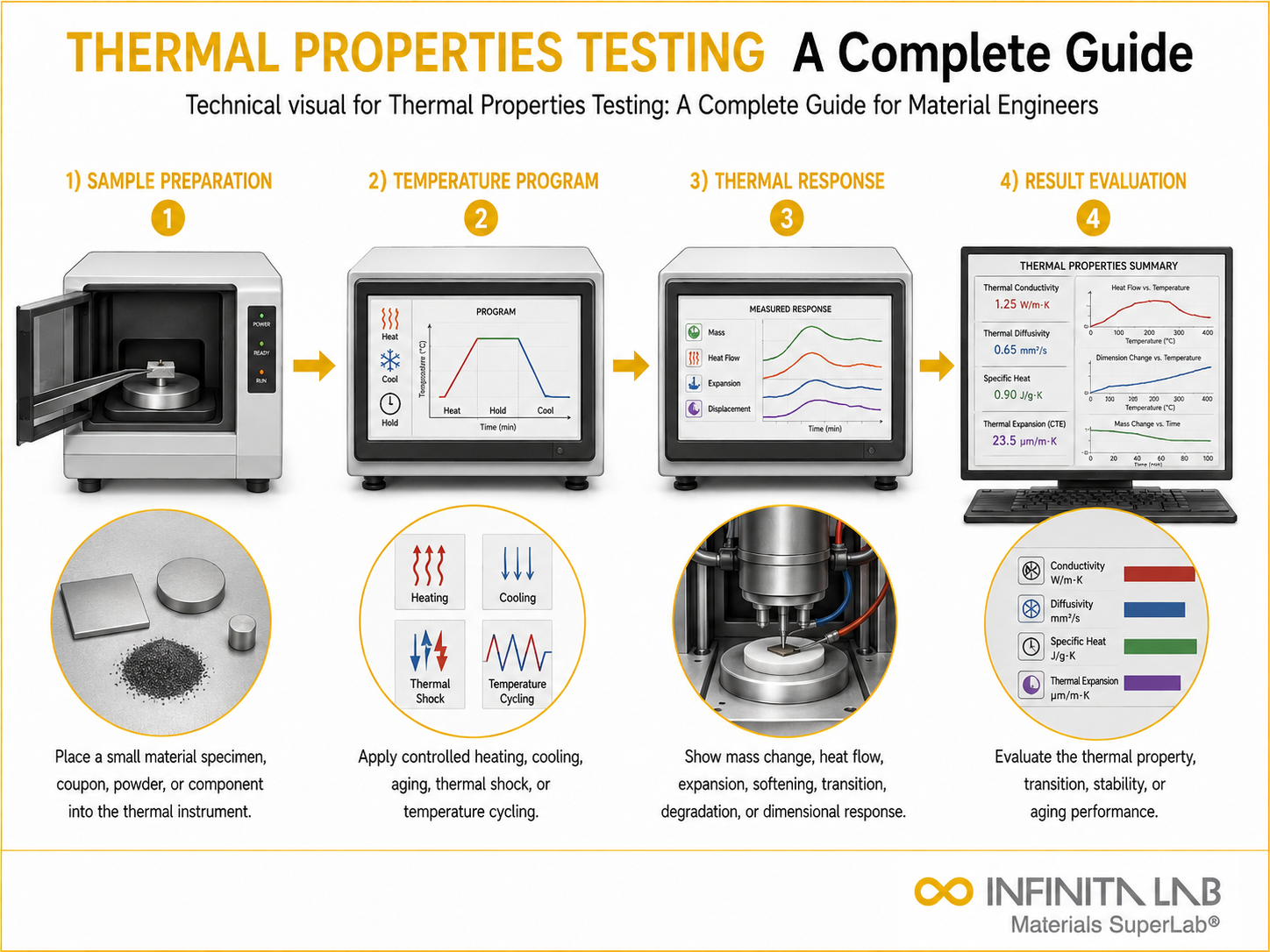
Thermal Properties Testing Services evaluate how materials respond to temperature changes, including heat flow, thermal stability, expansion, and decomposition behavior. These tests are essential for understanding performance under real-world thermal conditions, ensuring materials meet safety, durability, and functional requirements across various industries.
Advanced techniques such as TGA, DSC, TMA, and thermal conductivity analysis are used to generate precise data on thermal transitions and stability. These services support industries like polymers, aerospace, electronics, and pharmaceuticals by enabling informed material selection, improving product design, and ensuring compliance with global standards.

Scope, Applications, and Benefits
Scope
Thermal properties testing services involve comprehensive evaluation of material behavior under controlled temperature conditions to determine stability, transitions, and performance characteristics.
- Applicable to polymers, metals, ceramics, and composites
- Measures thermal stability, expansion, and conductivity
- Identifies phase transitions and decomposition
- Supports R&D and quality control
- Ensures compliance with ASTM, ISO, and other standards
Applications
- Polymer and plastic material evaluation
- Electronic component thermal analysis
- Aerospace material qualification
- Pharmaceutical stability studies
- Quality control in manufacturing
Benefits
- Enhances understanding of thermal behavior
- Improves product reliability and safety
- Supports optimal material selection
- Detects thermal degradation early
- Ensures compliance with industry standards
Test Process
Sample Preparation
The material is prepared and conditioned to required size and specifications
1Instrument Setup
Instruments are calibrated and programmed with specific temperature and testing conditions.
2Thermal Testing
The sample is subjected to controlled heating or cooling to measure thermal responses.
3Data Analysis
Results are analyzed to determine thermal properties and performance characteristics.
4Technical Specifications
| Parameter | Details |
|---|---|
| Temperature range | Ambient to 1000°C or higher depending on method |
| Heating rate | Typically 1–20°C/min |
| Measurement | Heat flow, weight change, expansion, conductivity |
| Sample size | Typically small (mg to grams depending on test) |
| Accuracy | High precision with calibrated instruments |
| Output | Thermal curves, graphs, and property values |


- Thermogravimetric Analyzer (TGA)
- Differential Scanning Calorimeter (DSC)
- Thermomechanical Analyzer (TMA)
- Dynamic Mechanical Analyzer (DMA)
- Thermal conductivity analyzer
Instrumentation Used for Testing
Results and Deliverables
- Thermal analysis reports and graphs
- Transition temperature data (melting, glass transition)
- Decomposition and stability information
- Material performance evaluation
- Compliance and certification reports
Frequently Asked Question
These services evaluate a material's effectiveness regarding resistance to, conduction, and heat storage.
These tests are used in automotive, aerospace, metallurgy, and building industries.
It is important because materials often operate under varying temperatures. Understanding thermal behavior helps prevent failures, improve product design, and ensure safety, performance, and compliance with industry standards.
The main challenges include the high costs of equipment, the long duration required for the tests, and the possibility of errors during the measurement.
Factors include heating rate, sample size, atmosphere, and instrument calibration. Proper control of these parameters is essential to obtain accurate and consistent results during thermal analysis.
Why Choose Infinita Lab for Advanced Materials Testing and Characterization?
At the core of this breadth is our network of 2,000+ accredited laboratories across the USA, offering access to over 10,000 testing methods and analytical services. From advanced materials characterization (SEM, TEM, RBS, XPS) to mechanical, chemical, environmental, biological, and standardized ASTM/ISO-compliant testing, we deliver unmatched flexibility, specialization, and scale. You are never limited by geography, facility, or methodology — Infinita Lab connects you to the right expertise and testing solution, every time.

Looking for a Trusted Partner for Accurate and Reliable Testing Services?
Send query us at hello@infinitalab.com or call us at (888) 878-3090 to learn more about our services and how we can support you.



Request a Quote
Submit your material details and receive testing procedures, pricing, and turnaround time within 24 hours.
 Quick Turnaround and Hasslefree process
 Confidentiality Guarantee
 Free, No-obligation Consultation
 100% Customer Satisfaction
