


ASTM F22: Water Break Testing Services
ASTM F22 is a standard test method for determining if there are any hydrophobic contaminants present on the surface of a specimen. This test procedure is commonly used to determine if surface contaminants on metal surfaces are absent, as they interfere with subsequent surface treatments like a surface coating.
TRUSTED BY


Get ASTM F22 compliant results — request your water break testing quote
- Overview
- Scope, Applications, and Benefits
- Test Process
- Specifications
- Instrumentation
- Results and Deliverables
What Is ASTM F22 Water Break?
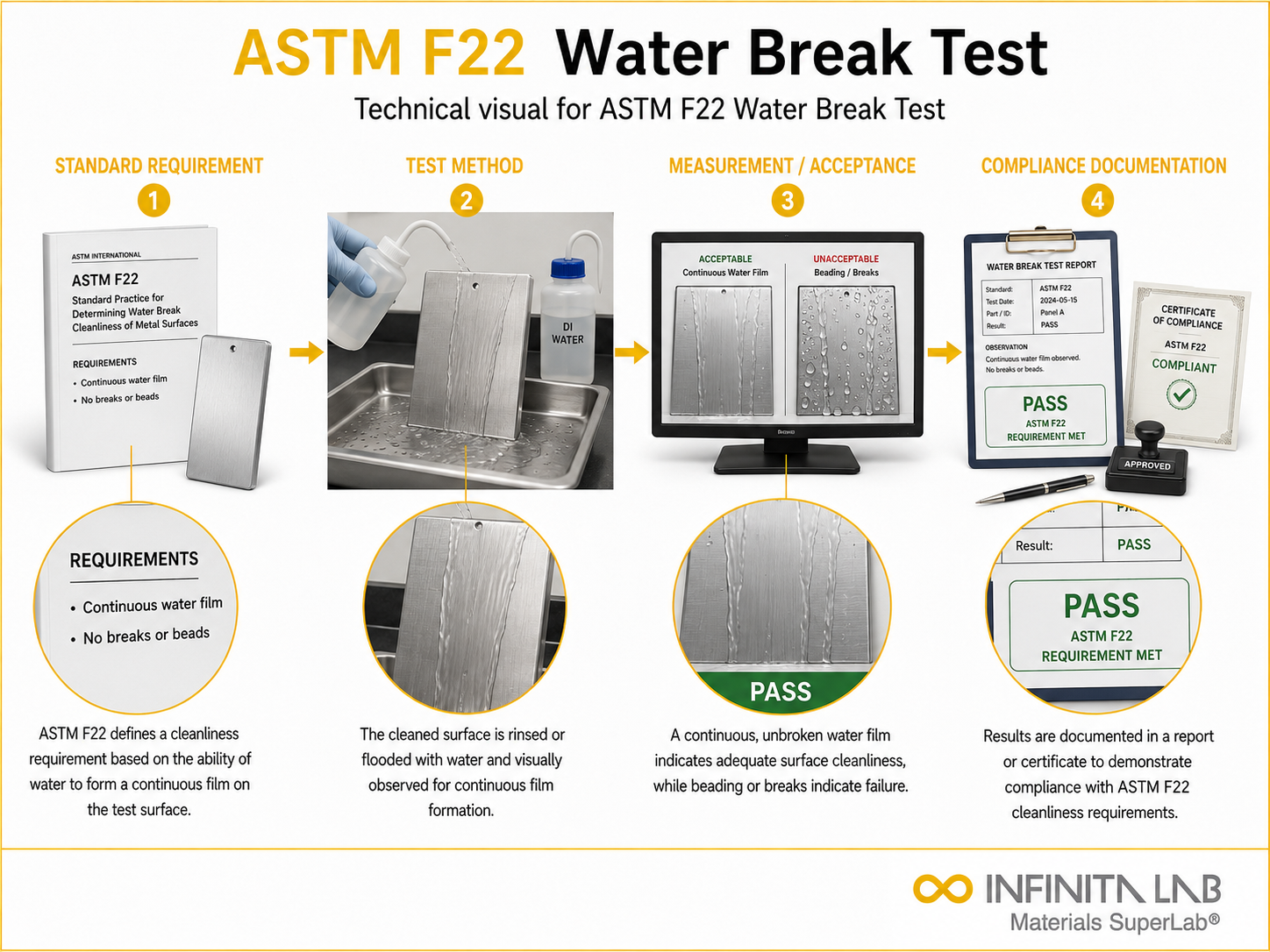
ASTM F22 is the standard test method for detecting hydrophobic contamination on surfaces using the water-break test. The method evaluates how water behaves when applied to a surface. A clean surface allows water to spread uniformly and form a continuous film. In contrast, contaminants such as oils, greases, silicones, waxes, or mold-release agents cause water to bead, break, or retract, indicating contamination.
The test is based on surface energy principles and provides a simple pass/fail assessment of surface cleanliness. ASTM F22 is widely used before processes such as bonding, coating, painting, plating, welding, and sealing, where contamination can lead to adhesion failures or reduced performance. Because it requires only water and visual observation, it is a practical and cost-effective method for in-process cleanliness verification across aerospace, electronics, metalworking, and precision manufacturing industries.

Applications and Benefits of ASTM F22 Water Break Testing
Scope
ASTM F22 is used to detect hydrophobic contamination on surfaces that must be clean before further processing or use. It applies to metals, glass, ceramics, and certain polymers. It identifies contaminants such as oils, greases, waxes, silicones, fingerprints, machining fluids, and mold-release agents that prevent uniform wetting with water.
The test is a simple go/no-go cleanliness assessment rather than a quantitative measurement. It is commonly used to verify the cleanliness of metal components, glass and optical surfaces, electronic assemblies, aerospace parts, precision-machined components, and surfaces prepared for welding, brazing, bonding, coating, or painting, where residual contamination can affect product performance and process reliability.
Applications
- Post-cleaning verification — confirming that a cleaning process — solvent degreasing, aqueous alkaline cleaning, vapor degreasing, or acid treatment — has successfully removed hydrophobic contamination before the part proceeds to the next operation
- Adhesive bonding preparation — verifying surface cleanliness immediately before primer application or adhesive bonding in structural, aerospace, and industrial assembly programs where bond integrity is safety-critical
- Painting and coating preparation — confirming that surfaces are free of hydrophobic films before primer, paint, powder coat, or conversion coating application, where contamination would cause adhesion failure, fisheye defects, or premature coating delamination
- Electroplating and anodizing preparation — verifying that substrate surfaces are clean before entering plating or anodizing baths, where oil contamination would cause skip plating, poor adhesion, or bath contamination
- Soldering and brazing — checking that surfaces to be joined are free of hydrophobic films that would prevent flux activity and solder wetting
- Process control and cleaning system qualification — monitoring the effectiveness of cleaning processes over time and validating new cleaning chemistries, temperatures, or cycle times against a defined cleanliness acceptance criterion
- Laboratory glassware verification — confirming that glassware used in analytical chemistry, biological assays, or surface science experiments is free of hydrophobic residues that would affect meniscus behavior, wetting, or adsorption
Benefits
- No instrumentation required — the test requires only a clean water source, making it executable at the point of cleaning without laboratory equipment, chemical reagents, or trained analysts
- Immediate result — the water-break or water-sheet response is observed in real time as water is applied to the surface, providing an instantaneous cleanliness indication without waiting for measurement or analysis
- Extremely sensitive to trace contamination — hydrophobic films at very low surface coverage — in some cases approaching a monolayer — are sufficient to produce a visible water-break response, making the test sensitive to contamination levels that many instrumental methods would miss or require special preparation to detect.
- Non-destructive and non-contaminating — the test leaves no residue, does not alter the surface, and does not require contact with reagents that could themselves introduce contamination.
- Applicable in-process and in the field — the test can be performed on assembled structures, large components, and production parts in place, not only on laboratory specimens
Our ASTM F22 Testing Procedure
Water & Surface Preparation
Use clean distilled/deionized water and document the surface condition before testing.
1Water Application
Apply water uniformly to the surface by pouring, flowing, or immersion.
2Wetting Evaluation
Observe the water behavior for continuous sheeting (clean surface) or beading/water-break (contamination).
3Result & Documentation
Classify the surface as water-break-free or water-break, document findings, and re-clean/retest if required.
4ASTM F22 Test Parameters and Requirements
| Parameter | Details |
|---|---|
| Detectable Contaminants | Hydrophobic films — oils, greases, waxes, silicones, mold release agents, fingerprints, machining fluids |
| Water Type | Distilled or deionized water |
| Water Temperature | Ambient unless otherwise specified |
| Application Method | Pouring, flowing, or immersion and withdrawal as appropriate to the part geometry |
| Applicable Surfaces | Metals, glass, ceramics, and selected polymers |
| Instrumentation Required | None |
| Quantitative Output | None — presence or absence of water-break only |
| Sensitivity | Detects hydrophobic films at very low surface coverage — approaching a monolayer in favorable cases |


- Distilled or deionized water supply of verified quality
- Clean pouring vessel, wash bottle, or flow apparatus appropriate to the part size and geometry
- Adequate lighting for clear observation of the water surface — the water-break response is a visual observation, and lighting conditions directly affect the detectability of a partial water-break
- A timer where water contact time or drainage time is specified
- Photographic documentation equipment is used where a visual record of the wetting response is required for the process record
Equipment and Instrumentation Used for ASTM F22 Testing
What You Receive: Test Report, Data, and Certification
- Test report — documentation of surface identification, material, prior processing and cleaning method, water source and quality, application method, observed wetting behavior, and pass/fail classification
- Pass/fail determination — water-break-free or water-break classification for each surface or surface area tested, forming the cleanliness acceptance record for the part or lot.
- Contamination location record — for surfaces exhibiting water-break, documentation of the location, approximate extent, and character of the contaminated areas to guide re-cleaning or corrective action
- Re-test records — documentation of cleaning cycles and re-test results where initial water-break results required corrective action and re-verification
- Process control records — trend data on water-break incidence rates for production cleaning processes, where the test is used as an ongoing process monitoring tool
ASTM F22 Water Break FAQs
Water Resistance Testing of Coatings in 100% Relative Humidity (ASTM D 2247): Water resistance testing of painted or coated panels is accomplished by placing them in an enclosed chamber containing a heated, saturated mixture of air and water vapor. The chamber's temperature is usually maintained at 100° F (38° C).
The specimens are dried in an oven for a specified time and temperature for the water absorption test and then placed in a desiccator to cool. Immediately upon cooling, the specimens are weighed. The material then emerges in water at agreed-upon conditions, often 23°C, for 24 hours or until equilibrium.
ASTM F22 Water break tests are used primarily for metal surfaces to identify surface contaminants on incoming raw materials or after surface processes, such as cleaning processes, etching, anodizing, painting, priming, coating, grit-blasting, or sanding, have occurred.
The water break check simply involves flooding a clean surface similar to those inspected and observing the surface film. A sufficient wetting agent is present if a continuous film forms over the entire surface.
No. ASTM F22 is normally used as a qualitative go/no-go cleanliness test rather than providing a numerical contamination value. Contact-angle testing may be used when quantitative wetting measurements are required.
Why Choose Infinita Lab for Water Break Testing
At the core of this breadth is our network of 2,000+ accredited laboratories across the USA, offering access to over 10,000 testing methods and analytical services. From advanced materials characterization (SEM, TEM, RBS, XPS) to mechanical, chemical, environmental, biological, and standardized ASTM/ISO-compliant testing, we deliver unmatched flexibility, specialization, and scale. You are never limited by geography, facility, or methodology — Infinita Lab connects you to the right expertise and testing solution, every time.

Looking for an Accredited Partner for ASTM F22 Water Break Testing?
Send query us at hello@infinitalab.com or call us at (888) 878-3090 to learn more about our services and how we can support you.



Request a Quote
Submit your material details and receive testing procedures, pricing, and turnaround time within 24 hours.
 Quick Turnaround and Hasslefree process
 Confidentiality Guarantee
 Free, No-obligation Consultation
 100% Customer Satisfaction
