


USP Plastics Physicochemical Testing Services
The USP Physicochemical Test Series is used to evaluate the physical and chemical properties of plastics and polymers, as required by USP General Chapter 32 and National Formulary 27, 2009. USP 661 is the standard used in the tests, which consist of four categories: buffering capacity, nonvolatile residue (NVR), residue on ignition (ROI), and heavy metals
TRUSTED BY


Get compliant results — request your USP plastics physicochemical testing quote
- Overview
- Scope, Applications, and Benefits
- Test Process
- Specifications
- Instrumentation
- Results and Deliverables
What Is USP Plastics Physicochemical?
USP Physicochemical Plastics Tests evaluate the chemical and physical characteristics of plastic materials used in pharmaceutical applications to ensure safety, stability, and compatibility with drug products. These tests are essential for verifying that packaging materials do not interact adversely with formulations.
The testing includes assessment of extractables, non-volatile residues, buffering capacity, and material reactivity under controlled conditions. It supports regulatory compliance with pharmacopeial standards by ensuring plastics maintain integrity and do not release harmful substances during storage or use.

Applications and Benefits of USP Plastics Physicochemical Testing
Scope
USP Physicochemical Plastics Tests focus on evaluating the chemical stability and physical behavior of plastic materials under standardized pharmacopeial test conditions.
It includes analysis of extractable substances, residue content, and chemical reactivity to ensure materials are suitable for pharmaceutical packaging and do not compromise product quality or patient safety.
- Evaluation of extractable and leachable substances
- Determination of non-volatile residue content
- Assessment of buffering capacity and pH effects
- Analysis of chemical reactivity with solvents
- Testing of plastic containers and closures
- Verification of compliance with USP standards
- Assessment of material stability under test conditions
- Monitoring of potential contamination risks
Applications
- Pharmaceutical packaging materials
- Medical-grade plastic components
- Drug container and closure systems
- Quality control in pharma manufacturing
- Regulatory compliance verification
- Material qualification and validation
Benefits
- Ensures safety of pharmaceutical packaging
- Prevents contamination and product interaction
- Supports compliance with pharmacopeial standards
- Identifies extractable and leachable risks
- Improves product stability and shelf life
- Enhances patient safety and product quality
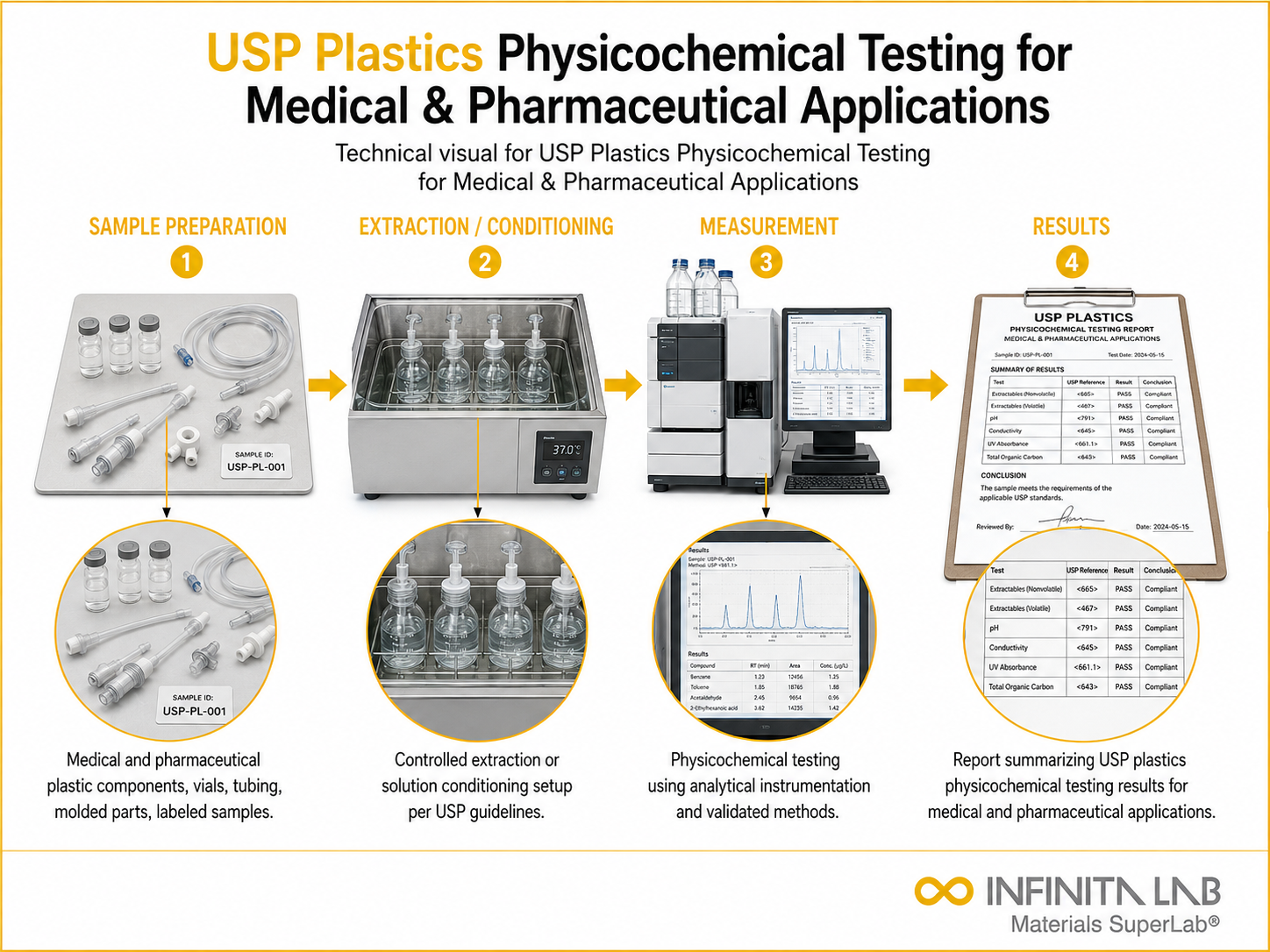
USP Physicochemical Plastics Tests – Process
Sample Preparation & Controlled Extraction
Plastic samples are prepared and exposed to extraction media under defined conditions to simulate potential interactions.
1Extraction & Solution Preparation
Extracted solutions are collected and conditioned for physicochemical evaluation and testing.
2Chemical Testing & Property Evaluation
Tests such as non-volatile residue, buffering capacity, and reactivity are performed on extracts.
3Analysis & Reporting
Results are analyzed against USP acceptance criteria and documented for compliance verification.
4Test parameters and requirements
| Parameter | Details |
|---|---|
| Test Method | Physicochemical evaluation of plastic extracts |
| Measurement Type | Residue, pH, buffering capacity, and reactivity |
| Sample Type | Plastic containers, closures, and packaging materials |
| Loading Type | Controlled extraction using solvents or aqueous media |
| Units | mg/L, pH units |
| Measurement Basis | Chemical properties of extracted solutions |


- pH meter
- Analytical balance
- Heating and extraction apparatus
- Glassware for extraction and analysis
- Conductivity meter
- Laboratory filtration setup
Equipment and Instrumentation Used for Testing
What You Receive: Test Report, Data, and Certification
- Non-volatile residue values
- pH and buffering capacity results
- Reactivity test outcomes
- Extractables assessment data
- Compliance with USP requirements
- Detailed analytical report
USP Plastics Physicochemical FAQs
These tests ensure that plastic materials do not release harmful substances or interact with drug products, maintaining product stability, safety, and regulatory compliance throughout storage and usage conditions.
Extractables are potential compounds released under aggressive conditions, while leachables are substances that actually migrate under real storage conditions, requiring different testing approaches for comprehensive safety assessment.
It quantifies residual substances that remain after solvent evaporation, indicating the presence of impurities or additives that could affect drug safety.
Reactivity tests determine whether plastic materials chemically interact with solvents or formulations, ensuring compatibility and preventing degradation or contamination.
Temperature, solvent type, and extraction time influence the quantity and type of substances extracted, requiring standardized conditions to ensure reproducibility and relevance.
Why Choose Infinita Lab for USP Plastics Physicochemical Testing
At the core of this breadth is our network of 2,000+ accredited laboratories across the USA, offering access to over 10,000 testing methods and analytical services. From advanced materials characterization (SEM, TEM, RBS, XPS) to mechanical, chemical, environmental, biological, and standardized ASTM/ISO-compliant testing, we deliver unmatched flexibility, specialization, and scale. You are never limited by geography, facility, or methodology — Infinita Lab connects you to the right expertise and testing solution, every time.

Looking for an Accredited Partner for USP Plastics Physicochemical Testing?
Send query us at hello@infinitalab.com or call us at (888) 878-3090 to learn more about our services and how we can support you.



Request a Quote
Submit your material details and receive testing procedures, pricing, and turnaround time within 24 hours.
 Quick Turnaround and Hasslefree process
 Confidentiality Guarantee
 Free, No-obligation Consultation
 100% Customer Satisfaction
