


Time Domain Reflectometry TDR Testing Services
Accredited time domain reflectometry TDR testing from Infinita Lab, performed to the exact standard requirements - accurate, reproducible results with full documentation for compliance, R&D, and quality control programs.
TRUSTED BY


Get compliant results - request your time domain reflectometry TDR testing quote
- Overview
- Scope, Applications, and Benefits
- Test Process
- Specifications
- Instrumentation
- Results and Deliverables
What Is Time Domain Reflectometry TDR?
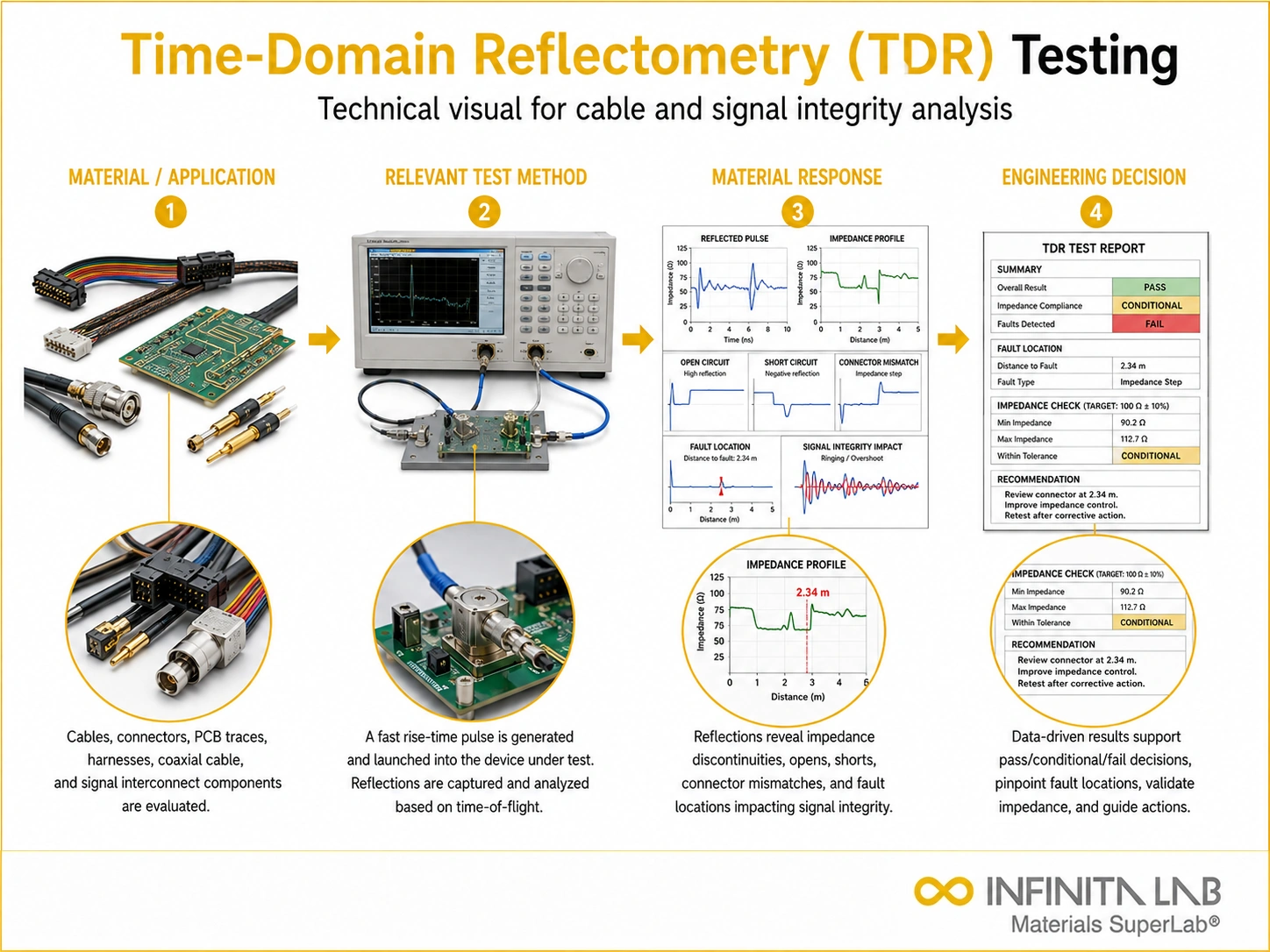
Time Domain Reflectometry (TDR) is a diagnostic technique used to detect faults, discontinuities, and impedance variations in electrical cables, transmission lines, and circuits. It works by sending a fast electrical pulse through a conductor and analyzing the reflected signals caused by changes in impedance along the path.
TDR is widely used in telecommunications, power systems, and electronics to locate faults such as open circuits, short circuits, and insulation defects. It provides precise distance-to-fault measurements, enabling efficient troubleshooting, maintenance, and quality assurance of cable and network systems.

Applications and Benefits of Time Domain Reflectometry TDR Testing
Scope
Time Domain Reflectometry evaluates the integrity of cables and transmission systems by analyzing reflected signals to detect faults and impedance changes.
- Applicable to electrical cables and transmission lines
- Detects faults such as opens, shorts, and impedance mismatches
- Measures distance to fault location
- Supports maintenance and troubleshooting
- Ensures system reliability and performance
Applications
- Cable fault location in power systems
- Telecommunications line testing
- PCB trace and signal integrity analysis
- Network cable diagnostics
- Insulation and impedance testing
Benefits
- Provides accurate fault location
- Reduces downtime and maintenance costs
- Enables non-destructive testing
- Improves system reliability
- Supports preventive maintenance
Our Testing Procedure
Signal Injection
A fast electrical pulse is transmitted into the cable or conductor under test.
1Signal Propagation
The pulse travels along the cable and interacts with impedance variations.
2Reflection Detection
Reflected signals are captured when the pulse encounters faults or discontinuities.
3Data Analysis
The time delay and waveform are analyzed to determine fault type and location.
4Test parameters and requirements
| Parameter | Details |
|---|---|
| Measurement principle | Pulse reflection and impedance analysis |
| Pulse type | Fast rise-time electrical pulse |
| Distance range | From a few meters to several kilometers |
| Resolution | High spatial resolution depending on pulse width |
| Accuracy | Typically within ±1% of cable length |
| Output | Waveform trace showing reflections |


- Time Domain Reflectometer (TDR device)
- Pulse generator
- Oscilloscope (for waveform analysis)
- Test leads and connectors
- Cable adapters
Equipment and Instrumentation Used for Testing
What You Receive: Test Report, Data, and Certification
- TDR waveform traces
- Distance-to-fault measurement
- Identification of fault type (open, short, impedance mismatch)
- Cable condition assessment
- Detailed diagnostic report
Time Domain Reflectometry TDR FAQs
TDR, or time-domain reflectometry, is an efficient, non-destructive test for determining the characteristics of any electrical or transmission line.
Send a low-voltage pulse into the testing cable and observe the reflection on the TDR at different impedance points. The TDR equipment measures the time difference between the transmitted and reflected signal. Thus, the time difference and propagation velocity determine the distance at which the pulse is reflected. Hence, it provides information regarding the change in impedance and flaws existing in the cable.
TDR assists in verifying that controlled impedance interconnects in high-performance PCBs are correctly fabricated.
The TDR is considered part of the regular maintenance and quality assurance duties. Regular testing will help in the early detection of these problems, sustaining system reliability and reducing overall maintenance costs.
Yes, TDR is useful for preventive maintenance as it can detect early signs of cable degradation or impedance changes before complete failure occurs, helping reduce downtime.
Time Domain Reflectometers (TDRs) send a fast electrical pulse through a cable or transmission line and measure reflections caused by changes in impedance. The timing and strength of the reflected signals help locate faults, discontinuities, and damaged sections.
A TDR test sends an electrical pulse along a cable and records the reflected waveform. The time taken for the reflection to return helps determine the distance to a fault, while the waveform can indicate issues such as open circuits, short circuits, or impedance mismatches.
Reflectometry testing sends a signal through a material, cable, or system and analyzes the signal reflected by changes in its properties. Depending on the technique, the results can help identify faults, measure distances, or characterize electrical and material properties.
Why Choose Infinita Lab for Time Domain Reflectometry TDR Testing
When your Time Domain Reflectometry TDR results have to hold up - for compliance, a customer audit, or an engineering decision - accuracy and an unbiased third-party report matter more than price. Infinita Lab routes your time domain reflectometry TDR testing to ISO/IEC 17025-accredited U.S. partner labs with hands-on method experience, so you get defensible data, transparent reporting, and turnaround times built around your project deadline - not ours.

Looking for an Accredited Partner for Time Domain Reflectometry TDR Testing?
Send query us at hello@infinitalab.com or call us at (888) 878-3090 to learn more about our services and how we can support you.



Request a Quote
Submit your material details and receive testing procedures, pricing, and turnaround time within 24 hours.
 Quick Turnaround and Hasslefree process
 Confidentiality Guarantee
 Free, No-obligation Consultation
 100% Customer Satisfaction
