


Temperature Testing Services
Testing for temperature measures the temperature of individuals or things. Traditional thermometers, infrared thermometers, thermal imaging cameras, and thermal forehead scanners are some of the available techniques. While it is crucial for screening, it cannot provide a conclusive diagnosis. For detailed directions, refer to government regulations or qualified medical personnel.
TRUSTED BY


Get compliant results — request your temperature testing quote
- Overview
- Scope, Applications, and Benefits
- Test Process
- Specifications
- Instrumentation
- Results and Deliverables
What Is Temperature?
Temperature testing evaluates how a product, component, or material performs and survives when exposed to controlled high and low temperatures, and to temperature changes over time. It is one of the most fundamental categories of environmental testing, because almost everything that is manufactured will experience temperature extremes at some point – during shipping, storage, or operation – and those extremes can degrade performance, accelerate aging, or cause outright failure.
The testing is carried out in environmental chambers that hold a product at a precisely controlled temperature, or cycle it between defined high and low temperatures, while the product is monitored for functional or physical change. Common test types include high-temperature operation and storage, low-temperature operation and storage, temperature cycling (slow transitions), and thermal shock (rapid transitions). Many programs combine temperature with humidity, since the two together are often more demanding than either alone.
Temperature testing is used to verify operating and storage temperature ratings, expose latent defects, qualify products against environmental standards, and screen production units for early-life failures. It spans virtually every industry – electronics, automotive, aerospace, medical devices, packaging, and materials – wherever temperature performance and reliability matter.

Applications and Benefits of Temperature Testing
Scope
Temperature testing covers the exposure of products and materials to controlled temperature conditions – steady-state extremes, cyclic profiles, and rapid transitions – in environmental chambers, with monitoring for functional and physical effects. The profile and limits are set by the applicable standard or the product’s specification.
Key test types within the scope include:
- High-temperature testing – operation and/or storage at elevated temperature to verify the product functions and survives at its upper rated limit
- Low-temperature testing – operation and/or storage at low temperature to verify performance and survival at the lower rated limit
- Temperature cycling – repeated, gradual transitions between high and low temperature to expose fatigue, delamination, and other defects driven by differential expansion
- Thermal shock – rapid transitions between temperature extremes to stress materials and joints with sudden thermal gradients
- Temperature-humidity testing – combined temperature and humidity exposure (steady-state or cyclic) for a more demanding environmental condition
- Applicable standards – including the IEC 60068-2 series (environmental testing), MIL-STD-810 (temperature methods), JEDEC standards for electronics, and numerous industry- and product-specific procedures
Applications
- Electronics and components – verifying that circuit boards, components, and assemblies operate and survive across their rated temperature range, and screening for early-life failures
- Automotive – qualification of automotive electronics and components against the wide temperature range and cycling seen in vehicle environments
- Aerospace and defense – temperature testing per MIL-STD-810 and related standards for equipment exposed to extreme operational environments
- Medical devices – verifying device performance and survival across operating, storage, and transport temperature conditions
- Packaging and cold chain – evaluating how packaging and products withstand temperature exposure during distribution, including cold-chain and temperature-sensitive shipments
- Materials evaluation – assessing how materials respond to temperature extremes and cycling, including dimensional, mechanical, and appearance changes
- Reliability and qualification testing – temperature cycling and thermal shock as part of accelerated life and qualification programs to expose latent defects
Benefits
- Verifies real-world temperature performance – confirms that a product actually operates and survives across the temperature range it will see in shipping, storage, and use, rather than relying on assumptions
- Exposes latent and early-life defects – temperature cycling and thermal shock are highly effective at revealing weak joints, delamination, and marginal components before they fail in the field
- Covers steady-state and transient stresses – the range of test types addresses both sustained temperature extremes and the differential-expansion stresses caused by changing temperature
- Combined temperature-humidity is more representative – pairing temperature with humidity reproduces a more demanding and realistic environmental condition for many products
- Supports qualification across industries – the same core chamber-based methods underpin temperature requirements in electronics, automotive, aerospace, medical, and packaging standards
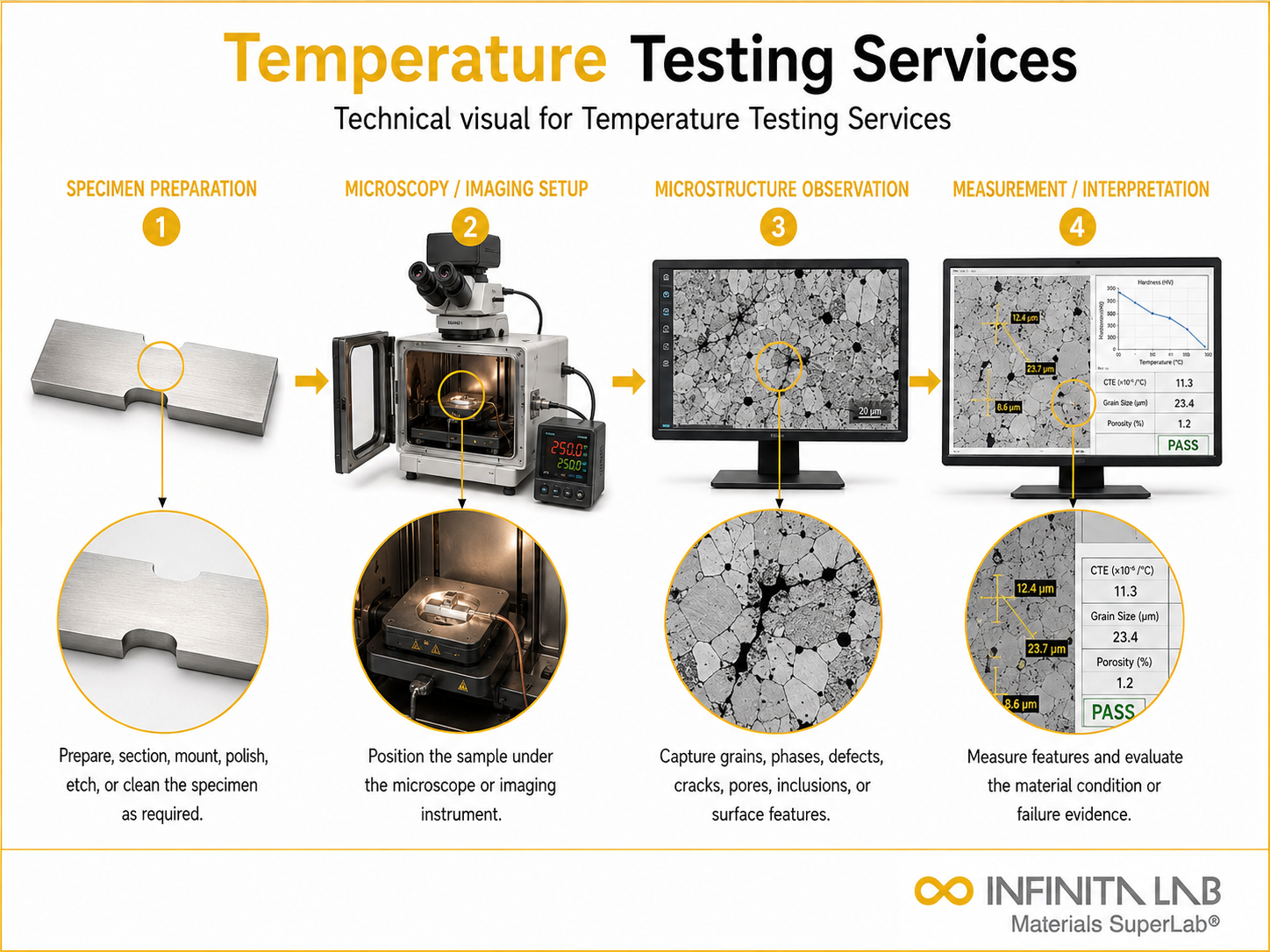
Our Testing Procedure
Define the Test
Set temperature limits, dwell times, transition rates, cycle count, and humidity requirements.
1Prepare the Product
Install monitoring sensors, place the product in the chamber, and confirm baseline performance.
2Run the Profile
Expose the product to high, low, cycling, or thermal shock conditions while monitoring performance.
3Evaluate and Report
Inspect and test the product, compare results with acceptance criteria, and record the pass/fail outcome.
4Test parameters and requirements
| Parameter | Details |
|---|---|
| Temperature Range | Chamber-dependent, commonly −70°C to +180°C (wider for specialized chambers) |
| Humidity (combined) | Controlled relative humidity where temperature-humidity testing is specified |
| Transition Rates | Gradual (cycling) or rapid (thermal shock) per the standard |
| Applicable Standards | IEC 60068-2 series, MIL-STD-810, JEDEC, industry/product-specific |
| Monitoring | Functional performance and/or physical condition during and after exposure |
| Product Types | Electronics, automotive, aerospace, medical, packaging, materials |
| Test Modes | Operating (powered/functional) and non-operating (storage/survival) |


- Environmental temperature chambers (high/low temperature)
- Temperature-humidity chambers
- Thermal shock chamber (dual-zone or rapid-transition)
- Thermocouples and temperature data loggers
- Functional monitoring/test equipment for powered tests
- Chamber control and data acquisition systems
Equipment and Instrumentation Used for Testing
What You Receive: Test Report, Data, and Certification
- Temperature test report – the test type and profile applied (temperatures, dwell times, transition rates, cycles), and the monitoring and inspection results
- Functional results – performance of the product during and after exposure for operating tests, against the acceptance criteria
- Physical inspection findings – any dimensional, structural, or appearance changes observed after exposure
- Pass/fail determination – outcome against the applicable standard or specification
- Monitoring data – temperature logs and functional monitoring records captured during the test
- Sample and setup records – product description, instrumentation, chamber configuration, and test conditions
Temperature FAQs
Products may experience extreme temperatures during manufacturing, storage, transportation or operation. Testing helps confirm reliability, safety and performance throughout the expected service environment.
Temperature testing is commonly performed on electronics, batteries, automotive components, medical devices, plastics, coatings and packaging. Aerospace, defence and industrial equipment may also require temperature qualification.
High-temperature testing exposes a specimen to elevated heat for a specified duration. It evaluates thermal stability, ageing, oxidation, dimensional changes and loss of mechanical or electrical performance.
Temperature cycling repeatedly exposes a product to alternating high and low temperatures. The test can identify fatigue, seal failure, delamination, cracking and damage caused by thermal expansion differences.
Thermal shock testing rapidly transfers a specimen between hot and cold environments. The sudden temperature change creates severe thermal stress and helps identify weak joints, interfaces and material combinations.
Why Choose Infinita Lab for Temperature Testing?
At the core of this breadth is our network of 2,000+ accredited laboratories across the USA, offering access to over 10,000 testing methods and analytical services. From advanced materials characterization (SEM, TEM, RBS, XPS) to mechanical, chemical, environmental, biological, and standardized ASTM/ISO-compliant testing, we deliver unmatched flexibility, specialization, and scale. You are never limited by geography, facility, or methodology — Infinita Lab connects you to the right expertise and testing solution, every time.

Looking for an Accredited Partner for Temperature Testing?
Send query us at hello@infinitalab.com or call us at (888) 878-3090 to learn more about our services and how we can support you.



Request a Quote
Submit your material details and receive testing procedures, pricing, and turnaround time within 24 hours.
 Quick Turnaround and Hasslefree process
 Confidentiality Guarantee
 Free, No-obligation Consultation
 100% Customer Satisfaction
