


Polysiloxane Analysis Testing Services
Explore the world of silicone chemistry by using our polysiloxane analysis guide. Learn about the complexities of molecules, and gain insight into the various applications of materials science.
TRUSTED BY


Get compliant results — request your polysiloxane analysis testing quote
- Overview
- Scope, Applications, and Benefits
- Test Process
- Specifications
- Instrumentation
- Results and Deliverables
What Is Polysiloxane Analysis?
Analysis of polysiloxanes is used to evaluate the chemical composition, molecular structure, and performance characteristics of silicone-based materials. Polysiloxanes are widely used due to their thermal stability, flexibility, and resistance to environmental degradation.
This analysis is commonly applied in industries such as electronics, automotive, medical devices, and coatings. It helps assess material quality, detect impurities, and understand performance under thermal, mechanical, and environmental conditions.

Applications and Benefits of Polysiloxane Analysis Testing
Scope
Polysiloxane analysis evaluates the chemical structure, molecular weight distribution, and physical properties of silicone materials using advanced analytical techniques. The test helps determine composition, stability, and performance characteristics.
The analysis evaluates:
- Chemical structure and composition of polysiloxanes
- Molecular weight and distribution
- Presence of additives, fillers, or impurities
- Thermal stability and degradation behavior
- Physical and mechanical properties
Applications
- Silicone sealants and adhesives
- Medical-grade silicone materials
- Automotive and aerospace components
- Electronic encapsulants and coatings
- Personal care and cosmetic formulations
- Industrial silicone products
Benefits
- Provides a detailed understanding of silicone composition
- Helps identify impurities and formulation inconsistencies
- Supports product development and optimization
- Assists in failure analysis and performance evaluation
- Enables comparison of different polysiloxane materials
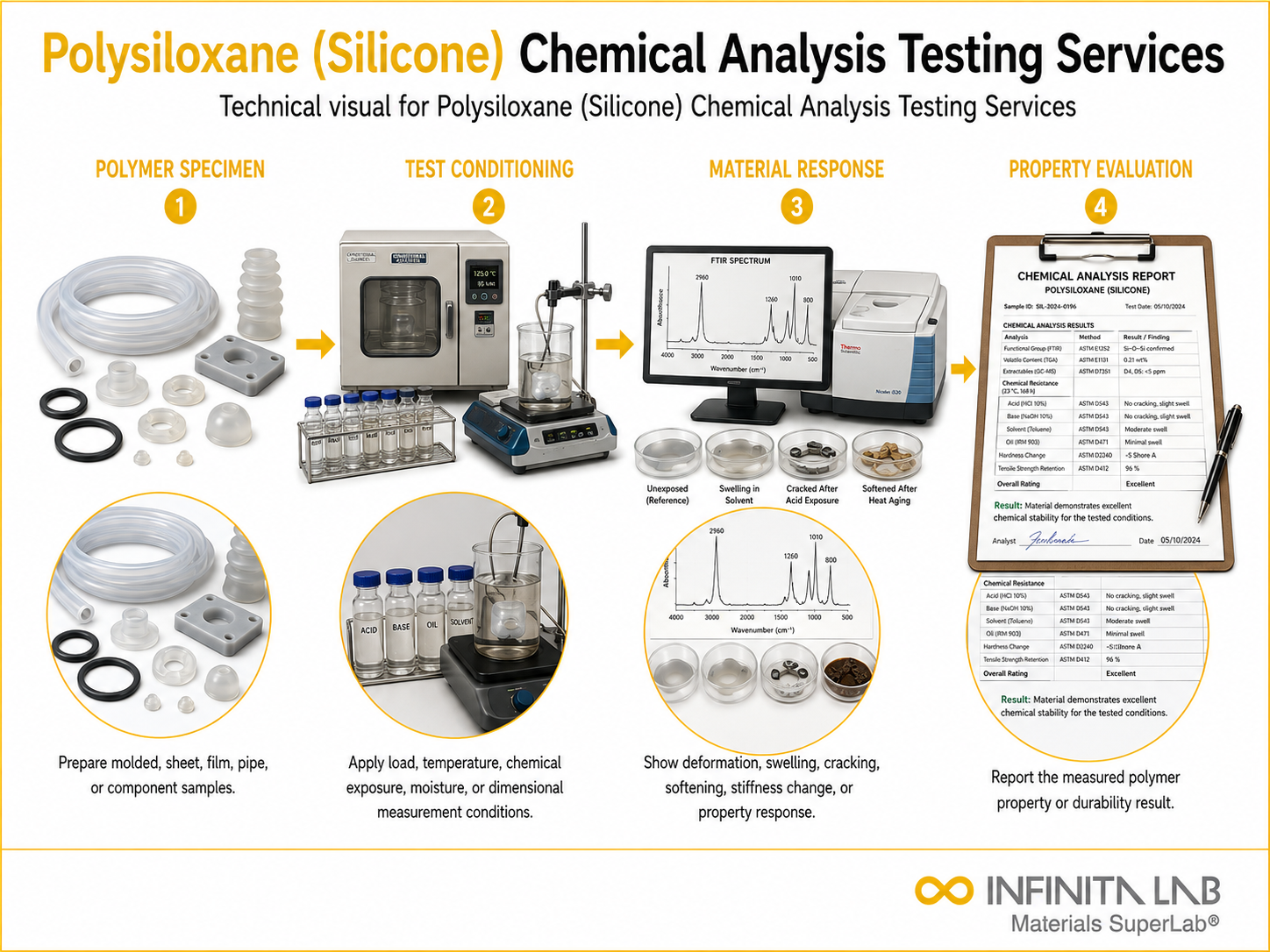
Our Testing Procedure
Sample Preparation
Polysiloxane samples are prepared and dissolved or sectioned for analysis.
1Chemical Analysis
Techniques such as spectroscopy are used to determine chemical structure and composition.
2Thermal and Physical Evaluation
Thermal behavior and physical properties are measured under controlled conditions.
3Data Recording & Evaluation
Results are analyzed to assess material quality and performance characteristics.
4Test parameters and requirements
| Parameter | Details |
|---|---|
| Applicable Materials | Silicone polymers and polysiloxanes |
| Molecular Weight Range | ~1,000 to 1,000,000 g/mol |
| Analysis Methods | FTIR, NMR, GC-MS |
| Thermal Range | -50°C to 300°C |
| Viscosity Range | ~10 to 1,000,000 cP |
| Measured Outputs | Composition, molecular weight, thermal properties |


- Fourier Transform Infrared Spectroscopy (FTIR)
- Nuclear Magnetic Resonance (NMR)
- Gas Chromatography-Mass Spectrometry (GC-MS)
- Thermogravimetric Analysis (TGA)
- Differential Scanning Calorimetry (DSC)
- Rheometer or viscometer
Equipment and Instrumentation Used for Testing
What You Receive: Test Report, Data, and Certification
- Chemical composition analysis
- Molecular weight distribution data
- Thermal stability and degradation results
- Viscosity and physical property measurements
- Test condition summary
- ASTM compliance report
Polysiloxane Analysis FAQs
Polysiloxane analysis includes molecular weight distribution, viscosity, crosslink density, chemical composition, and thermal stability, determining performance characteristics of silicone-based materials used in coatings, sealants, elastomers, and specialty applications.
Polysiloxane analysis ensures product quality, consistency, and performance by identifying composition, structure, and stability, supporting applications requiring durability, flexibility, and resistance to environmental conditions.
Polysiloxane analysis uses techniques such as Fourier transform infrared spectroscopy, nuclear magnetic resonance, gas chromatography, thermal analysis, and rheology to evaluate chemical structure and physical properties.
Polysiloxane analysis is commonly applied to silicone oils, elastomers, resins, coatings, and sealants used in automotive, electronics, medical, and industrial applications.
Polysiloxane analysis may be affected by sample preparation, complex molecular structures, and instrument sensitivity, requiring multiple analytical techniques to obtain comprehensive and accurate characterization of silicone-based materials.
Why Choose Infinita Lab for Polysiloxane Analysis Testing
At the core of this breadth is our network of 2,000+ accredited laboratories across the USA, offering access to over 10,000 testing methods and analytical services. From advanced materials characterization (SEM, TEM, RBS, XPS) to mechanical, chemical, environmental, biological, and standardized ASTM/ISO-compliant testing, we deliver unmatched flexibility, specialization, and scale. You are never limited by geography, facility, or methodology — Infinita Lab connects you to the right expertise and testing solution, every time.

Looking for an Accredited Partner for Polysiloxane Analysis Testing?
Send query us at hello@infinitalab.com or call us at (888) 878-3090 to learn more about our services and how we can support you.



Request a Quote
Submit your material details and receive testing procedures, pricing, and turnaround time within 24 hours.
 Quick Turnaround and Hasslefree process
 Confidentiality Guarantee
 Free, No-obligation Consultation
 100% Customer Satisfaction
