


Particulate Matter Testing Services
Particulate matter is the total number of harmful solid and liquid particles suspended in the air. Particulate matter testing is done to determine their concentration in the air as air pollution is one of the largest public health issues globally and many key research priorities including investigating effective interventions, quantifying air pollution exposures, and examining causal links between pollution and subclinical impairment need to be addressed to improve health globally.
TRUSTED BY


Get compliant results — request your particulate matter testing quote
- Overview
- Scope, Applications, and Benefits
- Test Process
- Specifications
- Instrumentation
- Results and Deliverables
What Is Particulate Matter?
Particulate matter (PM) testing measures the solid and liquid particles present in air, gases, liquids, or on surfaces – determining their concentration, size distribution, and in many cases their composition. “Particulate matter” covers a wide range, from the fine airborne particles that drive ambient air-quality concerns (such as PM2.5 and PM10) to the microscopic contamination that must be controlled in cleanrooms, fluids, and manufactured components. The common thread is the need to know how many particles are present, how big they are, and sometimes what they are made of.
In the environmental and air-quality context, particulate matter testing quantifies the mass concentration of suspended particles in air, because airborne PM is a recognized public-health concern linked to respiratory and cardiovascular effects. In the industrial and cleanliness context, particle testing counts and sizes particles in or on a product, fluid, gas, or controlled environment – critical wherever particulate contamination affects performance, reliability, or safety, such as in electronics, pharmaceuticals, aerospace fluids, and medical devices.
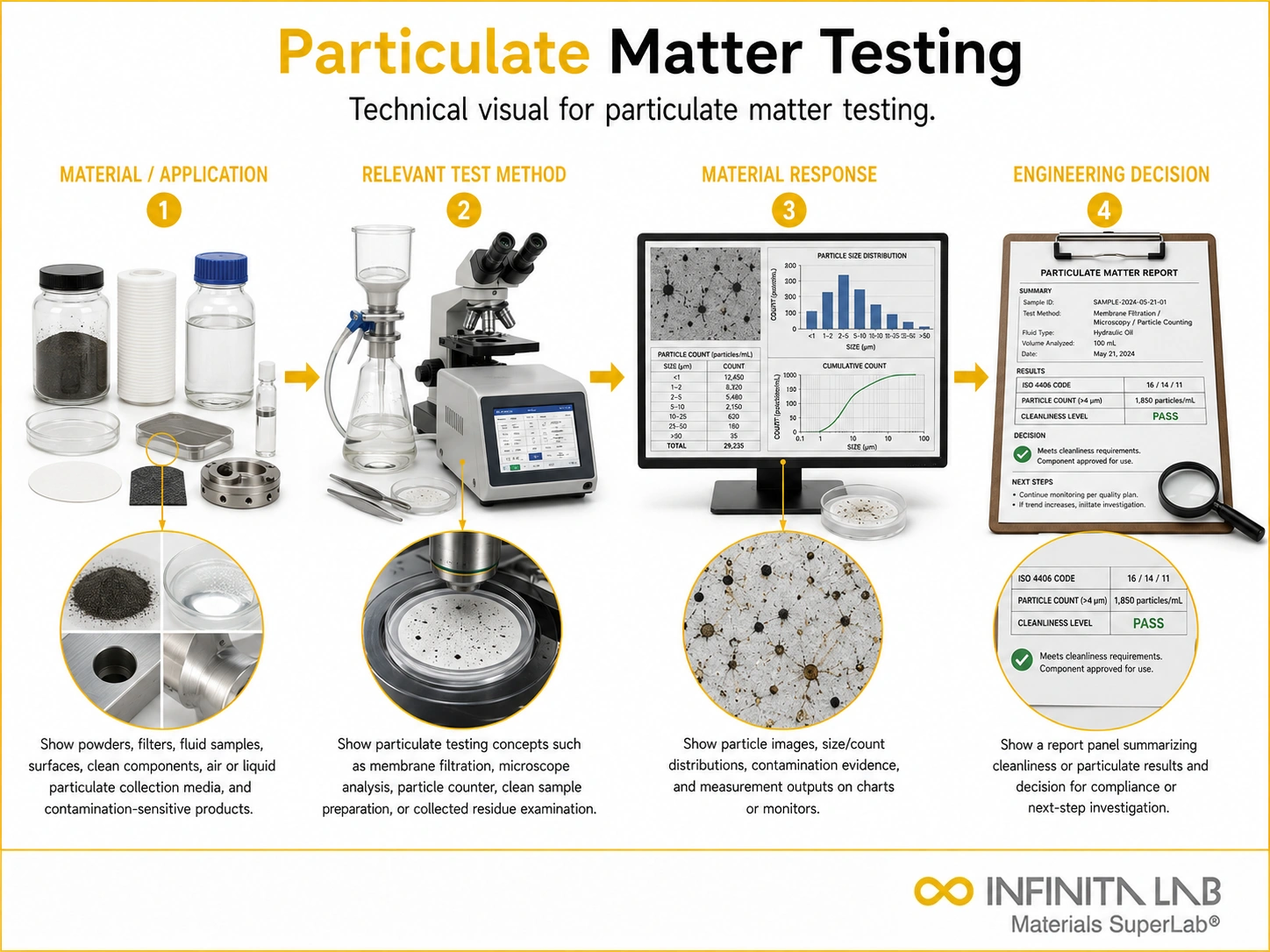
Because the applications are so varied, particulate matter testing draws on several measurement approaches – gravimetric (mass-based), optical and laser particle counting, microscopy, and compositional analysis – selected to match the sample type and the question being asked. The result supports air-quality assessment, cleanliness verification, contamination investigation, and process control.

Particulate Matter Testing Scope, Applications, and Benefits
Scope
Particulate matter testing covers the detection, counting, sizing, and (where required) compositional analysis of particles in air, gases, liquids, and on surfaces, using the method appropriate to the sample and the parameter of interest.
Key aspects of the testing scope include:
- Mass concentration (gravimetric) – collecting airborne particulate on a filter and weighing it to determine PM mass concentration (e.g., PM2.5, PM10, total suspended particulate)
- Particle counting and sizing – using optical or laser particle counters to count particles and report their size distribution in air, gases, or liquids
- Microscopic analysis – examining and sizing particles, and counting them by size class, using optical or electron microscopy
- Compositional/identification analysis – identifying the material of particles or contaminants using techniques such as SEM/EDS, FTIR, or other analytical methods
- Cleanliness testing – quantifying particulate contamination on components or in fluids against cleanliness specifications
- Sample environments – ambient and workplace air, cleanroom air, process gases, liquids and fuels, and component surfaces
- Applicable standards – environmental air-quality methods and cleanliness/particle-count standards (such as ISO 14644 for cleanrooms and various fluid-cleanliness standards), selected per application
Applications
- Air quality and environmental monitoring – measuring PM2.5, PM10, and total suspended particulate in ambient or workplace air for air-quality and exposure assessment
- Cleanroom monitoring – counting and sizing airborne particles to verify cleanroom air cleanliness against the applicable classification (e.g., ISO 14644)
- Component and surface cleanliness – quantifying particulate contamination on manufactured parts, especially in electronics, optics, aerospace, and medical device manufacturing
- Fluid and fuel cleanliness – counting and sizing particles in hydraulic fluids, fuels, lubricants, and process liquids where contamination affects performance and reliability
- Pharmaceutical particulate testing – measuring particulate matter in injectable and parenteral products and in controlled manufacturing environments
- Contamination investigation – identifying the size, quantity, and composition of contaminant particles when investigating a product or process problem
- Process and quality control – monitoring particulate levels in a process or environment to maintain consistent product cleanliness and quality
Benefits
- Quantifies particle level objectively – testing provides concrete particle counts, size distributions, or mass concentrations rather than subjective cleanliness judgments
- Covers air, fluids, gases, and surfaces – the range of methods allows particulate to be characterized wherever it matters, from ambient air to a component surface to a process fluid
- Identifies, not just counts – adding compositional analysis (e.g., SEM/EDS, FTIR) reveals what the particles are, which is often the key to finding a contamination source
- Supports cleanliness verification – particle counting and sizing provide the data needed to verify cleanrooms, fluids, and components against their cleanliness specifications
- Enables contamination control – by quantifying and identifying particulate, testing supports root-cause investigation and ongoing process control to keep contamination within limits
- Addresses both health and performance concerns – the same broad capability serves air-quality/health assessment and industrial cleanliness/reliability needs
Particulate Matter Testing Process
Select and Collect
Choose the appropriate method and collect a defined air, liquid, gas, or surface sample.
1Measure Particles
Determine particulate mass, count, or size using weighing, particle counting, or microscopy.
2Identify Composition
Use techniques such as SEM/EDS or FTIR when particle identification is required.
3Calculate and Report
Report particle concentration or cleanliness level and compare it with the applicable limit.
4Test parameters and requirements
| Parameter | Details |
|---|---|
| Methods | Gravimetric, optical/laser particle counting, microscopy, SEM-EDS/FTIR (ID) |
| Air-Quality Metrics | PM2.5, PM10, total suspended particulate |
| Sample Types | Ambient/workplace air, cleanroom air, process gases, liquids/fuels, surfaces |
| Cleanliness Standards | ISO 14644 (cleanrooms) and fluid/component cleanliness standards as applicable |
| Particle Identification | SEM/EDS, FTIR, and other analytical methods |
| Key Inputs | Sampled air/fluid volume, sampling time, filter/collection medium |


- Air sampling pumps and filter holders (gravimetric sampling)
- Analytical microbalance (gravimetric mass determination)
- Optical/laser particle counters (air, gas, and liquid)
- Optical microscope for particle examination and counting
- Scanning Electron Microscope (SEM) with EDS for particle identification
- FTIR for compositional analysis of particles
- Liquid particle counting and filtration apparatus (fluid cleanliness)
- Flow calibration and sampling equipment
Equipment and Instrumentation Used for Testing
What You Receive: Test Report, Data, and Certification
- Particulate matter report – the measured concentration, particle counts and size distribution, or cleanliness classification, with the method and sampling conditions documented
- Mass concentration data (gravimetric) – PM mass concentration with sampled volume and collection details
- Particle count and size data – counts by size class and size distribution for air, gas, or liquid samples
- Composition/identification results (where performed) – particle identity from SEM/EDS, FTIR, or other analysis, supporting source identification
- Comparison against specification (where provided) – measured results against the relevant air-quality limit or cleanliness classification
- Sample records – sample type, location, sampling volume/time, and collection medium used
Particulate Matter FAQs
Fine particles can affect respiratory health, product cleanliness, process efficiency and regulatory compliance. Testing helps identify contamination sources and evaluate the effectiveness of filtration or emission-control systems.
PM10 refers to particles with aerodynamic diameters of 10 micrometres or smaller, while PM2.5 includes particles 2.5 micrometres or smaller. PM2.5 can penetrate more deeply into the respiratory system.
Air is drawn through a size-selective inlet and filter using a calibrated sampling pump. The particles are captured on the filter for gravimetric, chemical or microscopic analysis.
Common instruments include optical particle counters, aerodynamic particle sizers, condensation particle counters and filter-based samplers. Scanning electron microscopy may be used to examine particle shape and composition.
Humidity, airflow, sampling duration, filter handling and instrument calibration can influence results. Particle losses in tubing, contamination and incorrect flow rates may also reduce measurement accuracy.
Why Choose Infinita Lab for Particulate Matter Testing
At the core of this breadth is our network of 2,000+ accredited laboratories across the USA, offering access to over 10,000 testing methods and analytical services. From advanced materials characterization (SEM, TEM, RBS, XPS) to mechanical, chemical, environmental, biological, and standardized ASTM/ISO-compliant testing, we deliver unmatched flexibility, specialization, and scale. You are never limited by geography, facility, or methodology — Infinita Lab connects you to the right expertise and testing solution, every time.

Looking for an Accredited Partner for Particulate Matter Testing?
Send query us at hello@infinitalab.com or call us at (888) 878-3090 to learn more about our services and how we can support you.



Request a Quote
Submit your material details and receive testing procedures, pricing, and turnaround time within 24 hours.
 Quick Turnaround and Hasslefree process
 Confidentiality Guarantee
 Free, No-obligation Consultation
 100% Customer Satisfaction
