


ISO 9001: Certification Testing Services
ISO 9001 (currently updated as ISO 9001:2015) specifies quality management system (QMS) requirements for organizations when they need to show that it can consistently meet and improve customer satisfaction through effective system application and improvement, and statutory and regulatory compliance.
TRUSTED BY


Get ISO 9001 compliant results — request your certification testing quote
- Overview
- Scope, Applications, and Benefits
- Test Process
- Specifications
- Instrumentation
- Results and Deliverables
What Is ISO 9001 Certification?
ISO 9001:2015, published by the International Organization for Standardization, is a standard that specifies the development and implementation of an effective Quality Management System (QMS) within an organization. The standard focuses on improving organizational processes, product quality, and customer satisfaction through a management approach.
The standard is based on risk-based thinking, process management, improvement, and customer operation. Organizations that adopt and implement the ISO 9001:2015 standard can demonstrate their ability to supply products and services that meet customer and regulatory requirements.

Applications and Benefits of ISO 9001 Certification Testing
Scope
ISO 9001 evaluates:
- Quality management system (QMS) implementation
- Process control and standardization
- Customer satisfaction and feedback systems
- Risk-based thinking and decision-making
- Continuous improvement processes
Applications
- Manufacturing and production industries
- Service-based organizations
- Construction and infrastructure
- Healthcare and pharmaceuticals
- IT, logistics, and public sector organizations
Benefits
- Improves customer satisfaction and trust
- Enhances process efficiency and consistency
- Reduces errors, waste, and operational costs
- Supports a continuous improvement culture
- Strengthens market credibility and competitiveness
Our ISO 9001 Testing Procedure
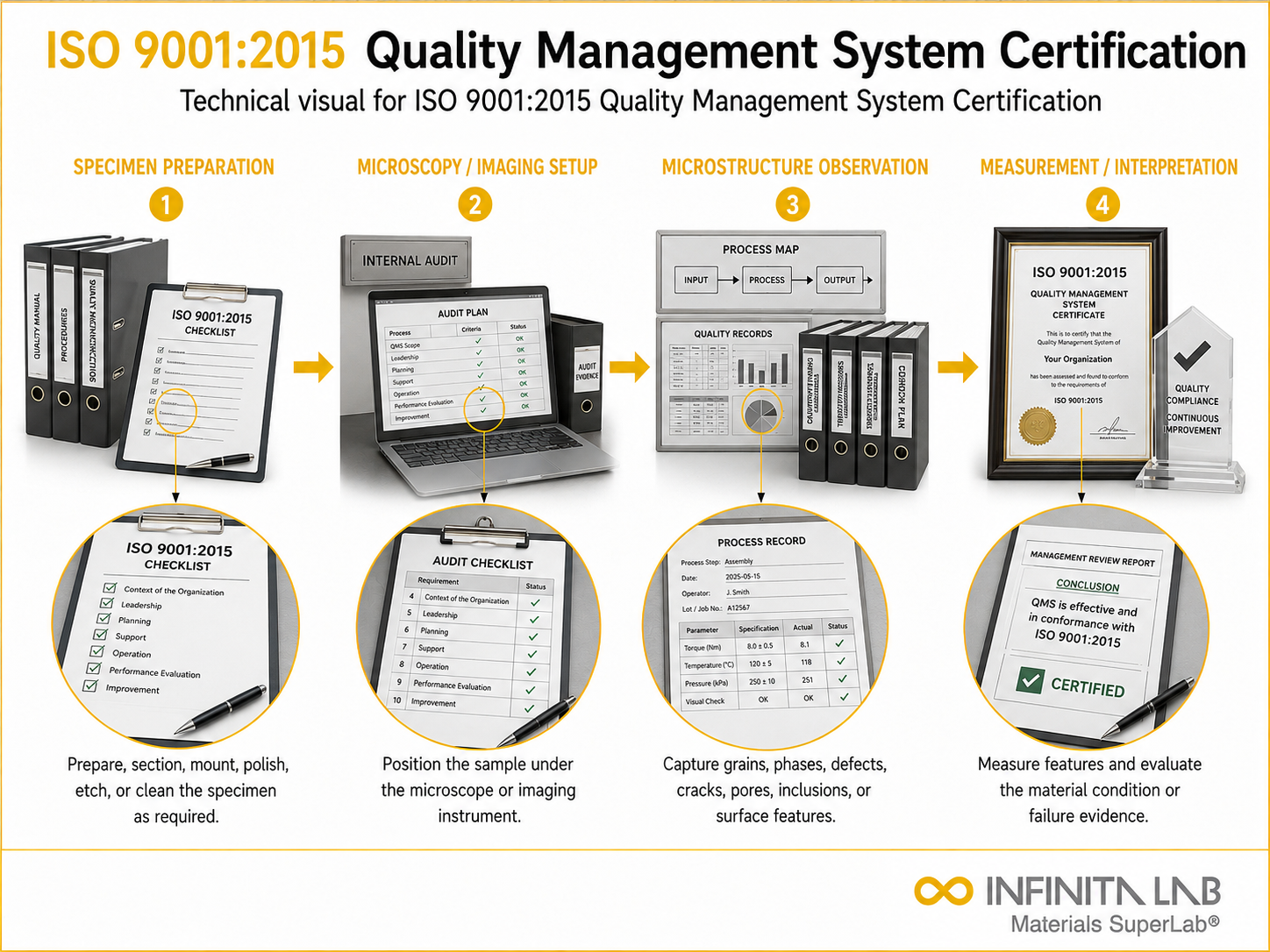
Gap Analysis
Existing processes are evaluated against ISO 9001 requirements to identify gaps.
1System Development
QMS documentation, policies, and procedures are established.
2Implementation
Processes are implemented, and employees are trained on QMS practices.
3Audit & Certification
Internal and external audits are conducted to verify compliance with ISO 9001.
4ISO 9001 Test Parameters and Requirements
| Parameter | Details |
|---|---|
| Standard | ISO 9001:2015 |
| System Type | Quality Management System |
| Applicable Organizations | All industries and sectors |
| Core Principles | Customer focus, leadership, process approach |
| Key Elements | Risk-based thinking, documentation, performance evaluation |
| Documentation | Quality manual, procedures, records |
| Assessment | Internal audits and external certification audits |


- Quality management software (QMS systems)
- Document control systems
- Internal audit tools
- Performance monitoring dashboards
- Risk management tools
- Training and competency systems
Equipment and Instrumentation Used for ISO 9001 Testing
What You Receive: Test Report, Data, and Certification
- QMS implementation and compliance report
- Process performance and efficiency evaluation
- Customer satisfaction analysis
- Risk and improvement action plans
- Continuous improvement roadmap
- Internationally recognized report
ISO 9001 Certification FAQs
ISO 9001:2015 is an internationally recognized standard that specifies requirements for a quality management system, helping organizations consistently provide products and services that meet customer expectations and regulatory requirements.
ISO 9001 certification demonstrates that an organization follows structured quality management practices, improves operational efficiency, enhances customer satisfaction, and supports continuous improvement across processes.
ISO 9001:2015 is widely used across industries including manufacturing, construction, healthcare, information technology, education, and service sectors to maintain consistent quality and operational control.
The standard is based on principles such as customer focus, leadership, process approach, evidence-based decision making, risk-based thinking, and continual improvement within the organization.
ISO 9001 certification is typically valid for three years, with annual surveillance audits conducted by certification bodies to ensure ongoing compliance with the standard requirements.
Why Choose Infinita Lab for Certification Testing?
At the core of this breadth is our network of 2,000+ accredited laboratories across the USA, offering access to over 10,000 testing methods and analytical services. From advanced materials characterization (SEM, TEM, RBS, XPS) to mechanical, chemical, environmental, biological, and standardized ASTM/ISO-compliant testing, we deliver unmatched flexibility, specialization, and scale. You are never limited by geography, facility, or methodology — Infinita Lab connects you to the right expertise and testing solution, every time.

Need ISO 9001 Certification Testing You Can Rely On?
Send query us at hello@infinitalab.com or call us at (888) 878-3090 to learn more about our services and how we can support you.



Request a Quote
Submit your material details and receive testing procedures, pricing, and turnaround time within 24 hours.
 Quick Turnaround and Hasslefree process
 Confidentiality Guarantee
 Free, No-obligation Consultation
 100% Customer Satisfaction
