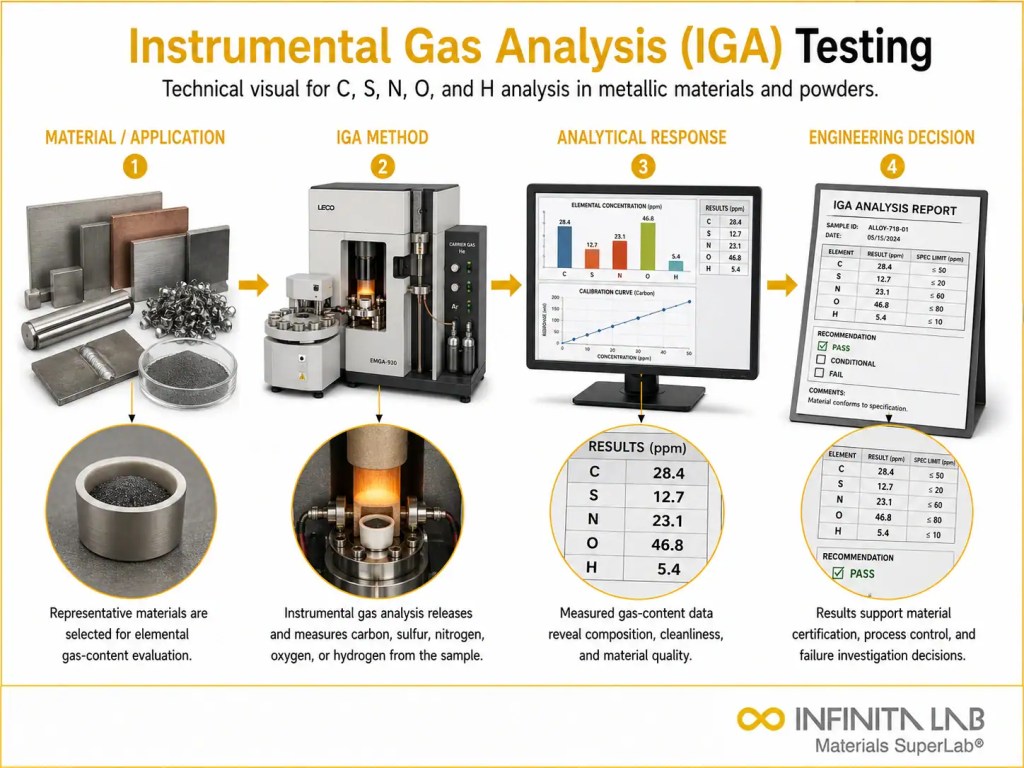


What Is Instrumental Gas Analysis IGA?
Instrumental Gas Analysis (IGA) is a critical analytical technique used to identify and quantify gaseous components in materials, environments, and industrial processes. It enables precise detection of gases such as oxygen, nitrogen, hydrogen, carbon dioxide, and trace impurities that can significantly influence product quality, safety, and performance across industries.
IGA utilizes advanced analytical instruments and detection technologies to provide accurate, real-time, or laboratory-based gas composition data. It is widely applied in sectors like petrochemicals, metallurgy, pharmaceuticals, and environmental monitoring, supporting quality control, process optimization, and regulatory compliance through reliable gas measurement and analysis.
Applications and Benefits of Instrumental Gas Analysis IGA Testing
Scope
Instrumental Gas Analysis involves the qualitative and quantitative determination of gases present in samples or environments using advanced analytical techniques and instruments for industrial and laboratory applications.
- Applicable to industrial gases and atmospheric analysis
- Detects major and trace gas components
- Supports process monitoring and quality control
- Used in environmental and emission testing
- Ensures compliance with regulatory standards
Applications
- Industrial process gas monitoring
- Environmental air quality analysis
- Metallurgical gas composition testing
- Pharmaceutical and chemical analysis
- Leak detection and safety assessment
Benefits
- Provides accurate and reliable gas measurements
- Detects trace-level impurities effectively
- Enhances process efficiency and control
- Supports regulatory compliance and reporting
- Improves safety in industrial operations
Our Testing Procedure
Sample Collection
Gas samples are collected using appropriate containers to avoid contamination.
1Instrument Setup
Instruments are calibrated and configured for target gas detection.
2Gas Analysis
The sample is analyzed to identify and quantify gas components.
3Data Interpretation
Results are processed to determine gas concentrations accurately.
4Test parameters and requirements
| Parameter | Details |
|---|---|
| Detection range | ppm to percentage levels depending on method |
| Accuracy | High precision with calibrated instrumentation |
| Sample type | Gaseous samples or gases extracted from materials |
| Response time | Rapid to real-time depending on instrument |
| Output | Quantitative concentration of gas components |
| Temperature/pressure | Controlled during analysis |


- Gas Chromatograph (GC)
- Infrared Gas Analyzer (IR analyzer)
- Thermal Conductivity Detector (TCD)
- Mass Spectrometer (MS)
- Gas sampling systems and cylinders
Equipment and Instrumentation Used for Testing
What You Receive: Test Report, Data, and Certification
- Detailed gas composition report
- Concentration of individual gas components
- Trace impurity analysis
- Compliance with relevant standards
- Graphs and chromatograms
Instrumental Gas Analysis IGA FAQs
Instrumental Gas Analysis is a technique used to identify and quantify gases in a sample using advanced analytical instruments. It provides accurate measurement of gas composition, helping industries ensure quality, safety, and compliance with regulatory standards.
IGA can analyze a wide range of gases including oxygen, nitrogen, hydrogen, carbon dioxide, carbon monoxide, and trace impurities. The specific gases detected depend on the analytical technique and instrumentation used.
Calibration ensures accuracy and reliability of results by comparing instrument readings with known standards. It is essential for maintaining measurement precision, especially when detecting trace gas concentrations in critical applications.
Gas chromatography separates gas components before detection, allowing precise identification and quantification. It is one of the most widely used techniques in IGA for analyzing complex gas mixtures.
Yes, IGA is capable of detecting trace impurities at ppm or even lower levels depending on the instrument used. This makes it highly valuable for quality control and environmental monitoring applications.
Internal Gas Analysis (IGA) measures the composition of gases trapped inside hermetically sealed packages, such as semiconductor devices. The package is opened or punctured under controlled conditions, and the released gases are analyzed using a mass spectrometer. The results identify moisture and other gases, helping assess sealing quality, contamination, and long-term component reliability.
Expert gas analysis uses specialized instruments to identify and quantify gases in sealed components, materials, or gas-filled systems. Depending on the application, techniques such as mass spectrometry or gas chromatography are used to measure gas composition and detect impurities. The findings help evaluate material quality, identify contamination, investigate failures, and verify process performance.
Insulating Glass Unit (IGU) gas analysis measures the concentration of insulating gases, such as argon or krypton, between glass panes. A gas sample is collected using a suitable sampling device and analyzed to determine its composition and concentration. The results help assess gas retention, edge-seal performance, and the thermal insulation efficiency of the glass unit.
Why Choose Infinita Lab for Instrumental Gas Analysis IGA Testing
When your Instrumental Gas Analysis IGA results have to hold up - for compliance, a customer audit, or an engineering decision - accuracy and an unbiased third-party report matter more than price. Infinita Lab routes your instrumental gas analysis IGA testing to ISO/IEC 17025-accredited U.S. partner labs with hands-on method experience, so you get defensible data, transparent reporting, and turnaround times built around your project deadline - not ours.

Looking for an Accredited Partner for Instrumental Gas Analysis IGA Testing?
Send query us at hello@infinitalab.com or call us at (888) 878-3090 to learn more about our services and how we can support you.



