


ASTM F22: Water Break Testing Services
Accredited ASTM F22 water break testing from Infinita Lab, performed to the exact standard requirements - accurate, reproducible results with full documentation for compliance, R&D, and quality control programs.
TRUSTED BY


Get ASTM F22 compliant results - request your water break testing quote
- Overview
- Scope, Applications, and Benefits
- Test Process
- Specifications
- Instrumentation
- Results and Deliverables
What Is ASTM F22 Water Break?
ASTM F22, Standard Test Method for Hydrophobic Surface Films by the Water-Break Test, describes a simple, qualitative procedure for detecting hydrophobic (water-repelling) contamination on metallic and non-metallic surfaces. The method is built around a straightforward physical principle: a clean, hydrophilic surface allows water to spread and drain as a continuous, unbroken film, while a surface carrying hydrophobic contaminants such as oils, greases, waxes, or silicone residues causes the water to bead up, retreat, or break apart within a short observation period. Because the behaviour of water on a surface reveals so much about its underlying chemistry, the water-break test has become a standard first checkpoint in surface cleanliness verification across a wide range of industrial processes.
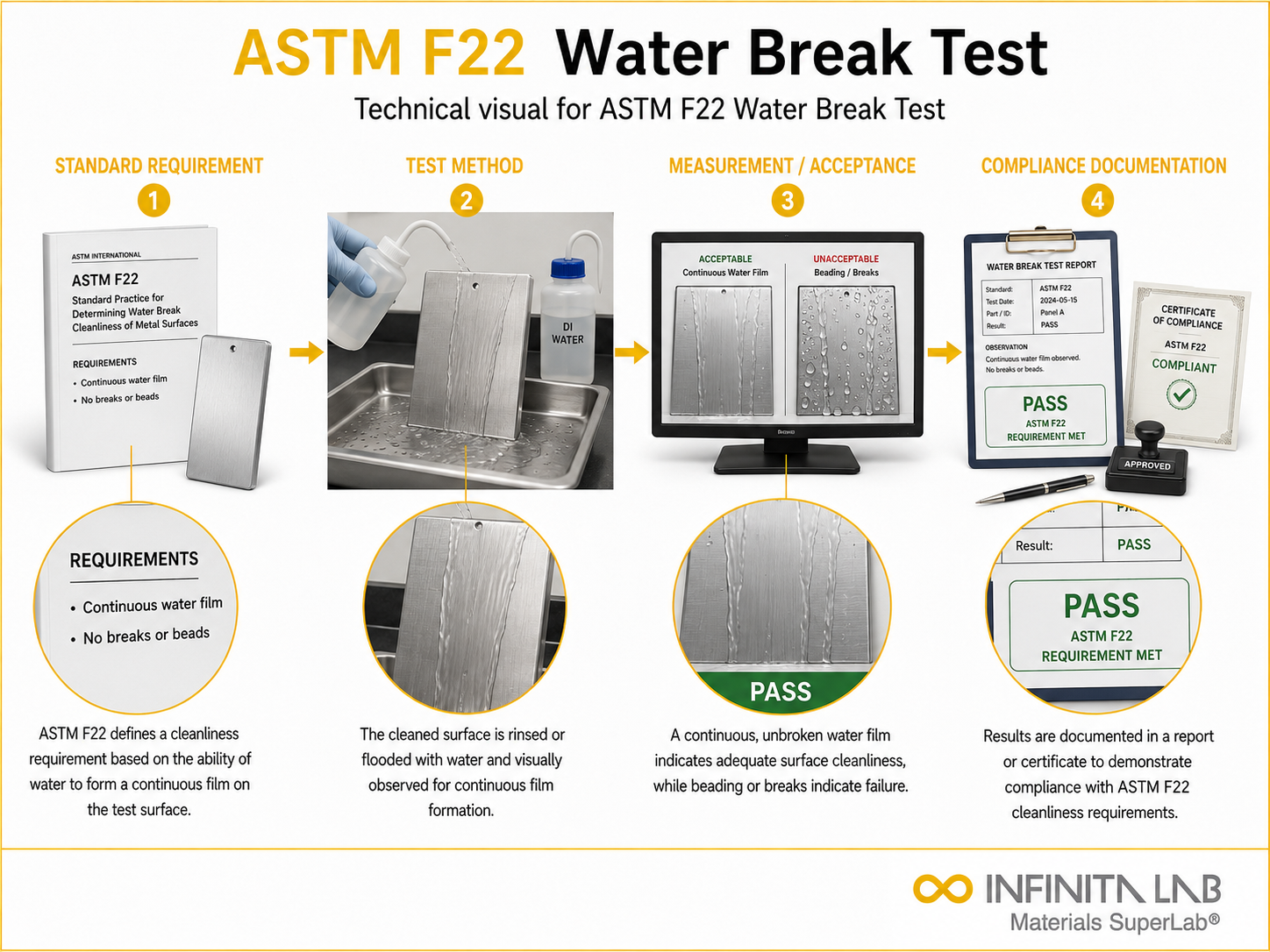
In practice, the test is performed by either spraying the prepared test surface with a fine mist of distilled or deionised water or briefly dipping the part and withdrawing it, then observing how the resulting water film behaves over a defined interval, typically on the order of thirty seconds. An inspector notes whether the film remains continuous (a pass) or whether it fragments into droplets or dry spots (a fail), and the result is reported as a simple pass/fail determination rather than a numeric value.
The value of ASTM F22 lies in its speed, low cost, and minimal equipment requirements. It gives manufacturers a fast go/no-go screening method to confirm that a surface is free of contamination before moving on to processes that depend on intimate surface contact, including painting, coating, adhesive bonding, electroplating, and welding preparation. Because residual films of oil or grease can compromise adhesion, coating uniformity, or weld quality, verifying cleanliness with a quick water-break check before committing to these downstream operations helps manufacturers catch problems early, reduce rework, and support consistent, defensible quality control across production lines.

Applications and Benefits of ASTM F22 Water Break Testing
Scope
- This test method evaluates the presence of hydrophobic (nonwetting) contamination, such as oils, greases, waxes, and silicone residues, on prepared metallic and non-metallic surfaces.
- The underlying test principle involves applying distilled or deionised water to the surface, either by spray or by dip immersion, and observing the resulting water film’s behaviour.
- A clean, uncontaminated surface causes water to spread and drain uniformly as a continuous film, while a contaminated or hydrophobic surface causes the water to bead, retreat, or break apart within the observation period.
- The method is qualitative and binary in nature, providing only a pass/fail or go/no-go result rather than a numeric measurement of contamination level.
- Test results do not identify the specific chemical composition of any contaminant present, only that hydrophobic residue is affecting surface wettability.
- Sensitivity of the test can decrease on rough, porous, or textured surfaces, and results can be influenced by lighting conditions, water quality, and operator judgment.
- The method applies broadly to metallic substrates such as aluminium, steel, and other alloys, as well as select non-metallic surfaces prepared for bonding or coating.
- It is widely used across aerospace, automotive, electronics, and general manufacturing environments as a routine in-process cleanliness check.
- Typical use cases include verifying cleaning line effectiveness, screening incoming or in-process parts, and monitoring witness surfaces for airborne contamination.
- Testing supports process control by confirming that a surface is suitable for subsequent operations that require intimate, contaminant-free surface contact.
Applications
- Post-cleaning verification – confirming that a cleaning process – solvent degreasing, aqueous alkaline cleaning, vapour degreasing, or acid treatment – has successfully removed hydrophobic contamination before the part proceeds to the next operation
- Adhesive bonding preparation – verifying surface cleanliness immediately before primer application or adhesive bonding in structural, aerospace, and industrial assembly programs where bond integrity is safety-critical
- Painting and coating preparation – confirming that surfaces are free of hydrophobic films before primer, paint, powder coat, or conversion coating application, where contamination would cause adhesion failure, fisheye defects, or premature coating delamination
- Electroplating and anodising preparation – verifying that substrate surfaces are clean before entering plating or anodising baths, where oil contamination would cause skip plating, poor adhesion, or bath contamination
- Soldering and brazing – checking that surfaces to be joined are free of hydrophobic films that would prevent flux activity and solder wetting
- Process control and cleaning system qualification – monitoring the effectiveness of cleaning processes over time and validating new cleaning chemistries, temperatures, or cycle times against a defined cleanliness acceptance criterion
- Laboratory glassware verification – confirming that glassware used in analytical chemistry, biological assays, or surface science experiments is free of hydrophobic residues that would affect meniscus behaviour, wetting, or adsorption
Benefits
- No instrumentation required – the test requires only a clean water source, making it executable at the point of cleaning without laboratory equipment, chemical reagents, or trained analysts
- Immediate result – the water-break or water-sheet response is observed in real time as water is applied to the surface, providing an instantaneous cleanliness indication without waiting for measurement or analysis
- Extremely sensitive to trace contamination – hydrophobic films at very low surface coverage – in some cases approaching a monolayer – are sufficient to produce a visible water-break response, making the test sensitive to contamination levels that many instrumental methods would miss or require special preparation to detect.
- Non-destructive and non-contaminating – the test leaves no residue, does not alter the surface, and does not require contact with reagents that could themselves introduce contamination.
- Applicable in-process and in the field – the test can be performed on assembled structures, large components, and production parts in place, not only on laboratory specimens
Our ASTM F22 Testing Procedure
Water & Surface Preparation
Use clean distilled/deionized water and document the surface condition before testing.
1Water Application
Apply water uniformly to the surface by pouring, flowing, or immersion.
2Wetting Evaluation
Observe the water behavior for continuous sheeting (clean surface) or beading/water-break (contamination).
3Result & Documentation
Classify the surface as water-break-free or water-break, document findings, and re-clean/retest if required.
4ASTM F22 Test Parameters and Requirements
| Parameter | Details |
|---|---|
| Detectable Contaminants | Hydrophobic films — oils, greases, waxes, silicones, mold release agents, fingerprints, machining fluids |
| Water Type | Distilled or deionized water |
| Water Temperature | Ambient unless otherwise specified |
| Application Method | Pouring, flowing, or immersion and withdrawal as appropriate to the part geometry |
| Applicable Surfaces | Metals, glass, ceramics, and selected polymers |
| Instrumentation Required | None |
| Quantitative Output | None — presence or absence of water-break only |
| Sensitivity | Detects hydrophobic films at very low surface coverage — approaching a monolayer in favorable cases |


- Spray bottle or dip tank – applies distilled or deionised water to the test surface via the spray or dip method specified for the evaluation.
- Distilled/deionized water supply – ensures the water used does not itself introduce minerals, ions, or residues that could affect wetting behaviour.
- Timer – tracks the observation period so that pass/fail judgments are made consistently within the specified time window.
- Adequate lighting and visual inspection setup – provides the illumination needed for the inspector to reliably observe water film continuity, beading, or breaking.
- Surface preparation and cleaning tools – used to prepare or clean test surfaces before testing so results reflect the intended process condition.
- Documentation equipment (camera) – captures photographic evidence of the water film behaviour to support the written test report.
Equipment and Instrumentation Used for ASTM F22 Testing
What You Receive: Test Report, Data, and Certification
- Test report – documentation of surface identification, material, prior processing and cleaning method, water source and quality, application method, observed wetting behaviour, and pass/fail classification
- Pass/fail determination – water-break-free or water-break classification for each surface or surface area tested, forming the cleanliness acceptance record for the part or lot.
- Contamination location record – for surfaces exhibiting water-break, documentation of the location, approximate extent, and character of the contaminated areas to guide re-cleaning or corrective action
- Re-test records – documentation of cleaning cycles and re-test results where initial water-break results required corrective action and re-verification
- Process control records – trend data on water-break incidence rates for production cleaning processes, where the test is used as an ongoing process monitoring tool
ASTM F22 Water Break FAQs
Water Resistance Testing of Coatings in 100% Relative Humidity (ASTM D 2247): Water resistance testing of painted or coated panels is accomplished by placing them in an enclosed chamber containing a heated, saturated mixture of air and water vapor. The chamber's temperature is usually maintained at 100° F (38° C).
The specimens are dried in an oven for a specified time and temperature for the water absorption test and then placed in a desiccator to cool. Immediately upon cooling, the specimens are weighed. The material then emerges in water at agreed-upon conditions, often 23°C, for 24 hours or until equilibrium.
ASTM F22 Water break tests are used primarily for metal surfaces to identify surface contaminants on incoming raw materials or after surface processes, such as cleaning processes, etching, anodizing, painting, priming, coating, grit-blasting, or sanding, have occurred.
The water break check simply involves flooding a clean surface similar to those inspected and observing the surface film. A sufficient wetting agent is present if a continuous film forms over the entire surface.
No. ASTM F22 is normally used as a qualitative go/no-go cleanliness test rather than providing a numerical contamination value. Contact-angle testing may be used when quantitative wetting measurements are required.
In a water-break test, a cleaned surface is immersed in or rinsed with purified water and then observed as the water drains. A continuous water film indicates a clean, wettable surface, while breaks or beading indicate the presence of hydrophobic contaminants such as oils or organic residues. ASTM F22 describes this rapid, nondestructive method for evaluating surface cleanliness.
Why Choose Infinita Lab for Water Break Testing
When your Water Break results have to hold up - for compliance, a customer audit, or an engineering decision - ASTM F22 accuracy and an unbiased third-party report matter more than price. Infinita Lab routes your ASTM F22 water break testing to ISO/IEC 17025-accredited U.S. partner labs with hands-on method experience, so you get defensible data, transparent reporting, and turnaround times built around your project deadline - not ours.

Looking for an Accredited Partner for ASTM F22 Water Break Testing?
Send query us at hello@infinitalab.com or call us at (888) 878-3090 to learn more about our services and how we can support you.



Request a Quote
Submit your material details and receive testing procedures, pricing, and turnaround time within 24 hours.
 Quick Turnaround and Hasslefree process
 Confidentiality Guarantee
 Free, No-obligation Consultation
 100% Customer Satisfaction
