

What Is ASTM E424 Solar Transmittance Reflectance Sheet?
When engineers need to know how much sunlight a sheet material actually lets through, and how much it bounces back, ASTM E424 is the standard test method they reach for. Its full title is a bit of a mouthful – “Standard Test Methods for Solar Energy Transmittance and Reflectance (Terrestrial) of Sheet Materials” -. Still, the idea is straightforward, and the standard has been in continuous use since 1971. It remains active today, with its most recent reapproval issued in 2023, and ASTM Subcommittee E44.20 on Optical Materials for Solar Applications maintains it as part of the broader Committee E44 on Solar, Geothermal and Other Alternative Energy Sources.
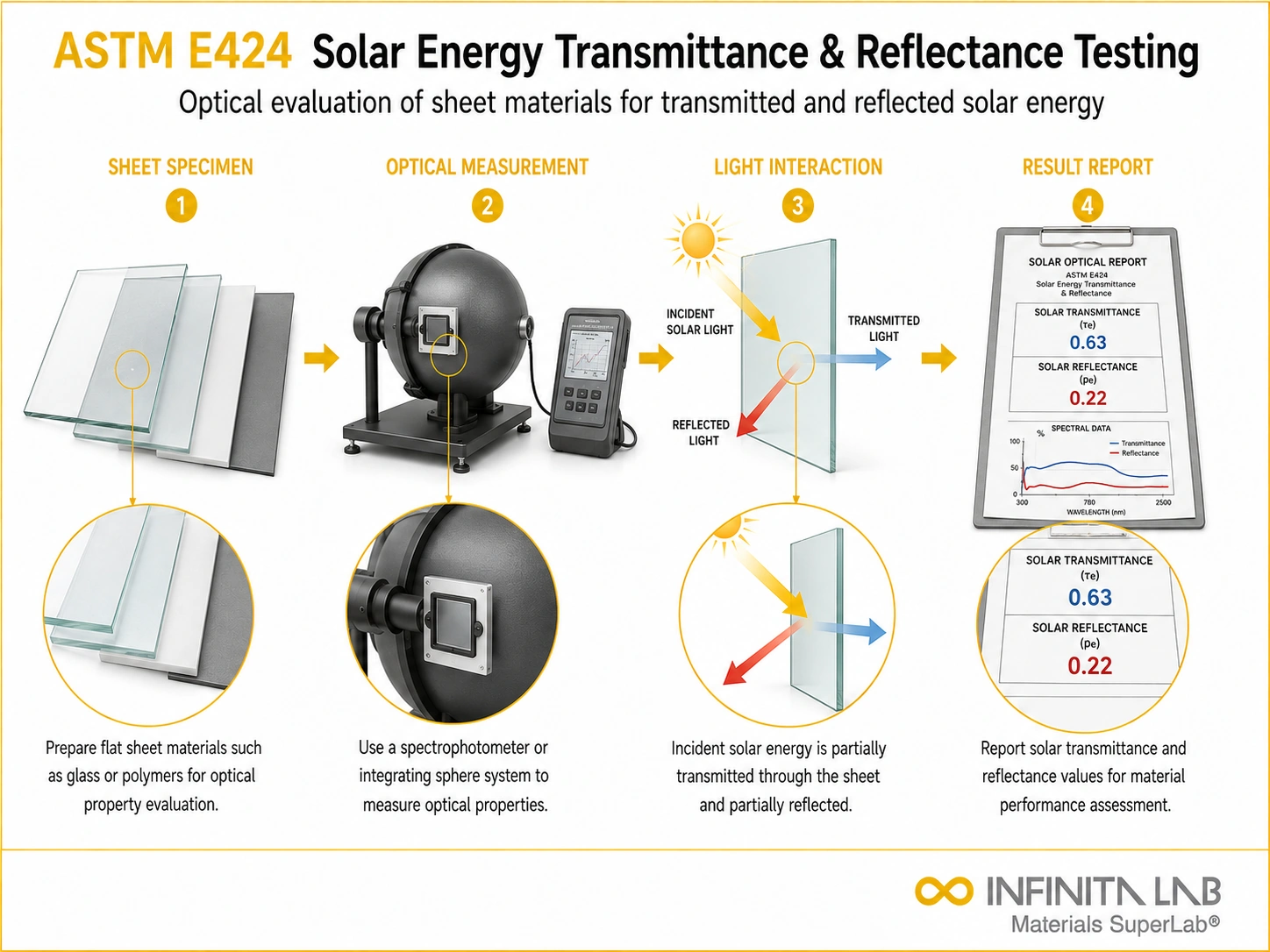
At its core, E424 answers a deceptively simple question: when terrestrial sunlight strikes a flat sheet of glass, plastic film, or coated glazing, what fraction of that solar energy passes through, and what fraction reflects off the surface? There are two ways to find out. Method A uses a spectrophotometer and serves as the referee method – capable of measuring both transmittance and reflectance with high precision, though limited by whatever specimen sizes a spectrophotometer’s geometry can accommodate. Method B takes a different route, placing a pyranometer inside an enclosure and letting natural sunlight serve as the energy source, which makes it especially useful for larger, patterned, corrugated, or otherwise non-uniform materials that wouldn’t fit into a spectrophotometer.
This distinction matters because sheet materials used in the real world aren’t always small, flat coupons. Architectural glazing, automotive glass, solar collector covers, and industrial films all need to perform predictably under sunlight, and E424 gives manufacturers, architects, and energy engineers a standardized, repeatable way to quantify that performance before a product ever reaches the field. In short, it’s a foundational method for anyone who needs defensible solar-performance data behind a sheet material.

Applications and Benefits of ASTM E424 Solar Transmittance Reflectance Sheet Testing
Scope
- At its core, ASTM E424 establishes two standardized test methods for determining the solar energy transmittance and reflectance of sheet materials under terrestrial solar radiation conditions.
- It applies to transparent and translucent sheet materials, including products carrying highly reflective coatings or other surface treatments.
- The standard is also written broadly enough to accommodate inhomogeneous, patterned, corrugated, or otherwise non-uniform sheet products that don’t behave like a simple flat coupon.
- Method A relies on a laboratory spectrophotometer and serves as the referee method whenever results from different laboratories or methods need to be reconciled.
- Method B, by contrast, relies on a pyranometer housed inside an enclosure and uses natural sunlight as the radiant source rather than a lamp-based instrument.
- While Method A is capable of measuring both transmittance and reflectance, Method B is limited to transmittance measurements only.
- Specimen size requirements differ meaningfully between the two methods, too, with Method B calling for a considerably larger sample area than Method A’s spectrophotometer geometry allows.
- Interestingly, for the materials evaluated during the standard’s development, both methods produced essentially equivalent transmittance results – which gives testing labs some real flexibility in method selection.
- Jurisdiction falls to ASTM Subcommittee E44.20 on Optical Materials for Solar Applications, situating E424 within the broader family of solar and alternative-energy test standards.
- And because the standard characterizes performance across the terrestrial solar spectrum, it applies wherever a sheet material’s real-world interaction with sunlight – rather than a narrow or artificial light source – needs to be quantified.
Applications
- Architectural glazing and window systems, where solar heat gain and daylighting performance directly shape a building’s energy use.
- Automotive glass and transparencies – think windshields and sunroofs – evaluated for their solar heat transmission characteristics.
- Aerospace canopies and transparencies, which have to perform predictably under direct, sustained sunlight exposure.
- Solar collector glazing and cover materials, where transmittance efficiency bears directly on collector output.
- Plastic films and laminates used in greenhouses, skylights, and other protective glazing applications.
- Reflective and coated glass products marketed specifically on solar control or energy-efficiency claims.
- Research and product development programs comparing new glazing formulations against established performance baselines.
Benefits
- It provides a nationally recognized, repeatable method for quantifying solar transmittance and reflectance, which supports fair, apples-to-apples comparisons between products.
- With two complementary test methods on offer, manufacturers get the flexibility to match specimen geometry and material type to whichever approach fits best.
- The data it generates feeds directly into energy modelling, building code documentation, and product performance claims.
- It also helps manufacturers validate coatings, tints, and film treatments before committing to large-scale production runs.
- For ongoing quality control, it gives labs a consistent reference point across production batches and suppliers.
- And it strengthens marketing and technical documentation with performance data that’s been verified by a third party.
Our ASTM E424 Testing Procedure
Specimen Preparation
Cut and clean sheet material specimens to specified dimensions; condition as required.
1Instrument Setup
Set up a spectrophotometer or solar measurement system as per ASTM E424 requirements.
2Calibration
Calibrate the instrument using standard reference materials
3Reporting
Report results with test conditions and specimen details.
4ASTM E424 Test Parameters and Requirements
| Parameter | Details |
|---|---|
| Measurement Method | Spectrophotometric measurement of transmittance and reflectance |
| Spectral Range | Solar spectrum (UV–Vis–NIR region) |
| Test Instrument | UV–Vis–NIR spectrophotometer with integrating sphere |
| Calibration | Use of certified reflectance/transmittance standards |
| Test Output | Solar energy transmittance and reflectance values |
| Sample Type | Sheet materials (transparent or translucent) |


- UV-Vis-NIR Spectrophotometer – This is the workhorse under Method A, capturing precise transmittance and reflectance data across the solar spectrum.
- Integrating Sphere Accessory – Paired with the spectrophotometer, it collects diffusely transmitted or reflected light so total measurements come out accurate.
- Pyranometer – Under Method B, this measures solar irradiance transmitted through the specimen during natural sunlight exposure.
- Sunlight Exposure Enclosure – It houses the specimen and pyranometer for Method B testing, controlling geometry and shielding against stray radiation.
- Certified Reference Standards – These calibration references verify instrument accuracy before and throughout testing.
- Specimen Holders and Fixtures – Positioning hardware that keeps sheet specimens flat and correctly oriented relative to the light source.
- Data Acquisition Software – It captures, logs, and helps process spectral or radiometric readings into the final transmittance and reflectance values.
Equipment and Instrumentation Used for ASTM E424 Testing
What You Receive: Test Report, Data, and Certification
- A formal test report documenting solar transmittance and reflectance, where applicable, for every specimen submitted.
- Method-specific data tables that lay out spectral or radiometric readings alongside the calculated solar-weighted results.
- Calibration and traceability records confirming instrument accuracy at the time of testing.
- Photographic documentation of specimens as received and as tested, available upon request.
- A results summary you can drop straight into product datasheets, energy modelling submissions, or building code documentation.
- Consultative support to help interpret the findings, plus guidance on retesting or complementary test methods when it’s needed.
ASTM E424 Solar Transmittance Reflectance Sheet FAQs
ASTM E424 determines the solar-energy transmittance and reflectance of sheet materials. These properties indicate how much incident terrestrial solar energy passes through or is reflected by a material.
The method can be applied to transparent, translucent, and highly reflective sheet materials, including glass and plastic glazing materials. It is particularly useful for materials used where solar heat admission and optical performance are important.
ASTM E424 provides two methods. Method A uses a spectrophotometer and can measure both solar transmittance and reflectance, while Method B uses a pyranometer in an enclosure with sunlight and measures transmittance only. Method B is especially suitable for large, patterned, corrugated, or otherwise inhomogeneous materials because it averages measurements over a larger area.
Solar transmittance and reflectance influence solar heat admission through windows, skylights, and other fenestration systems. The measurements can support material selection, energy-performance assessments, and solar-control design, although they do not by themselves determine total heat-transfer rates.
Testing provides quantitative solar-energy transmittance and/or reflectance values under the specified test conditions. Results can be used to compare the solar-optical performance of different sheet materials, glazing products, or solar-control surfaces.
Why Choose Infinita Lab for Solar Transmittance Reflectance Sheet Testing
When your Solar Transmittance Reflectance Sheet results have to hold up - for compliance, a customer audit, or an engineering decision - ASTM E424 accuracy and an unbiased third-party report matter more than price. Infinita Lab routes your ASTM E424 solar transmittance reflectance sheet testing to ISO/IEC 17025-accredited U.S. partner labs with hands-on method experience, so you get defensible data, transparent reporting, and turnaround times built around your project deadline - not ours.

Need ASTM E424 Solar Transmittance Reflectance Sheet Testing You Can Rely On?
Send query us at hello@infinitalab.com or call us at (888) 878-3090 to learn more about our services and how we can support you.





