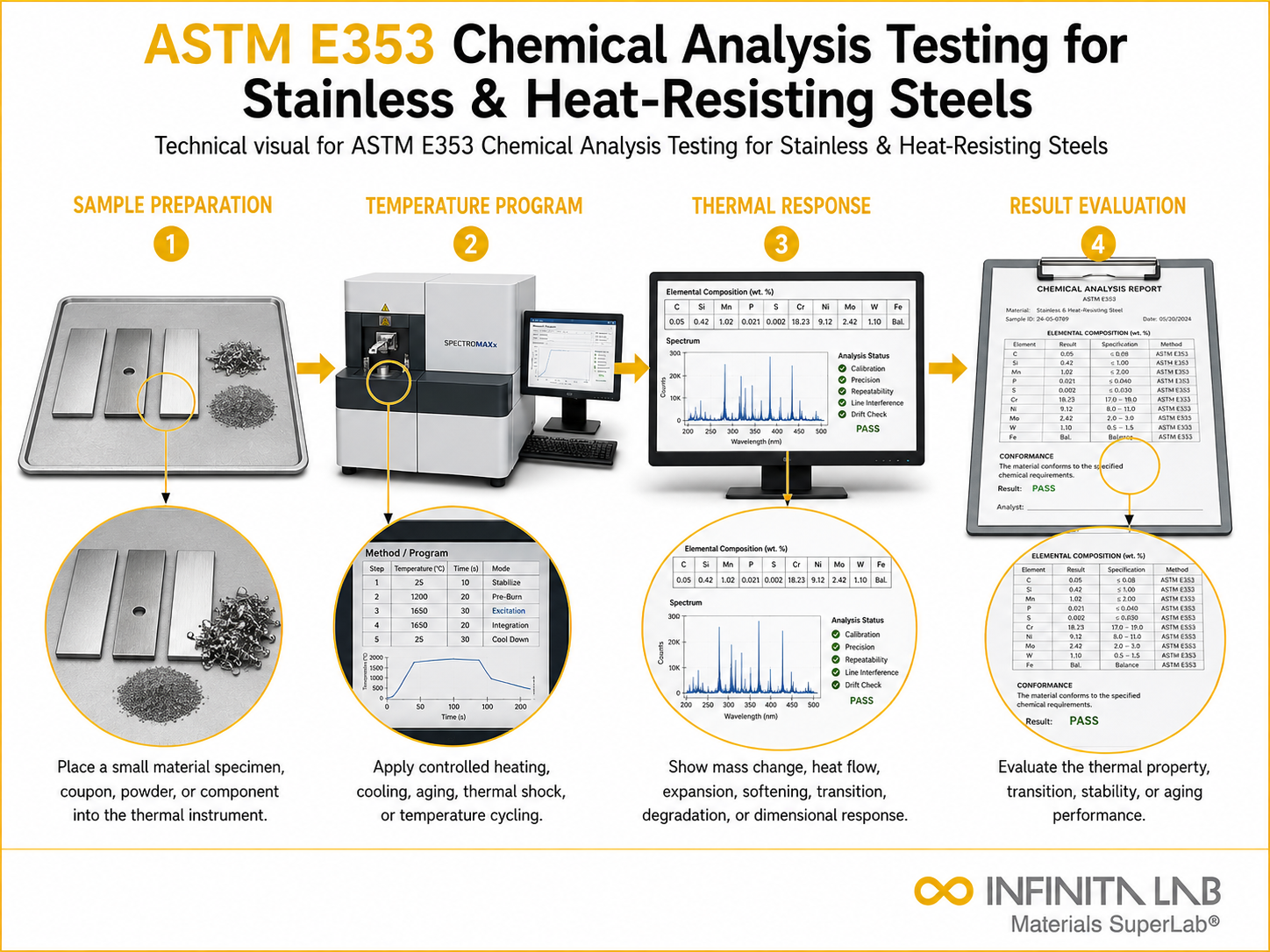


What Is ASTM E353 Stainless Heat Resisting Steel Chemical Analysis?
ASTM E353 is the standard test methods document governing how chromium-nickel-iron alloys – stainless steels, heat-resisting steels, maraging steels, and other closely related high-alloy grades – get chemically analyzed to confirm they meet their specified compositions. It’s not really a single test so much as a compilation of individual analytical procedures, each written for a specific element across a defined concentration range and rooted in classical wet-chemistry techniques: gravimetric analysis, spectrophotometric (colorimetric) determination, and volumetric titration, with atomic absorption spectrometry brought in for several elements as well. Because these procedures are painstaking, well-characterized, and reproducible from lab to lab, ASTM designates them as referee methods – the accepted fallback when faster instrumental techniques, like optical emission or X-ray fluorescence spectrometry, turn up results that get questioned or need independent confirmation.
In practice, a sample is dissolved through acid digestion, then carried through a method-specific sequence of separations, reactions, and measurements tailored to whichever element is being quantified, whether that’s chromium, nickel, molybdenum, aluminium, titanium, or one of the many other alloying and trace constituents these steels can contain. The resulting data tells a mill, forge, or fabricator whether a given heat of stainless, heat-resisting, or maraging alloy actually falls within its intended chemistry – and that chemistry, in turn, governs corrosion resistance, high-temperature strength, weldability, and mechanical performance further down the line.
For manufacturers, this matters because composition verification underpins every certification, every material traceability record, and every engineering decision built on top of it. Infinita Lab connects clients to accredited laboratories equipped to run these referee-grade procedures precisely, giving material producers, fabricators, and end users a defensible, standards-based answer whenever composition needs to be confirmed beyond doubt.

Applications and Benefits of ASTM E353 Stainless Heat Resisting Steel Chemical Analysis Testing
Scope
- ASTM E353 defines the chemical analysis test methods used for stainless, heat-resisting, maraging, and other similar chromium-nickel-iron alloys.
- ASTM Committee A01 on Steel, Stainless Steel, and Related Alloys publishes and maintains the standard.
- Roughly two dozen elements fall within its scope, including chromium, nickel, manganese, molybdenum, silicon, copper, cobalt, titanium, aluminium, phosphorus, sulfur, carbon, boron, tin, lead, vanadium, niobium, tantalum, tungsten, and zirconium.
- Each method is written for one specific element within a stated concentration range – the chemistry that works well at trace levels often looks nothing like the chemistry needed at major-constituent levels.
- For the most part, the procedures rely on gravimetric, spectrophotometric, and titrimetric wet-chemistry techniques. However, atomic absorption spectrometry is specified for select elements such as chromium, vanadium, tin, and lead.
- These test methods are described as primarily intended for referee purposes, serving as the authoritative check whenever compliance with a compositional specification is in question.
- Rather than targeting a single grade, the standard applies broadly across chromium-nickel-iron alloy families, which is why it covers austenitic, ferritic, and precipitation-hardening stainless grades alongside maraging and heat-resisting compositions.
- Before any element-specific procedure runs, sample preparation typically calls for acid dissolution of the metal.
- A handful of historical procedures within the standard, including certain carbon and sulfur determinations, have been discontinued over successive revisions in favor of methods covered elsewhere.
- The current active edition is ASTM E353-25, a reflection of ASTM’s ongoing maintenance of the document as analytical practice evolves.
Applications
- Verifying the chemical composition of incoming stainless and heat-resistant steel heats before they’re released for fabrication.
- Confirming maraging steel chemistry for aerospace, tooling, and high-strength structural components, where precise alloying is critical.
- Mill and foundry shipments lean on this testing to support certificate-of-compliance and material traceability documentation.
- When a supplier’s reported chemistry and an independent laboratory’s findings don’t line up, E353’s referee-grade methods are what settle the dispute.
- Qualifying raw material and weld filler metal chemistry for pressure vessel, piping, and valve manufacturing.
- Metallurgical failure investigations often call on these procedures to re-confirm composition against the original specification.
- Quality assurance programs at mills, service centers, and fabricators that handle chromium-nickel-iron alloys routinely depend on this same backing.
Benefits
- Delivers referee-level accuracy that stands up when compositional compliance is being formally challenged or verified.
- One standard covers a wide element list, so there’s no need to juggle multiple disparate procedures.
- Because it applies across several related alloy families, a single framework supports stainless, heat-resisting, and maraging materials alike.
- Traceability and documentation get stronger too, which matters most for regulated or safety-critical supply chains.
- Engineering and quality teams gain an independently defensible basis for accept/reject decisions on incoming material.
- And it reduces the risk of costly downstream failures caused by out-of-spec alloying content going undetected.
Our ASTM E353 Testing Procedure
Sample Preparation
Obtain a representative steel sample, then clean and prepare it to prevent surface contamination.
1Weighing
Accurately weigh the required quantity of the prepared sample as specified for the element to be analyzed.
2Calculation
Calculate element concentrations based on measured values and sample weight.
3Reporting
Report results as percentages or ppm, as specified in the standard.
4ASTM E353 Test Parameters and Requirements
| Parameter | Details |
|---|---|
| Applicable Materials | Stainless steels, heat-resisting steels, maraging steels, and similar alloys |
| Elements Determined | Major, minor, and trace alloying elements (e.g., C, Mn, Si, Cr, Ni, Mo, Co, Al, Ti, Cu, etc.) |
| Sample Mass | As specified for each element and method |
| Analytical Range | Element-dependent; suitable for low to high alloy contents |
| Result Reporting | Percentage (%) or parts per million (ppm) |


- UV-Vis Spectrophotometer – reads the colorimetric complexes formed during spectrophotometric determinations of elements such as manganese, phosphorus, aluminium, copper, molybdenum, and titanium.
- Atomic Absorption Spectrometer (AAS) – quantifies elements including chromium, vanadium, tin, and lead at the concentration ranges the standard specifies.
- Analytical Balance – delivers the high-precision mass measurements gravimetric determinations depend on, for elements like aluminium, silicon, nickel, and molybdenum.
- Automatic/Manual Titration Apparatus – handles the volumetric titrimetric procedures used for elements such as chromium and phosphorus.
- Ion-Exchange Separation Columns – isolate target elements from interfering species before spectrophotometric or AAS measurement, particularly for cobalt, molybdenum, and lead.
- Sample Digestion Equipment – takes care of the acid dissolution step that prepares solid alloy samples for wet-chemical analysis.
- Fume Hood and Wet Chemistry Workstation – gives chemists the controlled, ventilated environment reagent handling and acid digestion require throughout the procedures.
Equipment and Instrumentation Used for ASTM E353 Testing
What You Receive: Test Report, Data, and Certification
- A detailed elemental composition report, expressed as percent by weight for each tested constituent.
- A side-by-side comparison of measured values against the applicable material specification or purchase order requirement.
- A formal certificate of analysis, suitable for supplier qualification, audits, and customer documentation.
- Supporting raw data and method references for traceability, including which E353 procedure was applied per element.
- Pass/fail or conformance commentary, where a specification limit has been provided for comparison.
- Retained sample and record archiving, so future disputes, re-testing, or regulatory review have something to draw on.
ASTM E353 Stainless Heat Resisting Steel Chemical Analysis FAQs
ASTM E353 determines the chemical composition of stainless, heat-resisting, maraging, and similar chromium-nickel-iron alloys. It provides analytical methods for measuring specified alloying and residual elements to verify compliance with material composition requirements.
ASTM E353 includes methods for elements such as chromium, nickel, manganese, molybdenum, silicon, copper, cobalt, titanium, niobium, vanadium, aluminum, phosphorus, sulfur, carbon, nitrogen, boron, tungsten, tantalum, tin, lead, and zirconium, within the concentration ranges covered by the standard.
The standard applies to stainless steels, heat-resisting alloys, maraging steels, and other similar chromium-nickel-iron alloys. ASTM E353 covers compositions across broad concentration ranges, so the appropriate analytical procedure must be selected based on the alloy composition and potential interferences.
Yes. ASTM identifies these methods primarily as referee methods for determining compliance with chemical-composition specifications, particularly specifications associated with stainless steel and related alloys. The measured elemental composition can therefore be compared with the applicable material specification.
Chemical composition directly affects the corrosion resistance, strength, heat resistance, weldability, and other performance characteristics of stainless and heat-resisting alloys. ASTM E353 analysis supports material verification, quality control, incoming inspection, failure investigation, supplier qualification, and specification compliance.
Why Choose Infinita Lab for Stainless Heat Resisting Steel Chemical Analysis Testing
When your Stainless Heat Resisting Steel Chemical Analysis results have to hold up - for compliance, a customer audit, or an engineering decision - ASTM E353 accuracy and an unbiased third-party report matter more than price. Infinita Lab routes your ASTM E353 stainless heat resisting steel chemical analysis testing to ISO/IEC 17025-accredited U.S. partner labs with hands-on method experience, so you get defensible data, transparent reporting, and turnaround times built around your project deadline - not ours.

Need ASTM E353 Stainless Heat Resisting Steel Chemical Analysis Testing You Can Rely On?
Send query us at hello@infinitalab.com or call us at (888) 878-3090 to learn more about our services and how we can support you.





