

What Is ASTM E258 Total Nitrogen Organic Materials Kjeldahl?
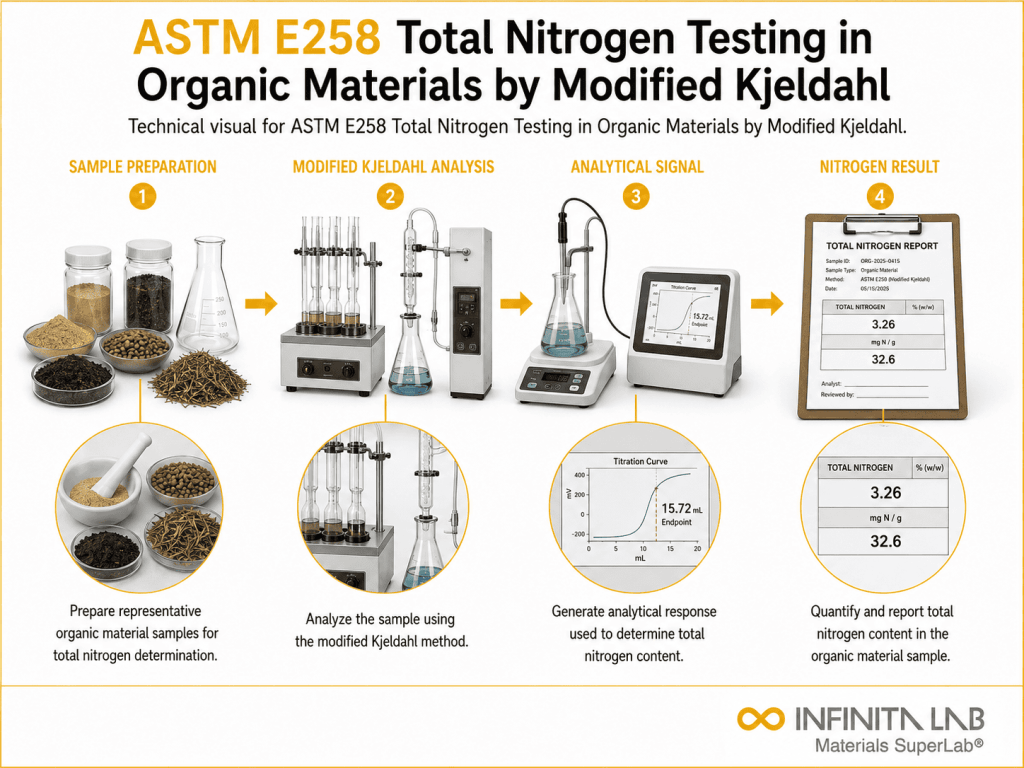
ASTM E258 describes the standard test method for determining total nitrogen in organic materials using the modified Kjeldahl method. The sample is digested with sulfuric acid and a catalyst to convert all organic nitrogen to ammonium sulfate, which is then distilled and titrated to quantify total nitrogen content.
Nitrogen determination is a fundamental analytical measurement for characterizing proteins, amino acids, fertilizers, pharmaceuticals, polymers containing nitrogen-based functional groups, and organic nitrogen compounds used in industrial synthesis.
Applications and Benefits of ASTM E258 Total Nitrogen Organic Materials Kjeldahl Testing
Scope
ASTM E258 evaluates:
- Total Kjeldahl nitrogen (TKN) in organic materials
- Applicable to solid and liquid organic samples
- Covers primary, secondary, and tertiary amines and amides
- Results expressed as wt% N or protein equivalent (N × 6.25)
Applications
- Protein content determination in food, feed, and agricultural materials
- Pharmaceutical active ingredient nitrogen content verification
- Fertilizer nitrogen grade certification
- Nitrogen-containing polymer and resin characterization
- Industrial organic nitrogen compound purity analysis
Benefits
- Well-established, highly reliable nitrogen determination method
- Applicable to virtually all organic nitrogen-containing matrices
- Provides traceable, internationally recognized results
- Supports protein calculation for nutritional labeling
- Complies with AOAC, USP, and ISO fertilizer analysis standards
Our ASTM E258 Testing Procedure
Acid Digestion
Digest sample with H₂SO₄, convert nitrogen to ammonium sulfate
1Alkalization & Distillation
Add NaOH, distill ammonia into boric acid or HCl
2Titration
Titrate ammonia with HCl or back-titrate using NaOH
3Nitrogen Calculation
Calculate nitrogen wt% from titration data and sample mass
4ASTM E258 Test Parameters and Requirements
| Parameter | Details |
|---|---|
| Applicable Materials | Organic compounds, food, feed, fertilizers, pharmaceuticals |
| Sample Mass | 0.1–2 g (concentration dependent) |
| Nitrogen Range | 0.05–50 wt% N |
| Catalyst | Se, Cu, or K₂SO₄/CuSO₄ mixture |


- Kjeldahl digestion block and fume scrubber
- Steam distillation unit (Kjeldahl distillation apparatus)
- Analytical balance (±0.1 mg)
- Potentiometric autotitrator
- Standardized HCl and NaOH titrants
- Certified nitrogen reference materials (EDTA, tryptophan)
Equipment and Instrumentation Used for ASTM E258 Testing
What You Receive: Test Report, Data, and Certification
- Total nitrogen content (wt% N)
- Protein equivalent (wt%, using appropriate conversion factor)
- Blank-corrected titration data
- Recovery verification with reference material
- Full ASTM E258 nitrogen analysis report
ASTM E258 Total Nitrogen Organic Materials Kjeldahl FAQs
ASTM E258-07 is a standard test method used to determine total nitrogen in organic materials using the modified Kjeldahl method for accurate chemical analysis.
ASTM E258-07 is important because nitrogen content affects composition, quality, and performance, making it essential for analysis in agriculture, chemicals, and environmental applications.
ASTM E258-07 involves digestion of the sample to convert nitrogen into ammonium, followed by distillation and titration to quantify total nitrogen.
ASTM E258-07 requires digestion units, distillation apparatus, titration setup, and analytical reagents for accurate nitrogen determination.
ASTM E258-07 results are reported as total nitrogen content, typically in percentage, indicating composition and suitability for intended applications.
Total Kjeldahl nitrogen (TKN) measures organic nitrogen and ammonia nitrogen in a sample. The sample is digested with sulfuric acid to convert suitable nitrogen compounds into ammonium, which is then released as ammonia under alkaline conditions. The ammonia is measured through titration or an appropriate detection method to calculate the nitrogen concentration. The method does not measure all forms of nitrogen, such as nitrate and nitrite.
A nitrogen test method determines the nitrogen content of a material using a technique appropriate to the sample type and required measurement. For the modified Kjeldahl method described in ASTM E258, an organic sample is digested with sulfuric acid and other reagents, converting suitable nitrogen compounds into ammonium sulfate. Ammonia is then distilled into a measured volume of standard acid, and titration is used to calculate the nitrogen content. ASTM E258 was withdrawn in 2019 and has no replacement listed by ASTM.
Total nitrogen analysis measures the nitrogen content of a sample using a suitable analytical technique. Depending on the material, methods may involve chemical digestion followed by titration, or high-temperature combustion followed by instrumental detection. For water samples, ASTM D8083 uses high-temperature catalytic combustion and chemiluminescence detection to determine total nitrogen. The selected method depends on the sample matrix and which nitrogen compounds must be measured.
Why Choose Infinita Lab for Total Nitrogen Organic Materials Kjeldahl Testing
When your Total Nitrogen Organic Materials Kjeldahl results have to hold up - for compliance, a customer audit, or an engineering decision - ASTM E258 accuracy and an unbiased third-party report matter more than price. Infinita Lab routes your ASTM E258 total nitrogen organic materials kjeldahl testing to ISO/IEC 17025-accredited U.S. partner labs with hands-on method experience, so you get defensible data, transparent reporting, and turnaround times built around your project deadline - not ours.

Looking for an Accredited Partner for ASTM E258 Total Nitrogen Organic Materials Kjeldahl Testing?
Send query us at hello@infinitalab.com or call us at (888) 878-3090 to learn more about our services and how we can support you.



