


ASTM E2180: Antimicrobial Treated Surface Efficacy Testing Services
Determining the Activity of Incorporated Antimicrobial Agent(s) In Polymeric or Hydrophobic Materials ASTM E2180. This test is useful in determining the antimicrobial activity of hydrophobic antimicrobial-treated materials.
TRUSTED BY


Get ASTM E2180 compliant results — request your antimicrobial treated surface efficacy testing quote
- Overview
- Scope, Applications, and Benefits
- Test Process
- Specifications
- Instrumentation
- Results and Deliverables
What Is ASTM E2180 Antimicrobial Treated Surface Efficacy?
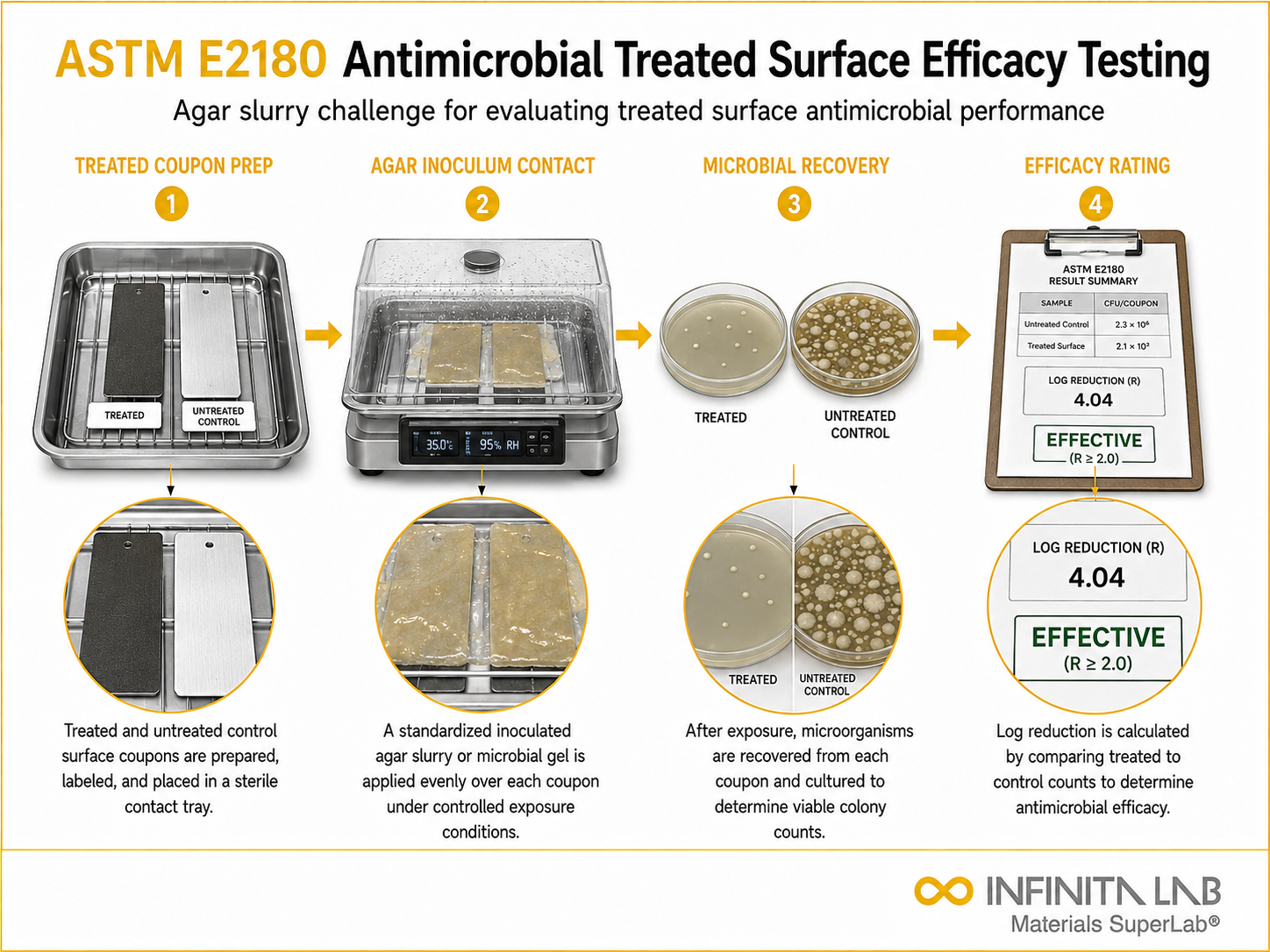
The ASTM E2180 is a standardized way of quantitatively evaluating the effectiveness of antimicrobial agents placed in flat hydrophobic materials, such as polymers. It is designed to ensure that microorganisms are indeed in contact with the treated hydrophobic surface.
Because it may be difficult to evenly distribute the microorganisms on the hydrophobic surface, the protocol accounts for this by mixing the microbial inoculum with an agar slurry. The agar slurry ensures that the microorganisms are in close contact with the antimicrobial-treated surface so that a precise assessment of the antimicrobial agent’s effectiveness can be made.

Applications and Benefits of ASTM E2180 Antimicrobial Treated Surface Efficacy Testing
Scope
ASTM E2180 applies to polymeric materials, hydrophobic surfaces, and flat solid materials that contain incorporated antimicrobial agents. The standard evaluates antimicrobial activity against bacteria such as Pseudomonas aeruginosa, Klebsiella pneumoniae, and Staphylococcus aureus, as well as yeast and fungal conidia. The method measures the reduction in viable microorganisms on the test surface after a defined contact period, providing an assessment of the material’s antimicrobial effectiveness.
Applications
- Evaluation of antimicrobial-treated plastics
- Medical device materials
- Healthcare surfaces
- Packaging material’s
- Consumer products
- Building materials
- Automotive interior components
- Research and development of antimicrobial formulations
- Quality control of treated polymer products
Benefits
- Provides quantitative measurement of antimicrobial efficacy
- Ensures proper microorganism-to-surface contact
- Suitable for hydrophobic and polymeric materials
- Applicable to bacteria, yeast, and fungi
- Standardized and reproducible methodology
- Supports regulatory and product performance validation
- Enables comparison between treated and untreated materials
Our ASTM E2180 Testing Procedure
Preparation & Inoculation
Microorganisms are mixed into a molten agar slurry, which is evenly spread onto treated and control samples.
1Primary Incubation
Samples are incubated for 24 hours (up to 96 hours for resistant organisms).
2Microbial Recovery & Plating
Surviving organisms are recovered into neutralizing broth, serially diluted, and plated on agar media.
3Incubation & Analysis
Plates are incubated, colonies counted, and log/percent reduction calculated.
4ASTM E2180 Test Parameters and Requirements
| Parameter | Details |
|---|---|
| Applicable Materials | Flat hydrophobic and polymeric materials |
| Typical Microorganisms | P. aeruginosa, K. pneumoniae, S. aureus, yeast, fungi |
| Primary Incubation Time | 24 hours (up to 96 hours if required) |
| Secondary Incubation Time | 48 hours |
| Replicates | Minimum triplicate control samples |
| Output Expression | Log reduction and Percent reduction (%) |


- Incubator (controlled temperature)
- Biological safety cabinet
- Autoclave
- Colony counter
- Analytical balance
- Micropipettes and dilution apparatus
- Neutralizing broth
- Agar media and petri plates
- Data analysis software
Equipment and Instrumentation Used for ASTM E2180 Testing
What You Receive: Test Report, Data, and Certification
- Log reduction value
- Percent reduction (%) of microorganisms
- Comparative analysis between treated and control samples
- Microbial count reports
- Quality control documentation
Why Choose Infinita Lab for Antimicrobial Treated Surface Efficacy Testing
ASTM E2180 determines the quantitative antimicrobial effectiveness of agents incorporated into or bound to polymeric and hydrophobic surfaces. Results are based on the reduction in surviving microorganisms on treated surfaces compared with untreated controls after exposure.
The method is applicable to mainly flat, two-dimensional polymeric and hydrophobic materials, including plastics, epoxy resins, and other hard surfaces treated with antimicrobial agents.
ASTM E2180 primarily evaluates antibacterial activity, but the method can also be used with other microorganisms such as yeast and fungal conidia, when appropriate for the testing objective.
Treated and untreated control specimens are inoculated using an agar-slurry matrix that promotes uniform contact with the surface. After the specified exposure period, surviving microorganisms are recovered, counted, and compared to calculate the percent reduction attributable to the antimicrobial treatment.
Yes. ASTM E2180 allows antimicrobial-treated surfaces to be evaluated over time, including comparisons of washed and non-washed specimens, to assess persistent antimicrobial activity and long-term durability of the treatment.
Why Choose Infinita Lab for Antimicrobial Treated Surface Efficacy Testing
At the core of this breadth is our network of 2,000+ accredited laboratories across the USA, offering access to over 10,000 testing methods and analytical services. From advanced materials characterization (SEM, TEM, RBS, XPS) to mechanical, chemical, environmental, biological, and standardized ASTM/ISO-compliant testing, we deliver unmatched flexibility, specialization, and scale. You are never limited by geography, facility, or methodology — Infinita Lab connects you to the right expertise and testing solution, every time.

Need ASTM E2180 Antimicrobial Treated Surface Efficacy Testing You Can Rely On?
Send query us at hello@infinitalab.com or call us at (888) 878-3090 to learn more about our services and how we can support you.



Request a Quote
Submit your material details and receive testing procedures, pricing, and turnaround time within 24 hours.
 Quick Turnaround and Hasslefree process
 Confidentiality Guarantee
 Free, No-obligation Consultation
 100% Customer Satisfaction
