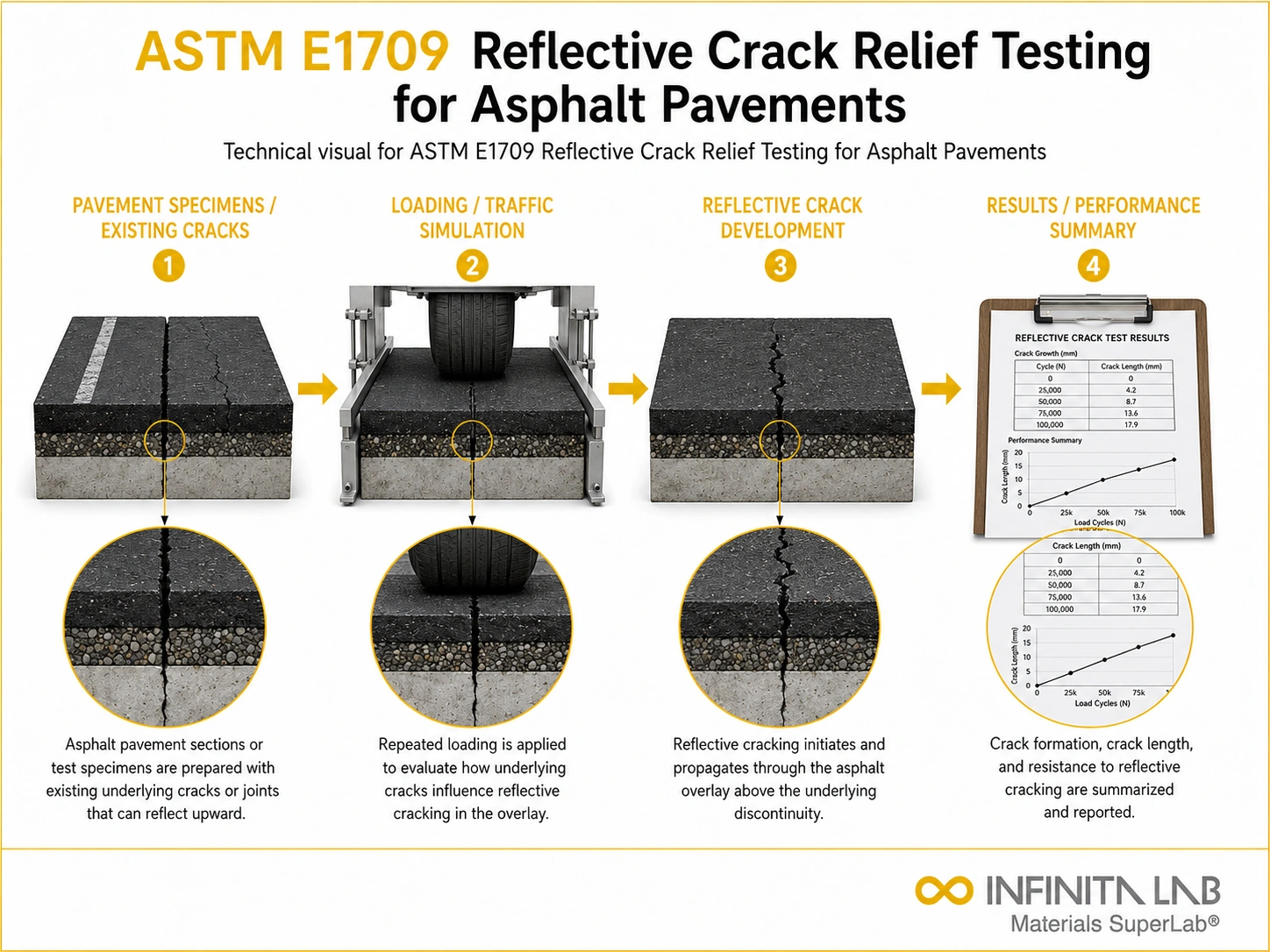


What Is ASTM E1709 Reflective Crack Relief?
ASTM E1709-09 provides a test method for measuring the retroreflective performance of traffic signs and similar materials. Retroreflection is the property by which light is reflected back toward its source, improving visibility under low-light conditions such as nighttime driving.
This standard is widely used in transportation and road safety applications to ensure that signs provide adequate visibility and meet regulatory requirements.

Applications and Benefits of ASTM E1709 Reflective Crack Relief Testing
Scope
ASTM E1709-09 focuses on measuring the coefficient of retroreflection of sign materials under specified geometry and lighting conditions. It ensures accurate evaluation of visibility performance.
The test evaluates:
- Retroreflective coefficient (RA)
- Brightness and visibility
- Performance under different angles
- Compliance with road safety standards
- Material durability
Applications
- Traffic signs and road signage
- Highway and street safety systems
- Reflective sheeting materials
- Road safety equipment
- Quality control and field inspection
Benefits
- Improves road safety and visibility
- Ensures compliance with standards
- Supports material selection
- Enables performance comparison
- Enhances nighttime driving safety
Our ASTM E1709 Testing Procedure
Sample Preparation
Sign surface is cleaned and positioned.
1Instrument Setup
Retroreflectometer is aligned at specified angles.
2Measurement
Light is directed and reflected back to detector.
3Data Recording & Evaluation
Retroreflection values are recorded and analyzed.
4ASTM E1709 Test Parameters and Requirements
| Parameter | Details |
|---|---|
| Applicable Materials | Retroreflective signs and sheeting |
| Geometry | Typically 0.2° observation angle, -4° entrance angle |
| Light Source | Standardized illumination |
| Measurement Unit | cd/lx/m² |
| Measured Outputs | Coefficient of retroreflection (RA) |


- Retroreflectometer
- Standard light source
- Calibration panels
- Positioning fixtures
- Data acquisition system
Equipment and Instrumentation Used for ASTM E1709 Testing
What You Receive: Test Report, Data, and Certification
- Retroreflectivity values (RA)
- Visibility performance assessment
- Compliance evaluation
- Test condition summary
- ASTM compliance report
ASTM E1709 Reflective Crack Relief FAQs?
ASTM E1709-09 is a standard test method used to measure retroreflectivity of traffic signs, evaluating their ability to reflect light back toward drivers for visibility at night.
ASTM E1709-09 is important because proper retroreflectivity ensures signs are visible in low-light conditions, helping drivers recognize information quickly and improving overall road safety.
ASTM E1709-09 measures light reflected from sign surfaces at specific observation and entrance angles, simulating vehicle headlight conditions to determine retroreflective efficiency.
ASTM E1709-09 requires a retroreflectometer, controlled geometry setup, and calibrated light source to measure reflected light intensity under standardized conditions.
Results are reported as coefficient of retroreflection, typically in candelas per lux per square meter, indicating sign visibility and compliance with traffic safety standards.
Why Choose Infinita Lab for Reflective Crack Relief Testing?
When your Reflective Crack Relief results have to hold up - for compliance, a customer audit, or an engineering decision - ASTM E1709 accuracy and an unbiased third-party report matter more than price. Infinita Lab routes your ASTM E1709 reflective crack relief testing to ISO/IEC 17025-accredited U.S. partner labs with hands-on method experience, so you get defensible data, transparent reporting, and turnaround times built around your project deadline - not ours.

Need ASTM E1709 Reflective Crack Relief Testing You Can Rely On?
Send query us at hello@infinitalab.com or call us at (888) 878-3090 to learn more about our services and how we can support you.