


ASTM E1409: Titanium Oxygen Nitrogen Testing Services
Accredited ASTM E1409 titanium oxygen nitrogen testing from Infinita Lab, performed to the exact standard requirements - accurate, reproducible results with full documentation for compliance, R&D, and quality control programs.
TRUSTED BY


Get ASTM E1409 compliant results - request your titanium oxygen nitrogen testing quote
- Overview
- Scope, Applications, and Benefits
- Test Process
- Specifications
- Instrumentation
- Results and Deliverables
What Is ASTM E1409 Titanium Oxygen Nitrogen?
ASTM E1409 is the standard test method for determining the concentrations of oxygen and nitrogen in titanium and titanium alloys using the inert gas fusion technique. Because titanium is highly reactive with interstitial gases, even small variations in oxygen and nitrogen content can significantly affect its mechanical behaviour, making precise quantification essential for materials qualification, alloy certification, and quality control throughout the titanium supply chain.
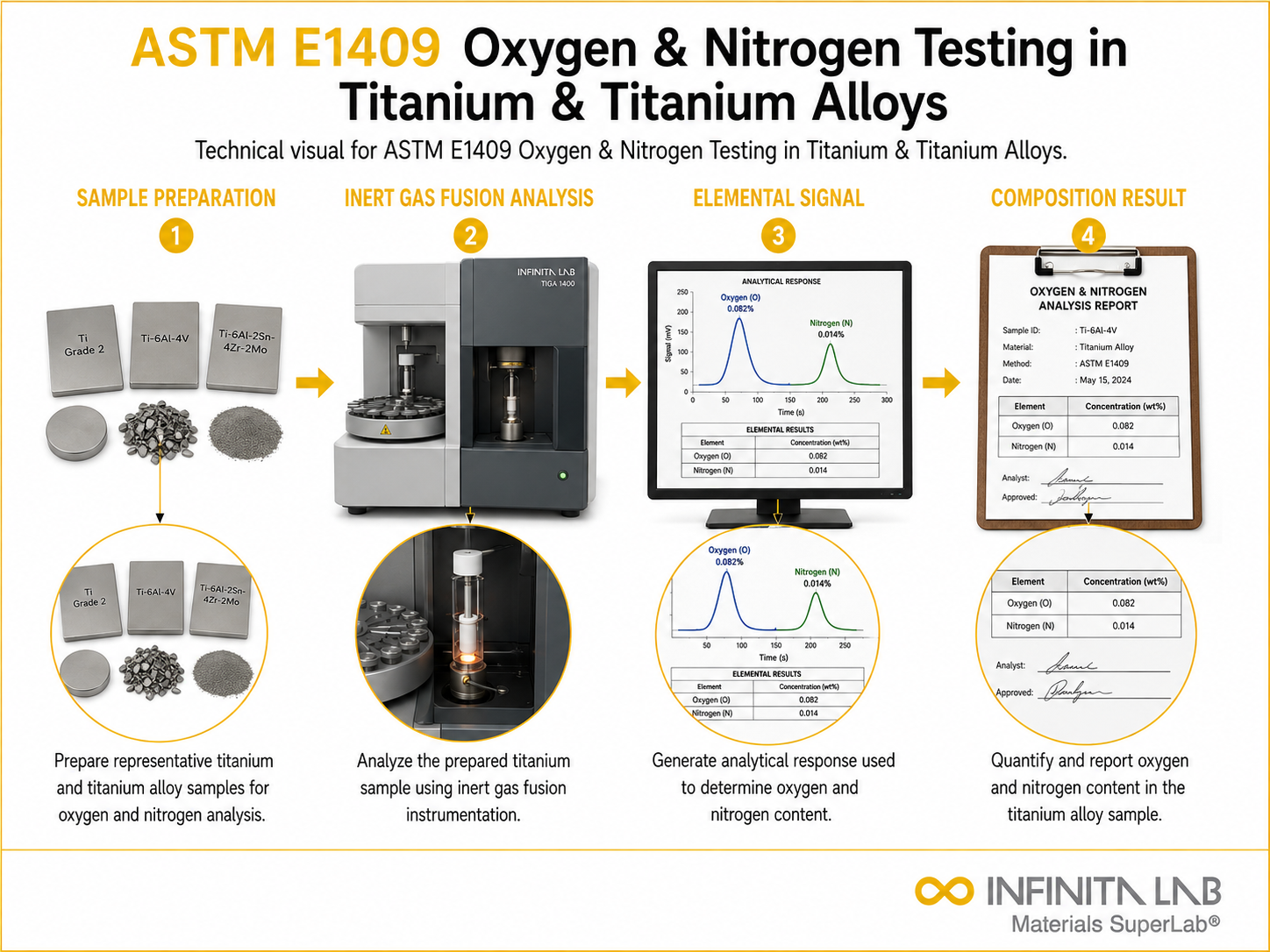
In practice, a solid metal specimen is fused at high temperature inside a graphite crucible under a flowing inert carrier gas, typically helium. The intense heat releases the oxygen and nitrogen trapped within the metal’s lattice. Oxygen reacts with carbon from the crucible to form carbon monoxide, which is oxidised to carbon dioxide and measured with an infrared detector, while nitrogen is liberated as molecular nitrogen gas and quantified using a thermal conductivity detector. The result is a fast, accurate, and reproducible measurement of both elements from a single fusion event.
Oxygen and nitrogen behave as interstitial, alpha-stabilising elements in titanium, occupying spaces within the crystal lattice and raising strength and hardness while reducing ductility and fracture toughness. Excessive levels can promote embrittlement, reduce fatigue resistance, and compromise long-term structural reliability in demanding service environments. Because of these effects, oxygen and nitrogen limits are written directly into titanium mill specifications and alloy grade definitions, distinguishing standard commercially pure and Ti-6Al-4V material from extra-low-interstitial variants used where higher toughness is required.
ASTM E1409 testing is therefore central to quality assurance in industries where titanium’s strength-to-weight ratio, corrosion resistance, and biocompatibility are relied upon, including aerospace, medical implants, and other high-performance engineering applications, supporting material certification, incoming inspection, and regulatory compliance.

Applications and Benefits of ASTM E1409 Titanium Oxygen Nitrogen Testing
Scope
- ASTM E1409 defines the standard test method for determining oxygen and nitrogen content in titanium and titanium alloys using the inert gas fusion technique.
- The method applies to solid titanium and titanium alloy samples in forms such as chips, turnings, sponge, or solid metal pieces.
- It quantifies oxygen by measuring carbon monoxide and carbon dioxide formation with an infrared detector after fusion in a graphite crucible.
- It quantifies nitrogen by measuring the thermal conductivity of the nitrogen gas released during fusion.
- The standard covers commercially pure titanium grades as well as alloyed titanium products such as Ti-6Al-4V.
- It applies to raw materials, mill products, and finished or semi-finished titanium components requiring chemical verification.
- The method is designed to provide rapid, single-run determination of both oxygen and nitrogen from one fused sample.
- It is commonly referenced alongside related inert gas fusion standards, such as ASTM E1447 for hydrogen determination in titanium and titanium alloys.
- The scope includes calibration using certified reference materials to help ensure measurement accuracy and traceability.
- It is used to verify compliance with titanium mill specifications and alloy grade chemistry requirements.
Applications
- Verifying incoming raw material chemistry for titanium mill products such as bar, plate, sheet, and forgings.
- Certifying titanium alloys used in aerospace structural components, engine parts, and fasteners.
- Qualifying titanium used in medical implants and surgical devices where biocompatibility and toughness are critical.
- Supporting research and development of new titanium alloys and processing methods.
- Confirming compliance with customer or regulatory specifications before shipment of finished titanium products.
- Investigating production or field issues where oxygen or nitrogen embrittlement is suspected as a contributing factor.
- Supporting quality audits and periodic requalification of titanium melt lots and heat treatments.
Benefits
- Provides accurate, standardised data that supports material certification and regulatory compliance.
- Delivers rapid results compared to traditional wet chemical methods, supporting faster production and release decisions.
- Uses a single fusion event to determine both oxygen and nitrogen, reducing sample preparation time and cost.
- Helps manufacturers identify embrittlement risks before components enter service, reducing the risk of costly failures.
- Supports the traceability and documentation required for aerospace and medical industry quality systems.
- Enables consistent, reproducible measurement across different suppliers, heats, and production batches.
Our ASTM E1409 Testing Procedure
Sample Preparation
A specimen weighing 0.100 g to 0.150 g is prepared according to specification requirements.
1Fusion and Gas Release
The sample is fused with flux in a graphite crucible under inert gas flow, releasing oxygen and nitrogen from the material.
2Oxygen and Nitrogen Detection
Oxygen forms CO/CO₂ for infrared detection, while nitrogen is measured using a thermal conductivity detector.
3Data Calculation
The instrument automatically calculates oxygen and nitrogen content with blank and mass corrections.
4ASTM E1409 Test Parameters and Requirements
| Parameter | Details |
|---|---|
| Applicable Materials | Titanium and Titanium Alloys |
| Specimen Weight | 0.100 g – 0.150 g |
| Detection Method (Oxygen) | Infrared or Thermal Conductivity Detector |
| Detection Method (Nitrogen) | Thermal Conductivity Detector |
| Reaction Medium | Graphite crucible under inert gas stream |
| Output Units | Percent (%) or mass fraction |


- Inert Gas Fusion Analyser – performs high-temperature fusion of the sample and houses the infrared and thermal conductivity detection systems.
- Graphite Crucible – contains the molten sample during fusion and supplies the carbon that reacts with released oxygen to form carbon monoxide.
- Induction or Resistance Furnace – supplies the intense, controlled heat required to fuse the titanium sample and release its trapped gases.
- Infrared Detector – measures the carbon monoxide/carbon dioxide generated from the sample’s oxygen content.
- Thermal Conductivity Detector (TCD) – measures the nitrogen gas released from the sample during fusion.
- Analytical Balance – accurately weighs the sample before analysis to enable precise concentration calculations.
- Certified Reference Materials – used to calibrate the analyser and verify measurement accuracy and traceability.
Equipment and Instrumentation Used for ASTM E1409 Testing
What You Receive: Test Report, Data, and Certification
- A certified test report presenting oxygen and nitrogen concentrations, typically expressed in weight per cent or parts per million.
- Comparison of measured results against applicable specification or customer-defined acceptance limits.
- Documentation suitable for material certification, regulatory submissions, and quality system records.
- Traceable calibration and reference material data supporting the validity of reported results.
- Digital or hard-copy reports formatted to support supply chain, procurement, and audit requirements.
- Technical support and result interpretation from laboratory specialists when questions arise about compliance or material suitability.
ASTM E1409 Titanium Oxygen Nitrogen FAQs
ASTM E1409 is test method used to determine oxygen and nitrogen content in titanium and titanium alloys using inert gas fusion techniques to ensure compliance with strict material specifications.
Oxygen and nitrogen significantly affect strength, hardness, ductility, and toughness. Excessive levels can embrittle titanium and reducing its performance.
According to ASTM E1409, the ranges for the calibrated analytical measurement are Oxygen: 0.04% to 0.50%, and Nitrogen: 0.005% to 0.11%. For materials beyond these ranges, the mass of the sample and the calibration curves can be altered in order to preserve the integrity of the analysis.
For standard validation, a quantity of 1 to 5 grams of material is usually required. Solid pins or small pieces are preferred over powders or turnings, as powders with high surface area-to-volume ratios can cause atmospheric contamination and high oxygen readings.
Accuracy depends on sample preparation, instrument calibration, furnace temperature control, carrier gas purity, and proper maintenance of analytical equipment.
ASTM E1409 Prüfung means ASTM E1409 testing or examination. It determines the oxygen and nitrogen content in titanium and titanium alloys using inert gas fusion. The active edition listed by ASTM is ASTM E1409-13(2021).
ASTM E1409 is the Standard Test Method for Determination of Oxygen and Nitrogen in Titanium and Titanium Alloys by Inert Gas Fusion. The method covers oxygen concentrations of 0.01%–0.5% and nitrogen concentrations of 0.003%–0.11%. It does not determine hydrogen; hydrogen in titanium alloys is covered by ASTM E1447.
Why Choose Infinita Lab for Titanium Oxygen Nitrogen Testing
When your Titanium Oxygen Nitrogen results have to hold up - for compliance, a customer audit, or an engineering decision - ASTM E1409 accuracy and an unbiased third-party report matter more than price. Infinita Lab routes your ASTM E1409 titanium oxygen nitrogen testing to ISO/IEC 17025-accredited U.S. partner labs with hands-on method experience, so you get defensible data, transparent reporting, and turnaround times built around your project deadline - not ours.

Need ASTM E1409 Titanium Oxygen Nitrogen Testing You Can Rely On?
Send query us at hello@infinitalab.com or call us at (888) 878-3090 to learn more about our services and how we can support you.



Request a Quote
Submit your material details and receive testing procedures, pricing, and turnaround time within 24 hours.
 Quick Turnaround and Hasslefree process
 Confidentiality Guarantee
 Free, No-obligation Consultation
 100% Customer Satisfaction
