


ASTM E132: Method For Poissons Ratio At Room Temperature Testing Services
Accredited ASTM E132 method for poissons ratio at room temperature testing from Infinita Lab, performed to the exact standard requirements - accurate, reproducible results with full documentation for compliance, R&D, and quality control programs.
TRUSTED BY


Get ASTM E132 compliant results - request your method for poissons ratio at room temperature testing quote
- Overview
- Scope, Applications, and Benefits
- Test Process
- Specifications
- Instrumentation
- Results and Deliverables
What Is ASTM E132 Method For Poissons Ratio At Room Temperature?
ASTM E132, titled “Standard Test Method for Poisson’s Ratio at Room Temperature,” is the ASTM International procedure for determining the ratio between transverse (lateral) strain and axial (longitudinal) strain when a specimen is loaded in uniaxial tension. Subcommittee E28.04 on Uniaxial Testing maintains it under ASTM Committee E28 on Mechanical Testing. The current edition is E132-17, reapproved in 2025 with an editorial change and designated E132-17(2025)e1. It’s active – not withdrawn, not superseded.
The method covers rectangular cross-section specimens made from homogeneous, isotropic materials that behave elastically under the applied load, with creep strain negligible compared with the strain produced at the instant of loading. Specimen width and thickness are measured precisely beforehand to establish cross-sectional area. Calibrate the testing machine per ASTM E4 to ensure load accuracy throughout the test. During the test, a specimen sits in a calibrated universal testing machine, instrumented with a deflectometer for transverse strain and, optionally, an extensometer for axial strain. Both instruments must meet Class B-1 or better under ASTM E83. Load is applied at a controlled, slow rate, keeping adiabatic heating or cooling effects negligible. Ductile specimens get loaded to yield strength; brittle ones go to fracture.
Poisson’s ratio is then worked out from the slope of the transverse-strain-versus-axial-strain relationship, within the specimen’s linear elastic region. It’s a fundamental elastic constant, so the data generated under E132 feeds directly into stress analysis, finite element modeling, and material specification work, anywhere precise structural behavior predictions matter.

Applications and Benefits of ASTM E132 Method For Poissons Ratio At Room Temperature Testing
Scope
ASTM E132 applies to structural metallic materials, structural polymeric materials, and other rigid materials tested in tension using rectangular cross-section specimens. The standard measures longitudinal and transverse strains during tension testing at room temperature to obtain an accurate value of Poisson’s ratio.
It applies to:
- A standardized tensile test procedure for determining Poisson’s ratio at room temperature.
- Applies to rectangular cross-section specimens loaded in uniaxial tension.
- Meant for homogeneous, isotropic materials that behave elastically under the applied load.
- Materials where creep strain is negligible next to the immediate strain from loading: that’s the limit here.
- Requires simultaneous measurement of axial (longitudinal) strain and transverse (lateral) strain on the same specimen.
- Derives Poisson’s ratio from the ratio of transverse strain to axial strain, within the elastic region of the stress-strain curve.
- The loading rate has to stay slow enough that adiabatic heating or cooling effects remain negligible.
- Ductile materials get tested to yield strength; brittle materials, to fracture.
- References ASTM Practices E4 for testing-machine calibration and ASTM E83 for extensometer and deflectometer classification.
- Results are reported primarily in inch-pound units, with SI equivalents given for reference.
Applications
- Aerospace structural alloy qualification (aluminum, titanium, steel components included).
- Automotive and transportation component material characterization.
- Defense and military materials qualification programs.
- Generating elastic constants that feed finite element analysis (FEA) and structural simulations.
- Structural design and engineering analysis, wherever accurate elastic property data matters.
- Incoming material verification and quality control for metals, polymers, and composites.
- Academic and research-oriented material characterization work.
Benefits
- A standardized, repeatable procedure recognized across industries and specification bodies.
- Produces a fundamental elastic constant essential to accurate stress and strain modelling.
- Makes finite element analysis and structural simulations more reliable.
- Aids material certification and verification against engineering specifications.
- Relies on widely available tensile testing equipment, so specialized tooling isn’t needed.
- Standardized instrument classification requirements improve comparability between labs.
Our ASTM E132 Testing Procedure
Specimen Preparation and Setup
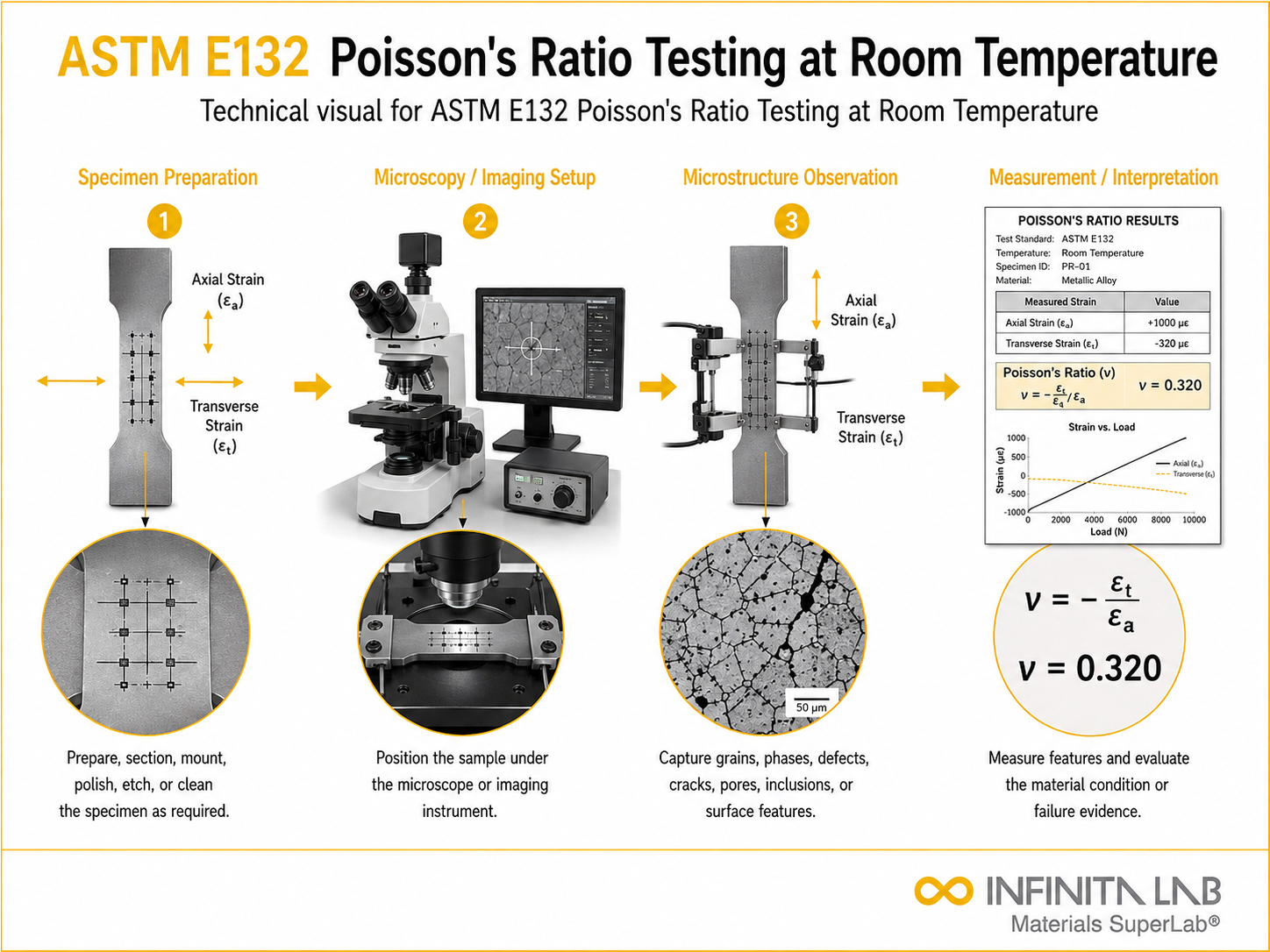
Measure width and thickness to determine cross-sectional area, mount the specimen in tensile grips, and attach extensometers to the gauge section.
1Controlled Loading
Apply tensile load at a low, controlled speed to prevent thermal effects.
2Strain Measurement and Data Recording
Record longitudinal and transverse strains simultaneously and obtain multiple strain data pairs.
3Analysis and Test Completion
Plot strain versus load data; continue testing to yield (ductile) or until failure (brittle).
4ASTM E132 Test Parameters and Requirements
| Parameter | Details |
|---|---|
| Test Temperature | Room temperature |
| Specimen Type | Rectangular cross-section |
| Width Parallelism Tolerance | Within 0.001 in. (0.025 mm) |
| Thickness Parallelism Tolerance | Within 0.0001 in. (0.0025 mm) |
| Width Measurement Accuracy | Within 0.0001 in. (0.0025 mm) |
| Thickness Measurement Accuracy | Within 0.001 in. (0.025 mm) |
| Measured Parameters | Longitudinal strain (εl), Transverse strain (εt) |


- Universal Testing Machine (UTM) – applies a controlled uniaxial tensile load.
- Deflectometer – measures transverse (lateral) strain across the specimen’s width.
- Extensometer – captures axial (longitudinal) strain along the gauge length.
- Precision Micrometre / Calliper – for measuring specimen width and thickness so that cross-sectional area can be calculated.
- Data Acquisition System – records paired load, axial strain, and transverse strain data in real time.
- Calibration Reference Standards – used to verify testing machine and extensometer system accuracy per ASTM E4 and ASTM E83.
Equipment and Instrumentation Used for ASTM E132 Testing
What You Receive: Test Report, Data, and Certification
- The calculated Poisson’s ratio value for the tested material and specimen configuration.
- A plotted axial strain versus transverse strain curve, showing the elastic relationship.
- Raw load, axial strain, and transverse strain data sets.
- A detailed test report, referencing the ASTM E132 methodology and specimen details.
- Documentation suitable for material certification and engineering design records.
- A statistical summary across multiple specimen replicates, if requested.
ASTM E132 Method For Poissons Ratio At Room Temperature FAQs
The procedure for calculating Poisson’s Ratio (ν), or the ratio of transverse to axial strain, is defined by ASTM E132. Poisson’s Ratio is a critical value used in the calculation of the shear modulus and in structural analysis. It is used to predict the deformation of materials when subjected to multi-axial loading.
The values of transverse strain are very small and require high sensitivity for measurement. ASTM E132 testing employs biaxial extensometers or bonded strain gauges to measure the strain values simultaneously. This reduces the chances of errors due to bending or misalignment of the specimens.
ASTM E132 is mainly applicable to structural metals like aluminum, steel, and titanium alloys. It is also applicable to rigid polymers and quasi-isotropic composites. The materials should have stable elastic properties.
The specimen should be rectangular or dogbone-shaped. A high width-to-thickness ratio ensures that the stresses are evenly distributed. The gauge length should be long enough to ensure that the strain measurement is stabilized. This geometry helps to reduce the scatter in the results of Poisson’s Ratio.
Measurement accuracy depends on precise strain sensing, proper specimen alignment, stable loading within the elastic range, and minimizing bending effects. Small errors in transverse strain measurement can significantly affect calculated Poisson’s Ratio values.
Why Choose Infinita Lab for Method For Poissons Ratio At Room Temperature Testing
When your Method For Poissons Ratio At Room Temperature results have to hold up - for compliance, a customer audit, or an engineering decision - ASTM E132 accuracy and an unbiased third-party report matter more than price. Infinita Lab routes your ASTM E132 method for poissons ratio at room temperature testing to ISO/IEC 17025-accredited U.S. partner labs with hands-on method experience, so you get defensible data, transparent reporting, and turnaround times built around your project deadline - not ours.

Need ASTM E132 Method For Poissons Ratio At Room Temperature Testing You Can Rely On?
Send query us at hello@infinitalab.com or call us at (888) 878-3090 to learn more about our services and how we can support you.



Request a Quote
Submit your material details and receive testing procedures, pricing, and turnaround time within 24 hours.
 Quick Turnaround and Hasslefree process
 Confidentiality Guarantee
 Free, No-obligation Consultation
 100% Customer Satisfaction
