


ASTM E1260 Spray Droplet Size Testing by Light Scattering
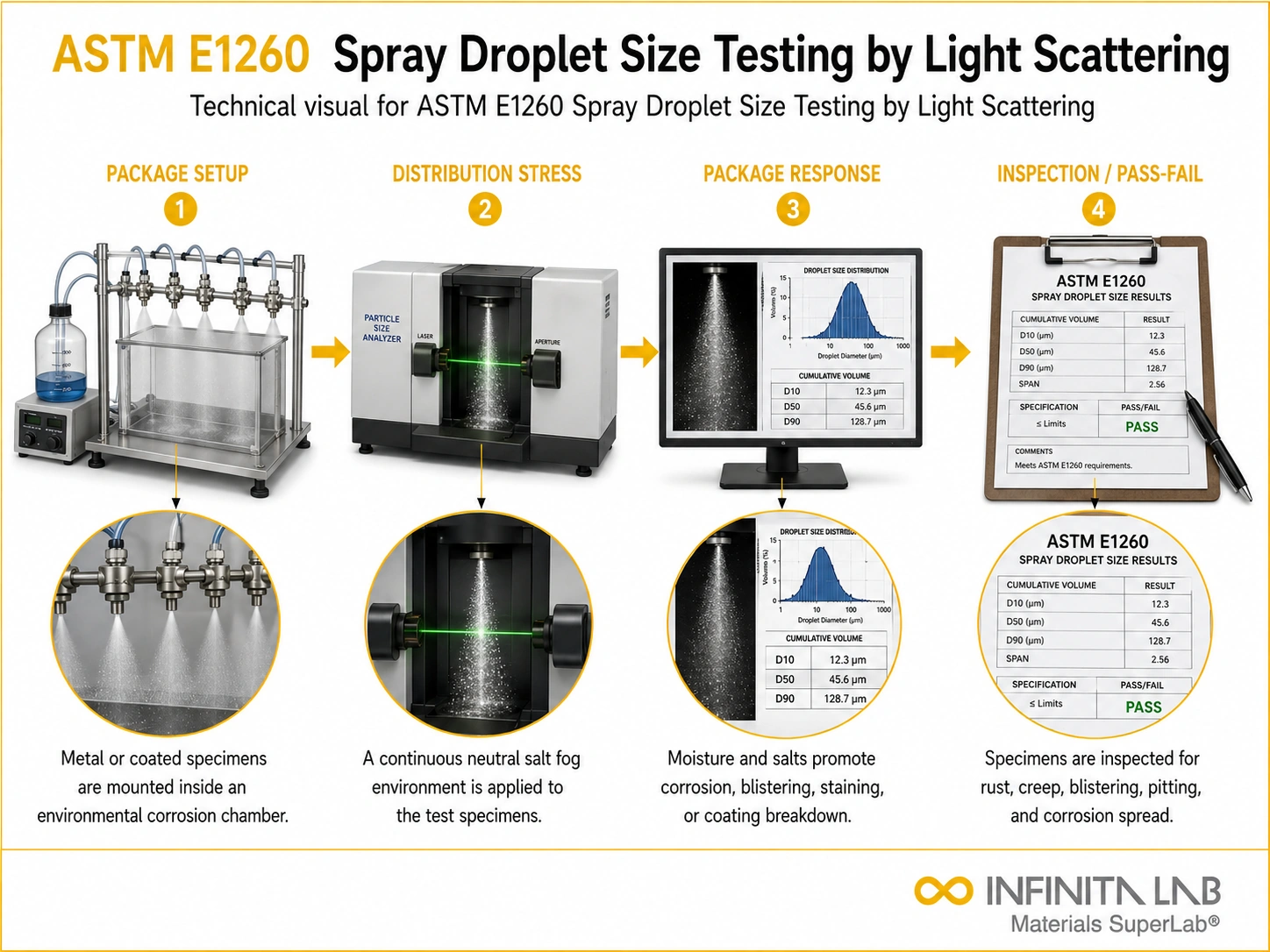
ASTM E1260 aims to gather data that characterizes the size of droplets produced by nozzles by using specific liquids under specific conditions. This test method is applicable to those devices which work by passing a beam of light through the spray nozzle. The light is then scattered by droplets to derive their sizes.
TRUSTED BY


Precision-driven testing for dimensional accuracy and compliance
- Overview
- Scope, Applications, and Benefits
- Test Process
- Specifications
- Instrumentation
- Results and Deliverables
Overview
ASTM E1260 defines a standardized method for measuring liquid droplet size distributions in sprays using optical nonimaging light-scattering instruments. The technique evaluates how droplets scatter light as they pass through a measurement zone, enabling determination of characteristic diameters and distribution profiles.
The method is widely used to quantify spray performance by analyzing droplet size parameters such as volume median diameter and distribution width. It ensures consistent measurement practices, minimizes operator-dependent variability, and supports accurate characterization of atomization processes under controlled experimental conditions.

Scope, Applications, and Benefits
Scope
ASTM E1260 covers procedures for determining droplet size characteristics in sprays using light-scattering instruments that do not form images but rely on scattering intensity patterns. It ensures accurate measurement of droplet distributions across a defined size range.
Key Scope Elements:
- Measurement of droplet size distribution using optical scattering
- Applicable to liquid sprays with stable flow characteristics
- Covers nonimaging light-scattering instruments
- Includes calibration and alignment requirements
- Addresses environmental and optical correction factors
Applications
- Spray nozzle performance evaluation
- Atomization studies in fluid systems
- Agricultural spraying analysis
- Coating and surface treatment processes
- Fuel injection and combustion research
- Quality control in spray-based manufacturing
Benefits
- Provides rapid and non-intrusive droplet size measurement
- Enables real-time monitoring of spray characteristics
- Reduces measurement variability and operator influence
- Supports optimization of spray systems and processes
- Ensures reproducibility across different test setups
- Enhances understanding of atomization efficiency
Test Process
Instrument Setup
Align the optical light-scattering instrument and configure measurement parameters for the spray system.
1System Calibration
Calibrate the instrument using reference particles or standards to ensure accurate size measurement.
2Spray Measurement
Pass the spray through the measurement zone and record scattering data for droplet size analysis.
3Data Analysis
Process scattering signals to calculate droplet size distribution and characteristic diameters.
4Technical Specifications
| Parameter | Details |
|---|---|
| Measurement Range | Typically 0.5 µm to 2000 µm depending on instrument |
| Principle | Light scattering intensity vs. droplet size correlation |
| Output Parameters | D10, D32 (Sauter Mean Diameter), D50, D90 |
| Accuracy | ±2–5% depending on calibration quality |
| Laser Source | Monochromatic coherent light |
| Detector Array | Multi-element photodetectors for scattering pattern capture |


- Optical nonimaging light-scattering analyzer
- Laser source (He-Ne or diode laser)
- Detector array system
- Spray generation system (nozzle setup)
- Calibration standards (monodisperse particles)
- Data acquisition and processing software
- Environmental monitoring sensors
Instrumentation Used for Testing
Results and Deliverables
- Droplet size distribution curve
- Characteristic diameters (D10, D50, D90, D32)
- Spray uniformity and dispersion analysis
- Calibration and validation records
- Measurement uncertainty report
- Test data and graphical outputs
Frequently Asked Question
ASTM E1260 uses light-scattering principles where droplets passing through a laser beam scatter light at angles dependent on their size. The scattering pattern is analyzed to calculate droplet size distribution using theoretical models like Mie scattering.
Droplet size distribution influences spray efficiency, coverage, evaporation, and penetration. Accurate measurement helps optimize performance in applications like coating, combustion, and agricultural spraying, ensuring effective and controlled fluid dispersion.
These values represent percentile-based droplet diameters. D50 is the median size, D10 indicates finer droplets, and D90 represents larger droplets, collectively describing the spread and uniformity of the spray distribution.
Mie theory provides a mathematical model to relate light-scattering intensity patterns to particle size. It enables accurate interpretation of detector signals, especially for droplets comparable in size to the wavelength of light.
Factors include misalignment of optical components, variations in refractive index, multiple scattering effects, environmental fluctuations, and improper calibration, all of which can introduce measurement errors.
Why Choose Infinita Lab for Advanced Materials Testing and Characterization?
At the core of this breadth is our network of 2,000+ accredited laboratories across the USA, offering access to over 10,000 testing methods and analytical services. From advanced materials characterization (SEM, TEM, RBS, XPS) to mechanical, chemical, environmental, biological, and standardized ASTM/ISO-compliant testing, we deliver unmatched flexibility, specialization, and scale. You are never limited by geography, facility, or methodology — Infinita Lab connects you to the right expertise and testing solution, every time.

Looking for a Trusted Partner for Accurate and Reliable Testing Services?
Send query us at hello@infinitalab.com or call us at (888) 878-3090 to learn more about our services and how we can support you.



Request a Quote
Submit your material details and receive testing procedures, pricing, and turnaround time within 24 hours.
 Quick Turnaround and Hasslefree process
 Confidentiality Guarantee
 Free, No-obligation Consultation
 100% Customer Satisfaction
