


ASTM D774: Paper Bursting Strength Testing Services
Accredited ASTM D774 paper bursting strength testing from Infinita Lab, performed to the exact standard requirements - accurate, reproducible results with full documentation for compliance, R&D, and quality control programs.
TRUSTED BY


Get ASTM D774 compliant results - request your paper bursting strength testing quote
- Overview
- Scope, Applications, and Benefits
- Test Process
- Specifications
- Instrumentation
- Results and Deliverables
What Is ASTM D774 Paper Bursting Strength?
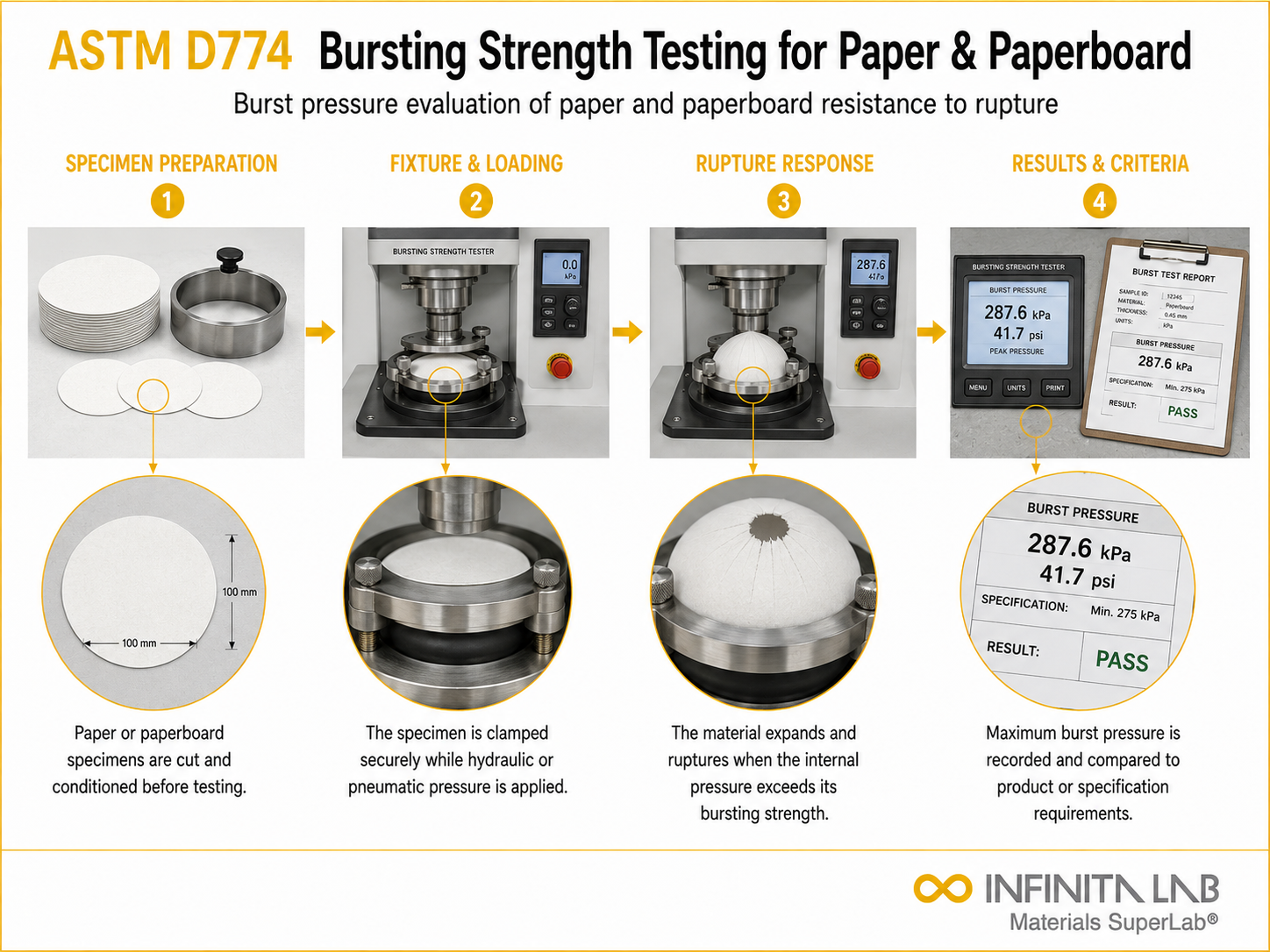
ASTM D774/D774M, the Standard Test Method for Bursting Strength of Paper, describes how to measure the hydrostatic pressure a sheet of paper or paperboard can withstand before it ruptures. Laboratories run the test on a Mullen-type burst tester, an instrument that clamps a flat specimen over a circular opening and then expands a rubber diaphragm against it using hydraulic pressure. As the diaphragm swells, the specimen stretches until it fails, and the pressure recorded at that instant is reported as the bursting strength, typically expressed in kilopascals (kPa) or pounds per square inch (psi). Because raw burst strength is influenced heavily by how much a sheet weighs, results are often normalised into a burst index, bursting strength divided by grammage, which lets engineers compare papers of very different basis weights on a level footing.
Originally published by ASTM, D774/D774M was formally withdrawn in 2010 with no direct one-to-one replacement, yet the Mullen burst principle it codified remains the working method across the packaging industry and is mirrored today in closely related procedures such as TAPPI T403 and ISO 2758. Infinita Lab connects manufacturers, converters, and packaging engineers with accredited partner labs that still run Mullen burst testing on calibrated equipment, giving clients a defensible, apples-to-apples strength figure for kraft paper, multiwall sack stock, linerboard, and other flat sheet materials.
Burst testing under this method matters most where paper has to survive handling stress rather than a clean cut or a controlled tear; think of a sack dropped on a loading dock or a roll of kraft stock racing through high-speed converting equipment. Whether you’re qualifying a new supplier, chasing a quality complaint, or writing a purchase specification for incoming material, this test gives you a single, repeatable number that procurement, quality, and engineering teams can all build decisions around.

Applications and Benefits of ASTM D774 Paper Bursting Strength Testing
Scope
ASTM D774 evaluates:
- This method applies to single-ply paper and paperboard sheets, generally up to about 0.6 mm in thickness.
- It measures the hydraulic pressure needed to rupture a specimen clamped over a fixed circular aperture.
- Results are reported as bursting strength, expressed in kPa or psi depending on the client’s specification.
- The standard covers a working range of roughly 30 to 1,400 kPa, though the practical ceiling depends on the tester in use.
- Burst index, calculated as bursting strength divided by grammage, is derived from the same raw data to normalise for basis weight.
- Specimens are conditioned at standard laboratory atmosphere, typically 23°C and 50% relative humidity, before testing.
- The method is not intended for corrugated boxboard, combined linerboard, or hardboard, since the expanding diaphragm can cut rather than burst those heavier structures.
- Both machine-direction and cross-direction behaviour can be captured by sampling and orienting specimens accordingly, since paper strength is rarely uniform in every direction.
- Multiple specimens per sample are tested and averaged to account for natural variability across a sheet or roll.
- Though the original ASTM designation was withdrawn in 2010, the underlying test principle continues in active use and lines up closely with TAPPI T403 and ISO 2758.
Applications
- Packaging paper producers use burst testing to confirm that kraft paper and sack paper meet strength targets before it ships to converters.
- Multiwall sack and bag manufacturers rely on the test to verify that base paper can survive filling, stacking, and transport without failing at the seams.
- Linerboard and corrugating medium suppliers test the flat paper components that later become combined board, even though the finished board itself falls outside this method’s scope.
- Converters use burst data as an incoming-material check to catch supplier variation before it turns into downstream production problems.
- Packaging engineers reference burst strength when writing purchase specifications for shipping containers and flexible packaging substrates.
- Quality teams use the test to investigate field complaints, such as bags or sacks that ruptured during handling or distribution.
- Mills and converters alike use trended burst index data to monitor process consistency across production runs and paper machine changes.
Benefits
- Provides an objective, instrument-based number instead of a subjective judgment of “strong enough” paper.
- Normalises results across different basis weights through burst index, making cross-grade comparisons meaningful.
- Correlates reasonably well with real-world handling stresses, unlike some laboratory tests that measure a single, narrow failure mode.
- Supports supplier qualification and ongoing incoming-inspection programs with a repeatable, well-understood procedure.
- Helps manufacturers set defensible purchase specifications that both buyer and supplier can test against independently.
- Gives quality and engineering teams a shared, quantitative basis for resolving disputes over material performance.
Our ASTM D774 Testing Procedure
Specimen Conditioning
Paper specimens are conditioned at 23 °C and 50% RH for a minimum of 4 hours before testing per ASTM D685.
1Specimen Clamping
A circular specimen is clamped between the annular clamping rings of the Mullen burst tester, holding it flat without wrinkling.
2Hydraulic Pressure Application
Hydraulic pressure is increased at a defined rate by expanding the rubber diaphragm beneath the specimen until it ruptures; the peak pressure is recorded.
3Burst Index Calculation
The bursting strength (kPa or psi) is recorded; burst index is calculated by dividing bursting strength by the paper's grammage (g/m²).
4ASTM D774 Test Parameters and Requirements
| Parameter | Details |
|---|---|
| Test Principle | Hydraulic diaphragm pressure to rupture |
| Applicable Materials | Paper, paperboard, multi-wall sack, linerboard |
| Pressure Range | 70–1400 kPa (instrument dependent) |
| Clamping Area | 30.5 cm² (standard) |
| Rate of Pressurization | Rupture in 15–30 seconds |


- Mullen-type Burst Tester – The core instrument that applies hydraulic pressure through a rubber diaphragm to rupture the clamped specimen.
- Rubber Diaphragm Assembly – The expanding membrane that transmits hydraulic pressure directly onto the specimen surface.
- Clamping Rings – Hold the specimen flat and taut over the circular aperture so pressure is applied evenly.
- Hydraulic Pressure System – Generates and controls the steady pressure increase that drives the diaphragm during the test.
- Digital Pressure Readout – Captures and displays the peak burst pressure at the moment of specimen rupture.
- Conditioning Chamber – Maintains specimens at standard temperature and humidity before testing to stabilise moisture content.
- Precision Cutting Die or Template – Used to prepare specimens of consistent size and shape ahead of clamping.
Equipment and Instrumentation Used for ASTM D774 Testing
What You Receive: Test Report, Data, and Certification
- A formal test report documenting bursting strength values for each tested specimen, along with the calculated average.
- Burst index figures, when requested, showing bursting strength normalised against the sample’s basis weight.
- Individual specimen data alongside summary statistics, so outliers or unusual variability are easy to spot.
- Pass/fail compliance statements when results are checked against a client-specified minimum or purchase specification.
- Machine-direction and cross-direction comparisons where directional sampling was part of the test plan.
- Supporting documentation, including sample identification, conditioning records, and instrument calibration references, for traceability.
ASTM D774 Paper Bursting Strength FAQs
Burst index normalizes bursting strength by paper grammage (basis weight), allowing meaningful comparison of papers of different weights. A heavier paper will naturally have higher bursting strength; burst index reveals whether the inherent fiber network quality is equivalent.
Higher moisture content generally reduces bursting strength by plasticizing fiber bonds and reducing inter-fiber bonding strength. Standardized conditioning at 23 °C/50% RH before testing is therefore mandatory for reproducible results.
ASTM D774, ISO 2758, and TAPPI T403 are based on the same Mullen hydraulic diaphragm principle. Minor differences exist in conditioning requirements and reporting units. Results are broadly comparable but not always numerically identical due to procedural differences.
Requirements vary by application. Typical kraft paper for bags and multi-wall sacks requires burst strengths of 400–700 kPa or higher. Corrugated linerboard may require 200–400 kPa depending on grade and end-use specification.
ASTM D774 recommends testing a minimum of 10 specimens to obtain a statistically reliable mean and standard deviation. Both machine direction (MD) and cross direction (CD) sampling are recommended for anisotropic papers.
ASTM D774 is a withdrawn standard test method for determining the bursting strength of paper. It measures the pressure required to rupture a paper specimen, providing an indication of its resistance to bursting.
Why Choose Infinita Lab for Paper Bursting Strength Testing
When your Paper Bursting Strength results have to hold up - for compliance, a customer audit, or an engineering decision - ASTM D774 accuracy and an unbiased third-party report matter more than price. Infinita Lab routes your ASTM D774 paper bursting strength testing to ISO/IEC 17025-accredited U.S. partner labs with hands-on method experience, so you get defensible data, transparent reporting, and turnaround times built around your project deadline - not ours.

Need ASTM D774 Paper Bursting Strength Testing You Can Rely On?
Send query us at hello@infinitalab.com or call us at (888) 878-3090 to learn more about our services and how we can support you.



Request a Quote
Submit your material details and receive testing procedures, pricing, and turnaround time within 24 hours.
 Quick Turnaround and Hasslefree process
 Confidentiality Guarantee
 Free, No-obligation Consultation
 100% Customer Satisfaction
