

What Is ASTM D7400 Downhole Seismic?
ASTM D7400 describes a standard test method for performing downhole seismic testing to determine the interval velocities of compression (P) and shear (S) waves in subsurface soils and rock. Several acceptable devices can be used to generate high-quality P or SV source waves, as well as SH source waves, making this method highly versatile.
This test method is widely used in geotechnical engineering to derive critical elastic constants such as Poisson’s ratio, shear modulus, bulk modulus, and Young’s modulus. It supports foundation design, site characterization, and seismic hazard assessments across construction, civil engineering, and environmental sectors.
Applications and Benefits of ASTM D7400 Downhole Seismic Testing
Scope
ASTM D7400 covers the determination of:
- Interval velocities from P-wave and S-wave arrival times
- Geotechnical elastic constants (shear modulus, bulk modulus, Young’s modulus, Poisson’s ratio)
- SV (vertically polarized) and SH (horizontally polarized) shear wave velocities
- Subsurface soil and rock dynamic properties
Applications
- Geotechnical site characterization for construction projects
- Seismic hazard and liquefaction assessment
- Foundation design and soil stiffness evaluation
- Environmental site investigations
- Infrastructure projects including bridges, dams, and tunnels
Benefits
- Provides in-situ, non-destructive subsurface data
- Directly yields elastic constants for engineering design
- Supports multiple wave types (P, SV, SH) in one test
- Delivers repeatable, standardized results across sites
- Reduces reliance on laboratory-only soil testing
Our ASTM D7400 Testing Procedure
Borehole Preparation
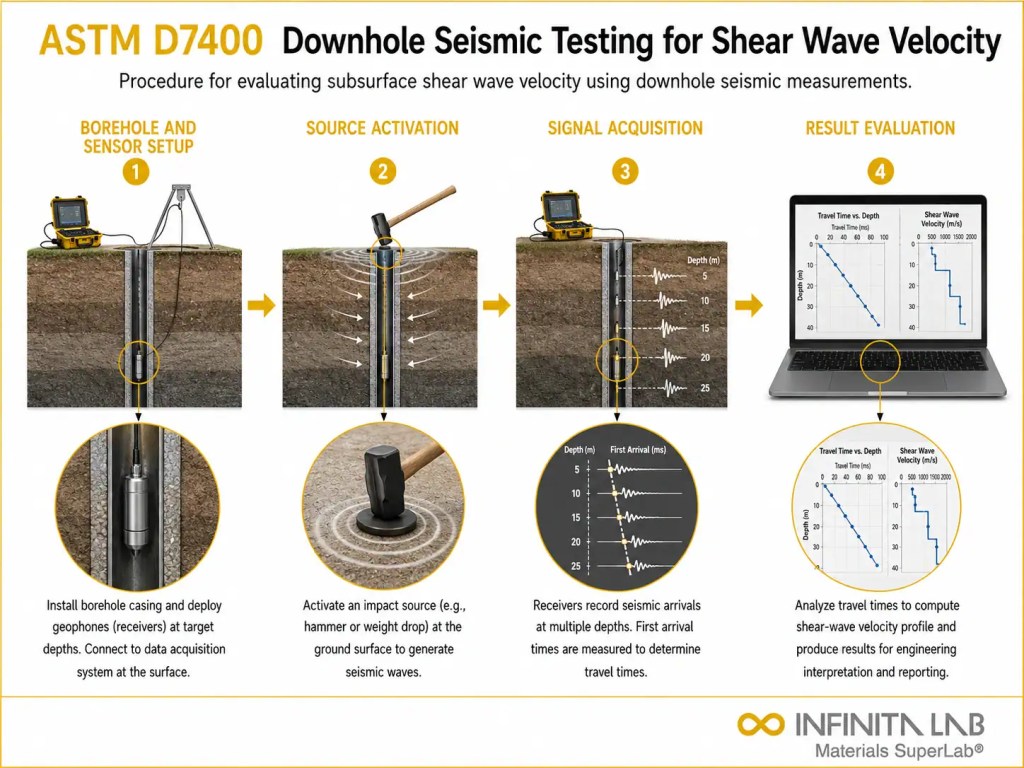
Drill a borehole to the required depth, case it with PVC or aluminum casing, and grout in place to ensure good acoustic coupling.
1Receiver Deployment
Push or lower seismic receivers to the desired test depth; align horizontal transducer axes with the shear beam direction.
2Downhole Testing
Activate the energy source, record P-wave and S-wave traces for all receivers, and repeat 3–5 times to improve signal-to-noise ratio.
3Data Analysis
Calculate interval velocities from arrival time differences; derive elastic constants using P and S wave velocity data.
4ASTM D7400 Test Parameters and Requirements
| Parameter | Details |
|---|---|
| Standard | ASTM D7400 |
| Test Principle | Measurement of seismic wave travel times in a borehole |
| Applicable Materials | Soils and rock formations |
| Borehole Diameter | Not exceeding 175 mm (7.0 in.) |
| Shear Beam Length | 2.4 m (8 ft.) |
| Shear Beam Width | 150 mm (6 in.) |
| Hammer Mass | 1 to 15 kg |
| Measured Outputs | P-wave velocity, S-wave velocity, elastic constants |
| Data Units | SI units and inch-pound units |


- Seismic energy source (hammer and shear beam)
- Downhole seismic receivers (uniaxial, biaxial, or triaxial)
- PVC or aluminum borehole casing
- Grout pump and grouting materials
- Seismic recording system with digital storage
- Potentiometers and timing verification equipment
Equipment and Instrumentation Used for ASTM D7400 Testing
What You Receive: Test Report, Data, and Certification
- P-wave and S-wave velocity profiles vs. depth
- Shear modulus, bulk modulus, and Young’s modulus profiles
- Poisson’s ratio values
- Interval velocity plots
- Site-specific elastic constant reports for engineering design
- Input data for seismic hazard and liquefaction analysis
ASTM D7400 Downhole Seismic FAQs
P-waves (compression waves) travel through soil by alternating compression and expansion. S-waves (shear waves) move material perpendicular to the wave direction. Both wave types are measured to calculate different geotechnical elastic constants.
ASTM D7400 does not set a strict depth limit; testing continues until the maximum borehole depth is reached. Practically, tests are conducted at intervals no greater than 1.5 m (5 ft.) apart.
Grouting ensures good acoustic coupling between the casing and the borehole wall, minimizing signal noise caused by gaps or loose material that could distort wave arrival times.
A dry borehole is preferred to avoid signal noise from waves traveling through the water column. Water-filled boreholes are permissible but may reduce data quality.
Receivers are repositioned at intervals of 0.5 to 1.5 m throughout the borehole depth, with all depths recorded. The number of test points depends on the total depth and required resolution of the velocity profile.
ASTM D7400/D7400M and ASTM D4428/D4428M are geotechnical test methods used to determine seismic wave velocities in subsurface soil and rock formations. ASTM D7400/D7400M evaluates compression (P) and shear (S) waves generated near the ground surface and detected by sensors installed inside a borehole. ASTM D4428/D4428M measures horizontally traveling P-waves and S-waves between two or more boreholes. Both methods provide information about subsurface stiffness and dynamic properties for foundation engineering, seismic site characterization, and earthquake-related geotechnical assessments.
A seismic downhole test evaluates the seismic wave velocities of subsurface materials using a surface seismic source and receivers installed at different depths inside a borehole. A controlled impact generates seismic waves that travel through the ground and are detected by the downhole sensors. The arrival times of compression (P) and shear (S) waves are recorded at successive depths. By comparing the travel times with the source-to-receiver distances, engineers calculate interval wave velocities and develop a subsurface velocity profile. The results help determine soil stiffness, shear modulus, and other geotechnical properties.
Why Choose Infinita Lab for Downhole Seismic Testing
When your Downhole Seismic results have to hold up - for compliance, a customer audit, or an engineering decision - ASTM D7400 accuracy and an unbiased third-party report matter more than price. Infinita Lab routes your ASTM D7400 downhole seismic testing to ISO/IEC 17025-accredited U.S. partner labs with hands-on method experience, so you get defensible data, transparent reporting, and turnaround times built around your project deadline - not ours.

Looking for an Accredited Partner for ASTM D7400 Downhole Seismic Testing?
Send query us at hello@infinitalab.com or call us at (888) 878-3090 to learn more about our services and how we can support you.



