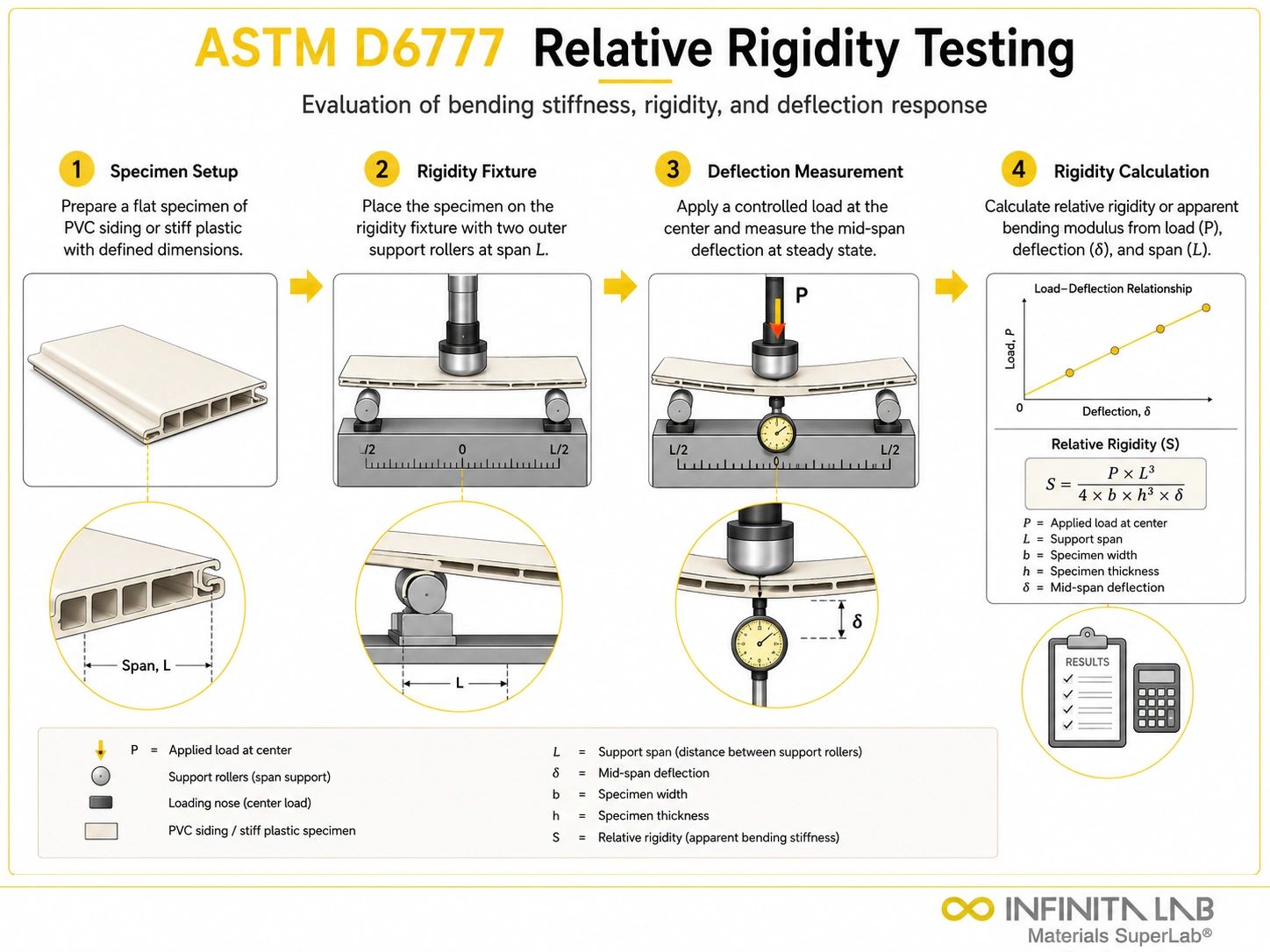


What Is ASTM D6777 PVC Siding Relative Rigidity?
ASTM D6777 provides a test method for determining the relative rigidity of poly(vinyl chloride) (PVC) siding. Rigidity is an important property that affects siding panels’ ability to resist deformation under load and maintain structural stability.
This standard is commonly used in the construction industry to ensure that PVC siding materials meet required stiffness and performance criteria for exterior building applications.

Applications and Benefits of ASTM D6777 PVC Siding Relative Rigidity Testing
Scope
ASTM D6777 focuses on evaluating the stiffness (rigidity) of PVC siding under applied loads. It helps compare different siding materials and ensures adequate structural performance.
The test evaluates:
- Relative rigidity of PVC siding
- Resistance to bending or deformation
- Load-deflection behavior
- Structural performance under service conditions
- Material consistency
Applications
- Exterior wall cladding
- Residential and commercial buildings
- Construction materials testing
- PVC siding manufacturing
Benefits
- Ensures adequate stiffness and durability
- Improves product performance
- Supports material comparison
- Enhances building safety
Our ASTM D6777 Testing Procedure
Sample Preparation
PVC siding specimens are cut to required dimensions.
1Fixture Setup
Specimen is mounted in a rigidity testing fixture.
2Load Application
Load is applied to measure deflection.
3Data Recording & Evaluation
Rigidity is calculated based on load and deflection.
4ASTM D6777 Test Parameters and Requirements
| Parameter | Details |
|---|---|
| Applicable Materials | Poly(vinyl chloride) siding |
| Span Length | Typically 300 mm to 400 mm |
| Load Type | Center or distributed load |
| Test Temperature | Approximately 23°C ± 2°C |
| Measured Outputs | Load-deflection, relative rigidity |


- Universal testing machine or rigidity tester
- Flexural fixture
- Deflection measurement device
- Dimensional measurement tools
- Environmental conditioning chamber
- Data acquisition system
Equipment and Instrumentation Used for ASTM D6777 Testing
What You Receive: Test Report, Data, and Certification
- Relative rigidity values
- Load-deflection curve
- Structural performance evaluation
- Material comparison results
- Test condition summary
- ASTM compliance report
ASTM D6777 PVC Siding Relative Rigidity FAQs
ASTM D6777 is a standard test method used to determine the relative rigidity of polyvinyl chloride (PVC) siding, evaluating its stiffness and resistance to bending under applied loads.
ASTM D6777 helps ensure PVC siding maintains structural integrity, resists deformation, and performs reliably under environmental loads such as wind pressure and handling during installation.
ASTM D6777 involves applying a specified load to a siding specimen and measuring its deflection, allowing comparison of rigidity between different PVC siding products.
ASTM D6777 requires a testing fixture, loading device, and measurement instruments to accurately record deflection and assess rigidity under controlled conditions.
Results are reported as relative rigidity values based on load and deflection data, indicating the stiffness and performance of PVC siding materials under bending forces.
Why Choose Infinita Lab for PVC Siding Relative Rigidity Testing?
When your PVC Siding Relative Rigidity results have to hold up - for compliance, a customer audit, or an engineering decision - ASTM D6777 accuracy and an unbiased third-party report matter more than price. Infinita Lab routes your ASTM D6777 PVC siding relative rigidity testing to ISO/IEC 17025-accredited U.S. partner labs with hands-on method experience, so you get defensible data, transparent reporting, and turnaround times built around your project deadline - not ours.

Looking for an Accredited Partner for ASTM D6777 PVC Siding Relative Rigidity Testing?
Send query us at hello@infinitalab.com or call us at (888) 878-3090 to learn more about our services and how we can support you.





