


ASTM D6761: Catalyst Total Pore Volume Testing Services
Accredited ASTM D6761 catalyst total pore volume testing from Infinita Lab, performed to the exact standard requirements - accurate, reproducible results with full documentation for compliance, R&D, and quality control programs.
TRUSTED BY


Get ASTM D6761 compliant results - request your catalyst total pore volume testing quote
- Overview
- Scope, Applications, and Benefits
- Test Process
- Specifications
- Instrumentation
- Results and Deliverables
What Is ASTM D6761 Catalyst Total Pore Volume?
ASTM D6761, the Standard Test Method for Determination of the Total Pore Volume of Catalysts and Catalyst Carriers, is the governing procedure for quantifying how much open pore space sits inside a catalyst particle or carrier material, measured through mercury intrusion porosimetry. ASTM Committee D32 on Catalysts maintains it under subcommittee D32.02. The method covers pore diameters from roughly 14 micrometers down to about 0.4 nanometers (4 angstroms) – a window wide enough to capture nearly every pore size that matters for catalytic activity and adsorption behavior. Mercury won’t spontaneously enter a pore. It’s a non-wetting liquid on most solid catalyst surfaces, so you have to force it in under pressure, and the pressure needed to enter a given pore is directly tied to that pore’s diameter. That pressure-diameter relationship is what the Washburn equation captures, relating applied pressure to pore diameter through mercury’s surface tension and its contact angle against the sample. In practice, a dried, weighed sample goes into a penetrometer, gets evacuated to remove residual air and moisture, then sits surrounded by mercury that’s pressurized in increments. First, a low-pressure pneumatic stage fills the larger pores, then a high-pressure hydraulic stage pushes into progressively smaller ones. The intruded volume is tracked electronically at each step, and the cumulative volume at the method’s terminal pressure becomes the sample’s total pore volume. D6761 isn’t built to generate a full pore-size distribution curve – that’s a different kind of method entirely. Its job is a single total pore volume value, which makes it faster and more targeted for catalyst developers and manufacturers who need a dependable number for quality control, specification compliance, or troubleshooting, not a detailed distribution profile.

Applications and Benefits of ASTM D6761 Catalyst Total Pore Volume Testing
Scope
ASTM D6761 measures the total pore volume of catalyst materials using liquid absorption or similar techniques. It ensures accurate characterization of porous structures.
The test evaluates:
- Specifies a mercury intrusion porosimetry procedure for determining total pore volume in catalysts and catalyst carriers.
- Applies to porous solids with pore diameters from about 14 micrometers down to roughly 0.4 nanometers (4 angstroms).
- Falls under ASTM Committee D32 on Catalysts, specifically subcommittee D32.02.
- Covers sample prep – drying and evacuation steps that remove moisture and trapped gases before mercury intrusion starts.
- Relies on the Washburn equation to convert applied mercury pressure into an equivalent pore diameter at each step.
- A mercury porosimeter is required, one capable of both low-pressure pneumatic intrusion and high-pressure hydraulic intrusion.
- Addresses safe handling for mercury, since it’s classified as a hazardous material with documented health risks.
- Defines how cumulative intruded mercury volume gets calculated and expressed as total pore volume per unit sample mass.
- Distinct from pore-size distribution testing, which related standards like ASTM D4284 handle instead.
- Extends across catalyst forms – pellets, extrudates, spheres, and granular carrier materials.
Applications
- Quality control checks on catalyst and carrier batches, run during production.
- Specification verification for petrochemical and refining catalysts – hydrotreating, cracking, reforming, and the like.
- R&D support for new catalyst formulations and support materials.
- Pore structure consistency checks on alumina, silica, and zeolite-based carriers.
- Troubleshooting performance issues tied to diffusion limitations or pore blockage.
- Supplier qualification and incoming material inspection for catalyst manufacturers.
- Comparing production batches head-to-head or benchmarking against competing suppliers.
Benefits
- Delivers one reliable total pore volume figure – fast- for quality decisions that can’t wait.
- Quicker and more targeted than full pore-size distribution testing, when all you need is the total.
- Generates data that speaks to both catalytic activity and adsorption performance.
- Supports lot-to-lot consistency and makes supplier transitions smoother.
- An ASTM methodology recognized and accepted across petrochemical and catalyst industries.
- Helps tie pore structure back to mechanical strength and diffusion characteristics.
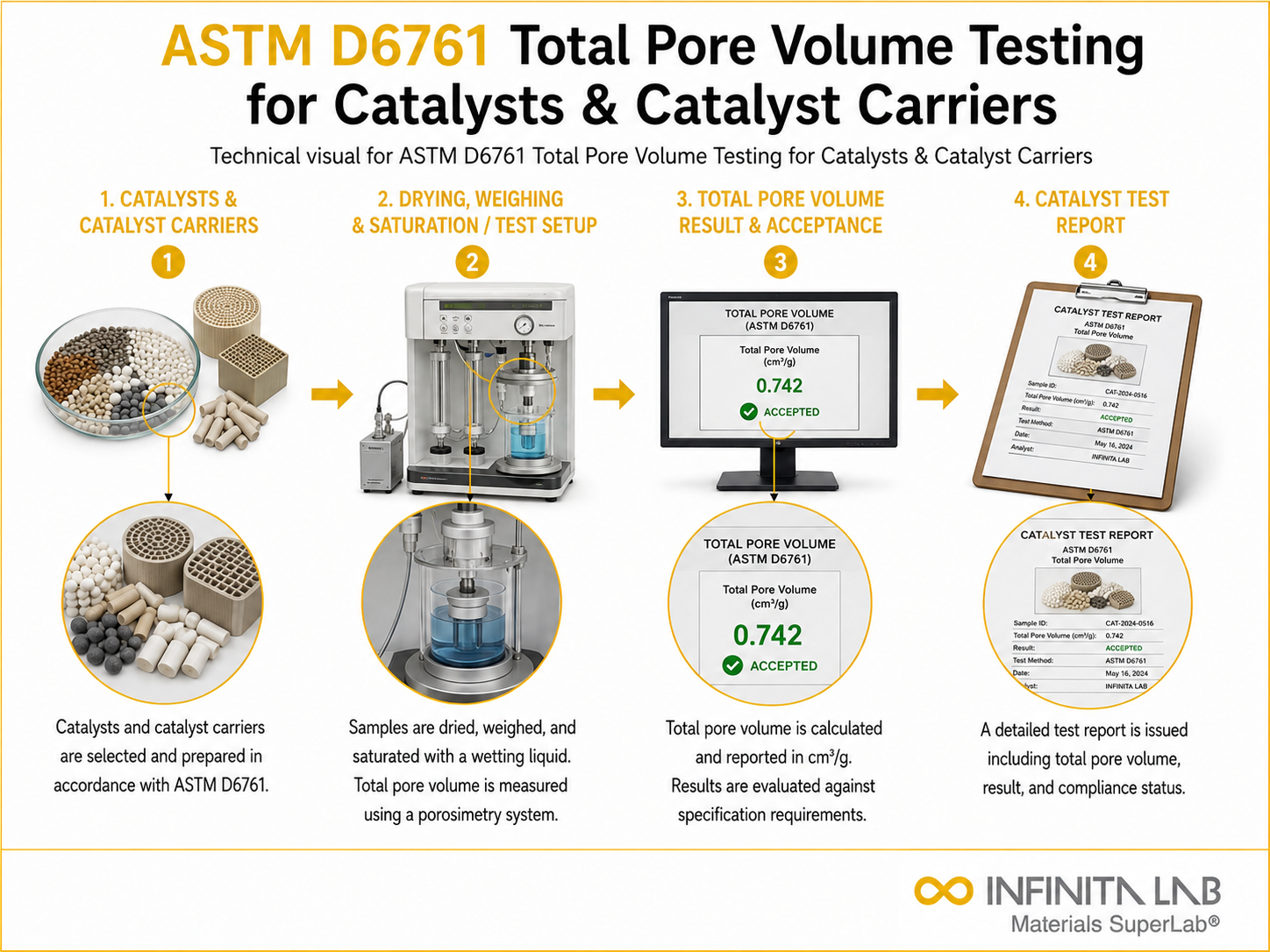
Our ASTM D6761 Testing Procedure
Sample Preparation
Catalyst sample is dried and prepared.
1Liquid Saturation
Sample is saturated with a suitable liquid.
2Volume Determination
Amount of liquid absorbed is measured.
3Data Recording & Evaluation
Total pore volume is calculated and analyzed.
4ASTM D6761 Test Parameters and Requirements
| Parameter | Details |
|---|---|
| Applicable Materials | Catalysts and catalyst carriers |
| Test Method | Liquid absorption method |
| Drying Temperature | Typically 100°C to 200°C |
| Saturating Liquid | Water or organic liquid (e.g., n-hexane) |
| Measurement Unit | cm³/g |
| Measured Outputs | Total pore volume |


- Mercury Porosimeter – the core instrument. It pressurizes mercury and measures intrusion volume across the full test range.
- Penetrometer (Sample Cell) – houses the sample and works as an electronic, capacitance-based burette, tracking mercury volume changes as pressure rises.
- Low-Pressure Pneumatic Port – fills the penetrometer with mercury, intruding the larger pores at relatively modest pressures.
- High-Pressure Hydraulic Chamber – pushes mercury into progressively smaller pores once pressure climbs well past the pneumatic stage.
- Vacuum/Degassing System – clears air and moisture from sample and penetrometer before mercury filling starts.
- Analytical Balance – delivers the accurate sample mass that pore volume calculations depend on.
- Drying Oven – strips residual moisture from samples ahead of testing.
Equipment and Instrumentation Used for ASTM D6761 Testing
What You Receive: Test Report, Data, and Certification
- A total pore volume value, typically expressed in mL/g or cm³/g.
- A formal test report, referencing ASTM D6761 methodology and the conditions used.
- Intrusion pressure data paired with the corresponding calculated pore diameter.
- Sample identification details – mass, form, and whatever preparation steps were applied.
- Notes on anomalies, deviations, or anything unusual observed during the run.
- Raw intrusion curve data, available on request if you need it for internal analysis.
ASTM D6761 Catalyst Total Pore Volume FAQs
ASTM D6761 is a standard test method used to determine the total pore volume of catalysts and catalyst carriers, evaluating their porosity and suitability for catalytic reactions and industrial processing applications.
ASTM D6761 helps assess catalyst efficiency, as pore volume influences surface area and reactant accessibility, directly affecting reaction rates, performance, and overall effectiveness in chemical processes.
ASTM D6761 typically involves measuring the volume of liquid or gas absorbed by the material, which fills the pores, allowing calculation of total pore volume under controlled conditions.
ASTM D6761 requires porosimetry instruments, vacuum systems, sample holders, and precise measurement tools to accurately determine pore volume of catalyst materials.
Results are reported as total pore volume per unit mass or volume, providing insight into porosity characteristics and helping evaluate catalyst performance in industrial applications.
Why Choose Infinita Lab for Catalyst Total Pore Volume Testing
When your Catalyst Total Pore Volume results have to hold up - for compliance, a customer audit, or an engineering decision - ASTM D6761 accuracy and an unbiased third-party report matter more than price. Infinita Lab routes your ASTM D6761 catalyst total pore volume testing to ISO/IEC 17025-accredited U.S. partner labs with hands-on method experience, so you get defensible data, transparent reporting, and turnaround times built around your project deadline - not ours.

Need ASTM D6761 Catalyst Total Pore Volume Testing You Can Rely On?
Send query us at hello@infinitalab.com or call us at (888) 878-3090 to learn more about our services and how we can support you.



Request a Quote
Submit your material details and receive testing procedures, pricing, and turnaround time within 24 hours.
 Quick Turnaround and Hasslefree process
 Confidentiality Guarantee
 Free, No-obligation Consultation
 100% Customer Satisfaction
