


ASTM D6744 Thermal Conductivity Testing for Anode Carbon Materials
ASTM D6744 test method determines the properties of carbon materials by measuring their thermal conductivity and thermal resistance at a specific temperature range. It is a steady-state method that ensures reduced thermal resistance of carbon materials. The final results of this method are expressed in SI Units.
TRUSTED BY


Precision-driven testing for dimensional accuracy and compliance
- Overview
- Scope, Applications, and Benefits
- Test Process
- Specifications
- Instrumentation
- Results and Deliverables
Overview
ASTM D6744 provides a test method for determining the thermal conductivity of anode carbon materials. These materials are commonly used in electrochemical applications such as aluminum production, where efficient heat transfer is critical for performance.
The standard helps evaluate how effectively anode carbons conduct heat, which influences energy efficiency, temperature distribution, and overall process stability.

Scope, Applications, and Benefits
Scope
ASTM D6744 focuses on measuring the thermal conductivity of anode carbon materials under controlled conditions. It ensures accurate assessment of heat transfer properties.
The test evaluates:
- Thermal conductivity of anode carbon
- Heat transfer efficiency
- Temperature distribution characteristics
- Material quality and consistency
- Suitability for industrial applications
Applications
- Aluminum smelting industry
- Electrochemical processes
- Carbon anode manufacturing
- High-temperature industrial systems
- Material research and development
Benefits
- Improves energy efficiency
- Supports process optimization
- Ensures consistent material performance
- Enables comparison of carbon materials
- Enhances quality control
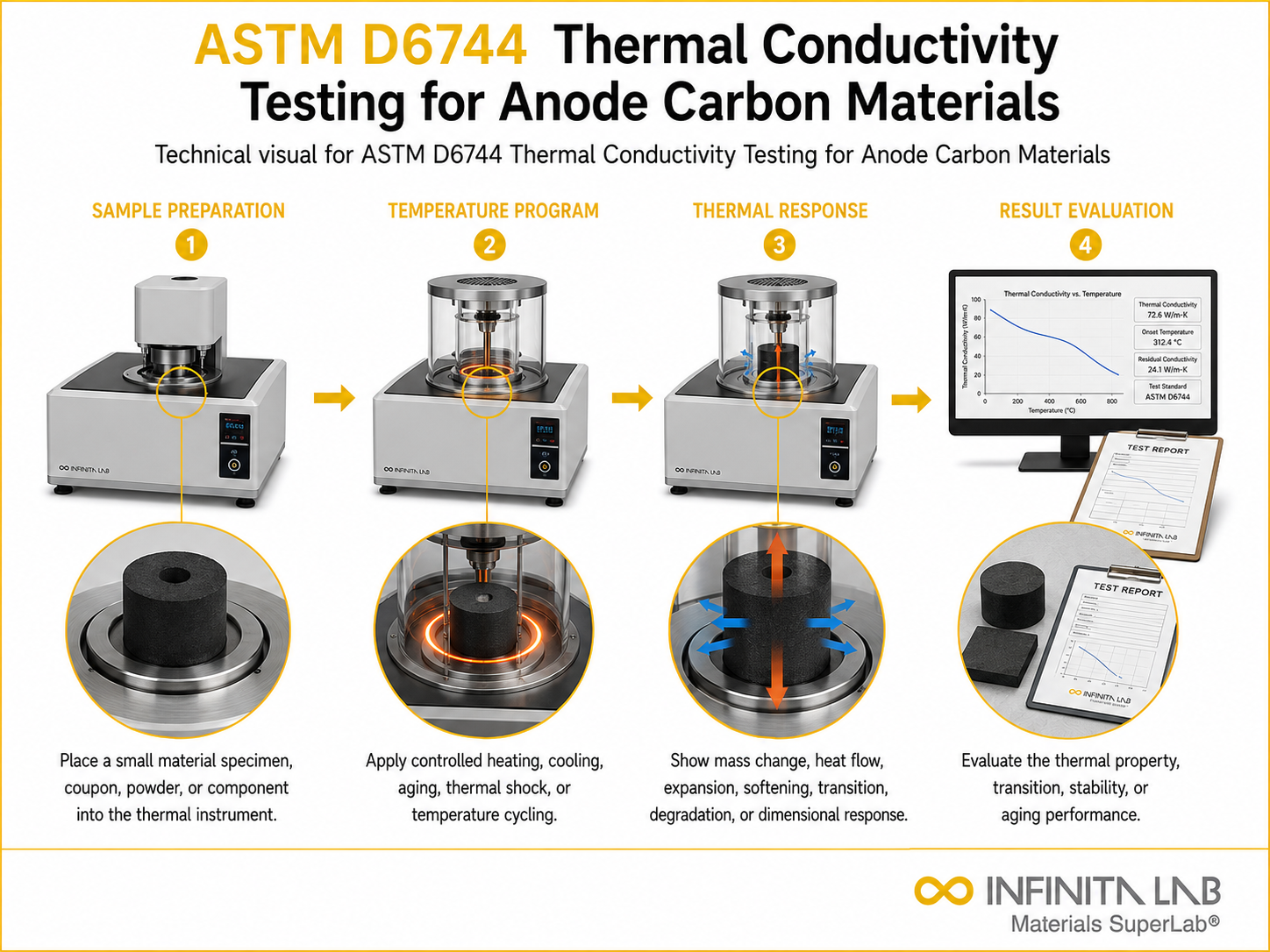
Test Process
Sample Preparation
Anode carbon specimen is prepared with specified dimensions.
1Temperature Application
Controlled heat is applied across the sample.
2Heat Flow Measurement
Heat transfer through the material is measured.
3Data Recording & Evaluation
Thermal conductivity is calculated and analyzed.
4Technical Specifications
| Parameter | Details |
|---|---|
| Applicable Materials | Anode carbon materials |
| Temperature Range | Typically 25°C to 100°C (or higher as required) |
| Sample Shape | Cylindrical or rectangular specimen |
| Measured Outputs | Thermal conductivity (W/m·K) |
| Accuracy | Depends on temperature control and measurement precision |


- Thermal conductivity measurement apparatus
- Heat source and temperature controller
- Thermocouples or temperature sensors
- Sample holder
- Data acquisition system
Instrumentation Used for Testing
Results and Deliverables
- Thermal conductivity values
- Heat transfer analysis
- Material performance evaluation
- Test condition summary
- ASTM compliance report
Frequently Asked Question
ASTM D6744 is a standard test method used to determine the thermal conductivity of anode carbon materials, evaluating their ability to conduct heat in applications such as aluminum production cells.
ASTM D6744 helps ensure efficient heat transfer in anode carbons, improving energy efficiency, process stability, and performance in high-temperature industrial processes like electrolytic aluminum production.
ASTM D6744 measures thermal conductivity by applying a heat flow through the carbon sample and determining temperature differences, allowing calculation of heat transfer properties under controlled conditions.
ASTM D6744 requires a thermal conductivity measurement apparatus, temperature sensors, heat source, and controlled environment setup to ensure accurate and repeatable results during testing.
Results are reported as thermal conductivity values, typically in watts per meter-kelvin, indicating the material’s efficiency in conducting heat under specified test conditions.
Why Choose Infinita Lab for Advanced Materials Testing and Characterization?
At the core of this breadth is our network of 2,000+ accredited laboratories across the USA, offering access to over 10,000 testing methods and analytical services. From advanced materials characterization (SEM, TEM, RBS, XPS) to mechanical, chemical, environmental, biological, and standardized ASTM/ISO-compliant testing, we deliver unmatched flexibility, specialization, and scale. You are never limited by geography, facility, or methodology — Infinita Lab connects you to the right expertise and testing solution, every time.

Looking for a Trusted Partner for Accurate and Reliable Testing Services?
Send query us at hello@infinitalab.com or call us at (888) 878-3090 to learn more about our services and how we can support you.



Request a Quote
Submit your material details and receive testing procedures, pricing, and turnaround time within 24 hours.
 Quick Turnaround and Hasslefree process
 Confidentiality Guarantee
 Free, No-obligation Consultation
 100% Customer Satisfaction
