


ASTM D6569 On-Line pH Measurement Testing & Verification
ASTM D6569 test method covers the non-stop dedication of pH of water through electrometric dimension, the use of the glass, the antimony, or the ion-selective field-impact transistor (ISFET) electrode as the sensor. The values expressed in SI are considered as standard.
TRUSTED BY


Precision-driven testing for dimensional accuracy and compliance
- Overview
- Scope, Applications, and Benefits
- Test Process
- Specifications
- Instrumentation
- Results and Deliverables
Overview
ASTM D6569 defines a method for the on-line measurement of pH in aqueous systems using continuous monitoring instruments. It evaluates hydrogen ion activity in real time, providing immediate insight into process conditions and chemical balance.
This method is widely used in industrial water systems, chemical processing, and environmental monitoring where pH control is critical. Continuous measurement enables rapid detection of deviations, supports process optimization, and ensures consistent product quality and regulatory compliance.

Scope, Applications, and Benefits
Scope
This method focuses on continuous pH monitoring in liquid systems.
- Measurement of pH using on-line sensors
- Applicable to industrial and environmental water systems
- Real-time monitoring of hydrogen ion activity
- Evaluation under dynamic process conditions
- Integration with automated control systems
- Supports process control and quality assurance
Applications
- Industrial process water monitoring
- Wastewater treatment plants
- Chemical manufacturing processes
- Cooling water and boiler systems
- Environmental water quality monitoring
- Food and beverage processing
Benefits
- Provides real-time pH monitoring
- Enables rapid process adjustments
- Improves product consistency
- Reduces manual sampling errors
- Enhances system efficiency and control
- Supports regulatory compliance
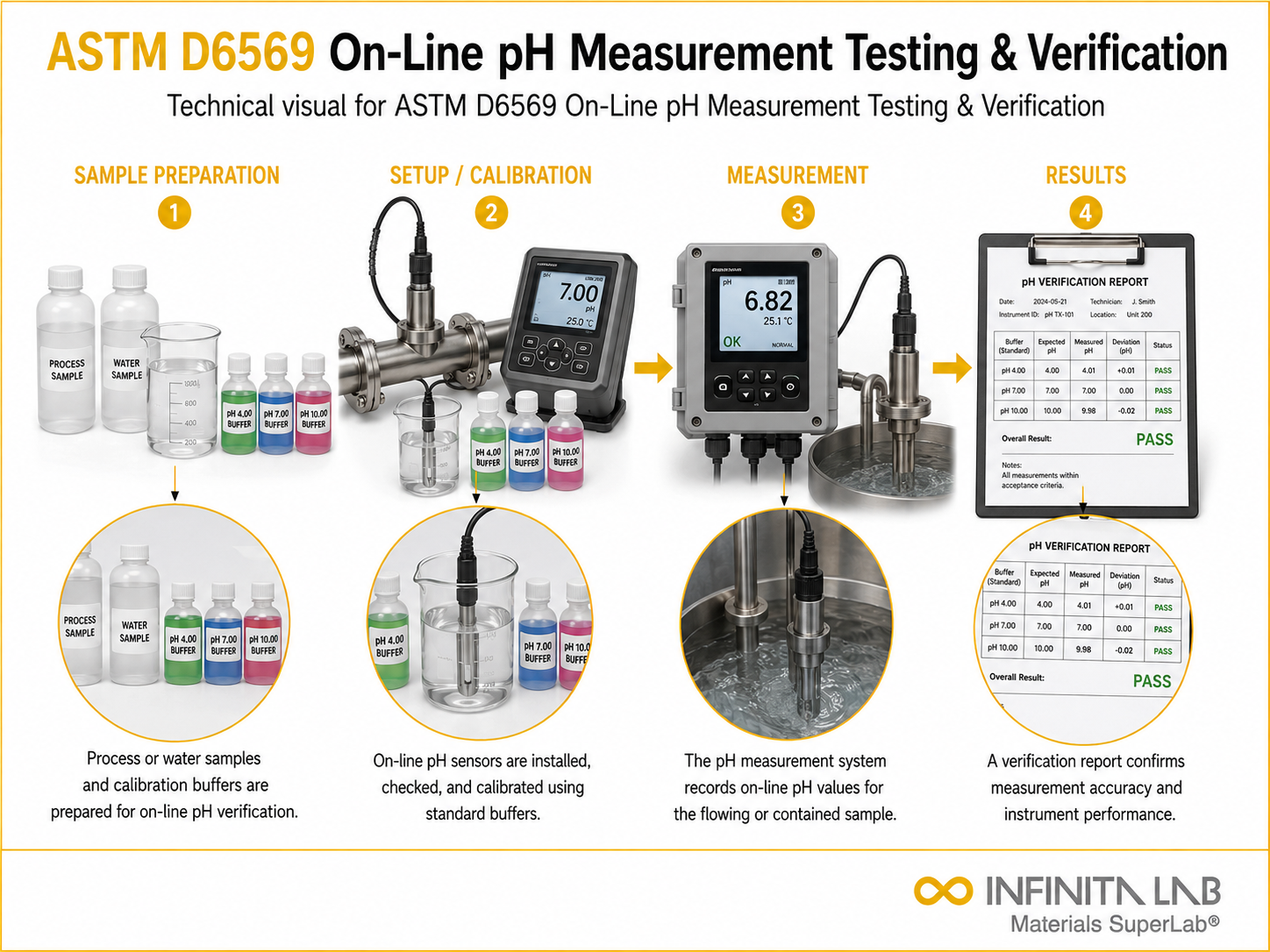
Test Process
Sensor Installation
pH electrode is installed in the process stream at a representative location.
1Calibration
The sensor is calibrated using standard buffer solutions to ensure measurement accuracy.
2Continuous Measurement
The system continuously measures pH and transmits real-time data.
3Data Monitoring and Control
Measured pH values are recorded and used for process control or corrective actions.
4Technical Specifications
| Parameter | Details |
|---|---|
| Measurement parameter | pH (hydrogen ion activity) |
| Sensor type | Glass electrode or equivalent |
| Measurement range | Typically pH 0–14 |
| Temperature compensation | Automatic or manual |
| Response time | Rapid, real-time measurement |
| Data output | Continuous digital signal |


- On-line pH analyzer
- pH electrode (glass or combination type)
- Temperature sensor
- Calibration buffer solutions
- Flow cell or insertion assembly
- Data acquisition and control system
- Cleaning and maintenance tools
Instrumentation Used for Testing
Results and Deliverables
- Continuous pH data readings
- Trend analysis over time
- Calibration records
- Process control data
- Alarm and deviation reports
- Detailed monitoring report
Frequently Asked Question
On-line pH measurement provides continuous, real-time monitoring directly within the process stream, capturing dynamic changes. Laboratory testing is intermittent and may miss transient variations, making on-line systems more effective for process control and immediate corrective actions.
pH readings are temperature-dependent due to changes in electrode response and chemical equilibrium. Temperature compensation ensures accurate readings by correcting for these variations, improving reliability in fluctuating process environments.
Fouling from deposits or coatings on the electrode surface interferes with ion exchange, leading to slow response and inaccurate readings. Regular cleaning and maintenance are essential to maintain measurement reliability.
Electrode lifespan is affected by exposure to harsh chemicals, temperature extremes, fouling, and mechanical damage. Proper handling, maintenance, and calibration extend operational life.
Calibration aligns the sensor response with known standards, correcting drift and ensuring accurate readings. Without regular calibration, measurement errors increase significantly over time.
Why Choose Infinita Lab for Advanced Materials Testing and Characterization?
At the core of this breadth is our network of 2,000+ accredited laboratories across the USA, offering access to over 10,000 testing methods and analytical services. From advanced materials characterization (SEM, TEM, RBS, XPS) to mechanical, chemical, environmental, biological, and standardized ASTM/ISO-compliant testing, we deliver unmatched flexibility, specialization, and scale. You are never limited by geography, facility, or methodology — Infinita Lab connects you to the right expertise and testing solution, every time.

Looking for a Trusted Partner for Accurate and Reliable Testing Services?
Send query us at hello@infinitalab.com or call us at (888) 878-3090 to learn more about our services and how we can support you.



Request a Quote
Submit your material details and receive testing procedures, pricing, and turnaround time within 24 hours.
 Quick Turnaround and Hasslefree process
 Confidentiality Guarantee
 Free, No-obligation Consultation
 100% Customer Satisfaction
