

What Is ASTM D6226 Rigid Foam Open Cell Content?
ASTM D6226, Standard Test Method for Open Cell Content of Rigid Cellular Plastics, determines what percentage of a rigid foam’s internal cell structure is open (interconnected) versus closed (isolated). This distinction is fundamental to how a cellular plastic performs in service, since the balance between open and closed cells governs thermal insulation efficiency, moisture and gas permeability, and buoyancy. The standard is widely applied to rigid polyurethane and polyisocyanurate foams, but it covers any rigid cellular plastic in which polymer membranes or walls separate small cavities that may be interconnected, isolated, or a mixture of both.
The test method relies on gas pycnometry. A specimen of precisely known geometric volume is placed inside a gas pycnometer, where a measured quantity of gas, typically nitrogen or air, determines the volume occupied by the solid polymer and any trapped, non-interconnected (closed) cell gas. Because gas cannot penetrate sealed closed cells but readily fills open, interconnected pathways, the pycnometer’s displacement measurement effectively excludes the open cell volume. Comparing this measured volume against the specimen’s known geometric volume yields the accessible, open cell volume, expressed as a percentage of the total specimen volume.
Open and closed cell content directly affects how a rigid foam performs. A high percentage of closed cells is generally required for effective thermal insulation, since sealed cells trap low-conductivity gas and resist convective heat transfer, supporting a stable R-value over time. Closed-cell structures also resist water absorption and vapour transmission, which is critical for buoyancy and flotation products. Higher open-cell content instead increases permeability, allowing air and moisture to pass through the material, which can suit acoustic or breathable foam applications but is detrimental where insulation value or water resistance is the priority. Because cutting specimens can open cells that were originally closed, accurate results depend on careful specimen preparation.

Applications and Benefits of ASTM D6226 Rigid Foam Open Cell Content Testing
Scope
- ASTM D6226 quantifies the percentage of open (interconnected) and closed (isolated) cells within a rigid cellular plastic specimen.
- The method uses a gas pycnometer to measure the volume of gas displaced by the solid polymer skeleton and any sealed closed-cell gas within a specimen of known geometric dimensions.
- The difference between the specimen’s geometric volume and its pycnometer-measured volume represents the volume of accessible, interconnected open cells.
- Specimens must be cut to specific size and shape requirements using techniques that minimise damage to internal cell walls, since ruptured closed cells will be counted as open cells and skew results.
- The standard applies to rigid cellular plastics in which polymer membranes separate small cavities, including rigid polyurethane foam, polyisocyanurate foam, and other rigid foamed plastics.
- The test is most accurate for materials that are predominantly open-celled, with accuracy declining as closed-cell content and cell size increase due to the practical difficulty of cutting specimens without opening some closed cells.
- Industries relying on this method include construction and building insulation, appliance manufacturing, marine and flotation equipment, and protective packaging.
- Results support material selection, formulation development, and quality control for foams where thermal performance, buoyancy, or moisture resistance is a design requirement.
- Open and closed cell content correlates directly with thermal conductivity and long-term R-value retention, since closed cells resist gas diffusion and convective heat loss far better than open cells.
- Testing under ASTM D6226 provides the data needed to support product specifications, regulatory submissions, and comparative evaluations between foam formulations or suppliers.
Applications
- Qualifying rigid polyurethane and polyisocyanurate foam insulation for building envelope, roofing, and appliance applications.
- Evaluating spray polyurethane foam (SPF) insulation for closed-cell content required to meet thermal performance specifications.
- Assessing rigid foam buoyancy and flotation materials used in marine, dock, and safety equipment applications.
- Verifying cell structure in rigid packaging and protective foam used to cushion sensitive goods during shipping and storage.
- Supporting formulation and process development for foam manufacturers, optimising blowing agent systems and cell structure.
- Comparing foam batches or competitor products for quality control and specification compliance.
- Generating data to support environmental product declarations (EPDs) and building code documentation for insulation products.
Benefits
- Provides an objective, standardised percentage value for open- and closed-cell content that supports specification compliance.
- Helps predict long-term thermal insulation performance and R-value stability of rigid foam products.
- Identifies foams suited to buoyancy and moisture-resistant applications based on closed-cell content.
- Supports quality control by flagging manufacturing or formulation issues that affect cell structure consistency.
- Enables direct, apples-to-apples comparison between foam formulations, suppliers, or production batches.
- Generates defensible, third-party data suitable for customer submittals, regulatory filings, and technical documentation.
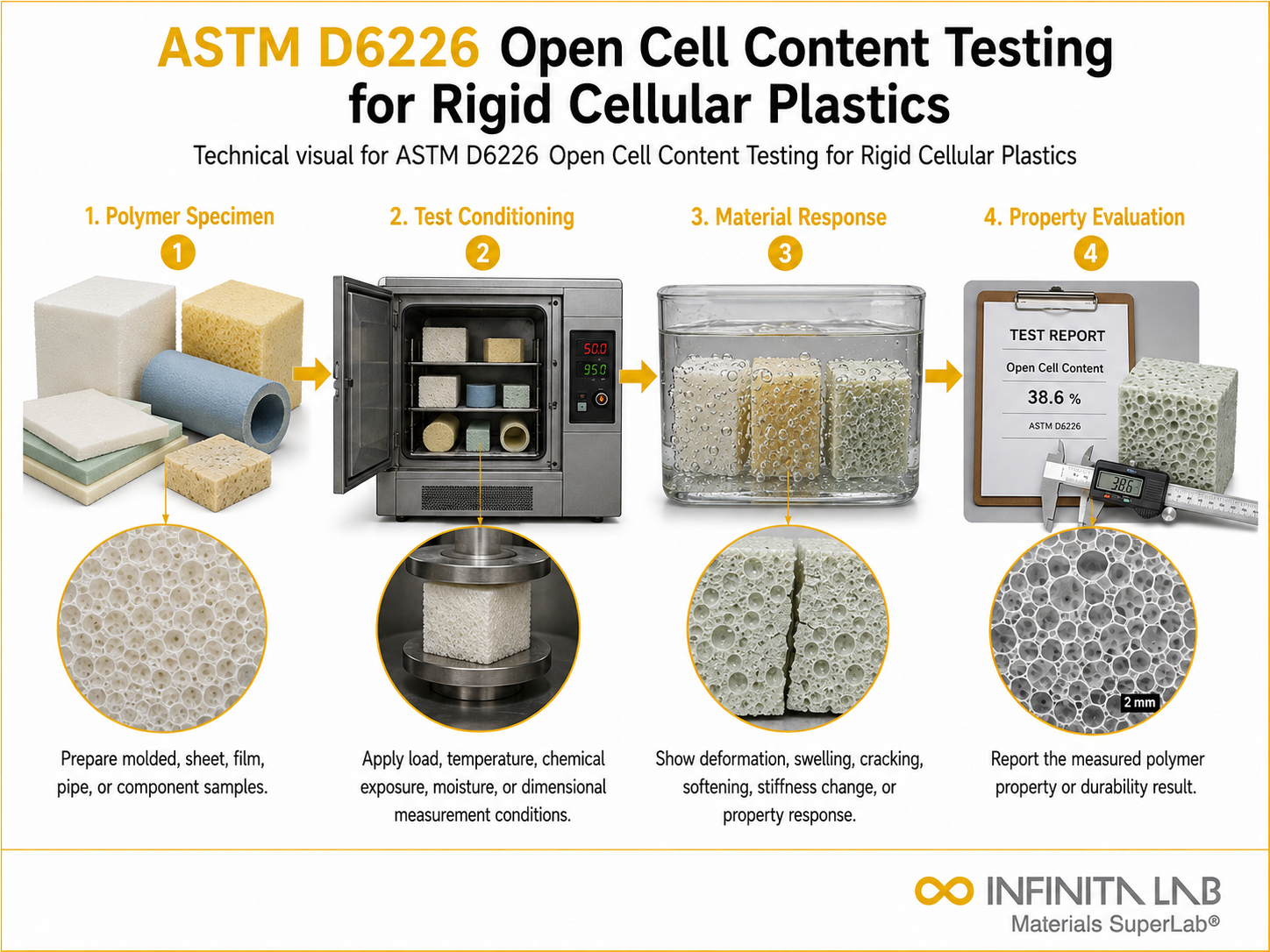
Our ASTM D6226 Testing Procedure
Sample Preparation
Specimen is cut to required dimensions ensuring no surface damage or deformation.
1Initial Measurement
Sample volume and mass are determined under controlled conditions.
2Gas Displacement
Gas pycnometer measures volume excluding open cells to determine closed-cell portion.
3Calculation
Open-cell content is calculated as percentage based on total and closed-cell volume difference.
4ASTM D6226 Test Parameters and Requirements
| Parameter | Details |
|---|---|
| Property Measured | Percentage of open-cell content within foam structure. |
| Material Type | Rigid cellular plastics including polymeric foam materials. |
| Method | Gas displacement technique using pycnometry for volume determination. |
| Measurement Unit | Reported as percentage (%) of open cells. |
| Output | Quantitative open-cell content value based on volume analysis. |
| Sensitivity | High sensitivity to detect small differences in cell structure. |


- Gas Pycnometer – Measures the volume of gas displaced by a specimen to determine accessible (non-open) volume, the core measurement device for this test method.
- Precision Specimen Cutting Equipment – Prepares foam specimens to the required size and shape while minimising damage to cell walls that could distort results.
- Callipers and Dimensional Measurement Tools – Determine the precise geometric volume of each specimen before pycnometer testing.
- Analytical Balance – Records specimen mass to support density calculations and data verification alongside volume measurements.
- Gas Supply System – Delivers a controlled, consistent supply of nitrogen or air to the pycnometer for accurate volume displacement measurement.
- Environmental Conditioning Equipment – Stabilises specimen temperature and moisture before testing to ensure repeatable results.
Equipment and Instrumentation Used for ASTM D6226 Testing
What You Receive: Test Report, Data, and Certification
- Per cent open-cell content and per cent closed cell content for each tested specimen.
- Summary of specimen geometric volume and pycnometer-measured volume used in the calculation.
- Documentation of specimen preparation method and any conditioning applied before testing.
- A detailed test report suitable for specification compliance, customer submittals, or regulatory documentation.
- Comparative data across multiple specimens or batches to support quality control and material qualification decisions.
- Optional consultation on result interpretation and next steps for formulation or product development.
ASTM D6226 Rigid Foam Open Cell Content FAQs
The expansion volume chamber is isolated to prevent interference from external pressure changes while accurately measuring the specimen's volume.
Factors include improper sample preparation, surface damage, incorrect calibration, environmental variations, and measurement errors, all of which must be controlled to ensure accurate and reproducible results.
Differentiating between open and closed cells helps assess the material's porosity, gas retention, water absorption, and thermal conductivity. These properties are crucial for determining the material's suitability for various applications, such as insulation or packaging.
Materials tested using this method are often used in industries requiring insulation, packaging, and automotive applications. The test results help determine the material's suitability based on water resistance, thermal conductivity, and durability.
To remove any trapped air and vapors from the specimen, at least two purging cycles are required. This can be accomplished by alternating the pressure inside the sample chamber.
ASTM D6226 is the Standard Test Method for Open Cell Content of Rigid Cellular Plastics, used to determine the percentage of open cells in rigid cellular plastic materials.
Why Choose Infinita Lab for Rigid Foam Open Cell Content Testing
When your Rigid Foam Open Cell Content results have to hold up - for compliance, a customer audit, or an engineering decision - ASTM D6226 accuracy and an unbiased third-party report matter more than price. Infinita Lab routes your ASTM D6226 rigid foam open cell content testing to ISO/IEC 17025-accredited U.S. partner labs with hands-on method experience, so you get defensible data, transparent reporting, and turnaround times built around your project deadline - not ours.

Looking for an Accredited Partner for ASTM D6226 Rigid Foam Open Cell Content Testing?
Send query us at hello@infinitalab.com or call us at (888) 878-3090 to learn more about our services and how we can support you.





