


ASTM D618: Plastic Specimen Conditioning Testing Services
Accredited ASTM D618 plastic specimen conditioning testing from Infinita Lab, performed to the exact standard requirements - accurate, reproducible results with full documentation for compliance, R&D, and quality control programs.
TRUSTED BY


Get ASTM D618 compliant results - request your plastic specimen conditioning testing quote
- Overview
- Scope, Applications, and Benefits
- Test Process
- Specifications
- Instrumentation
- Results and Deliverables
What Is ASTM D618 Plastic Specimen Conditioning?
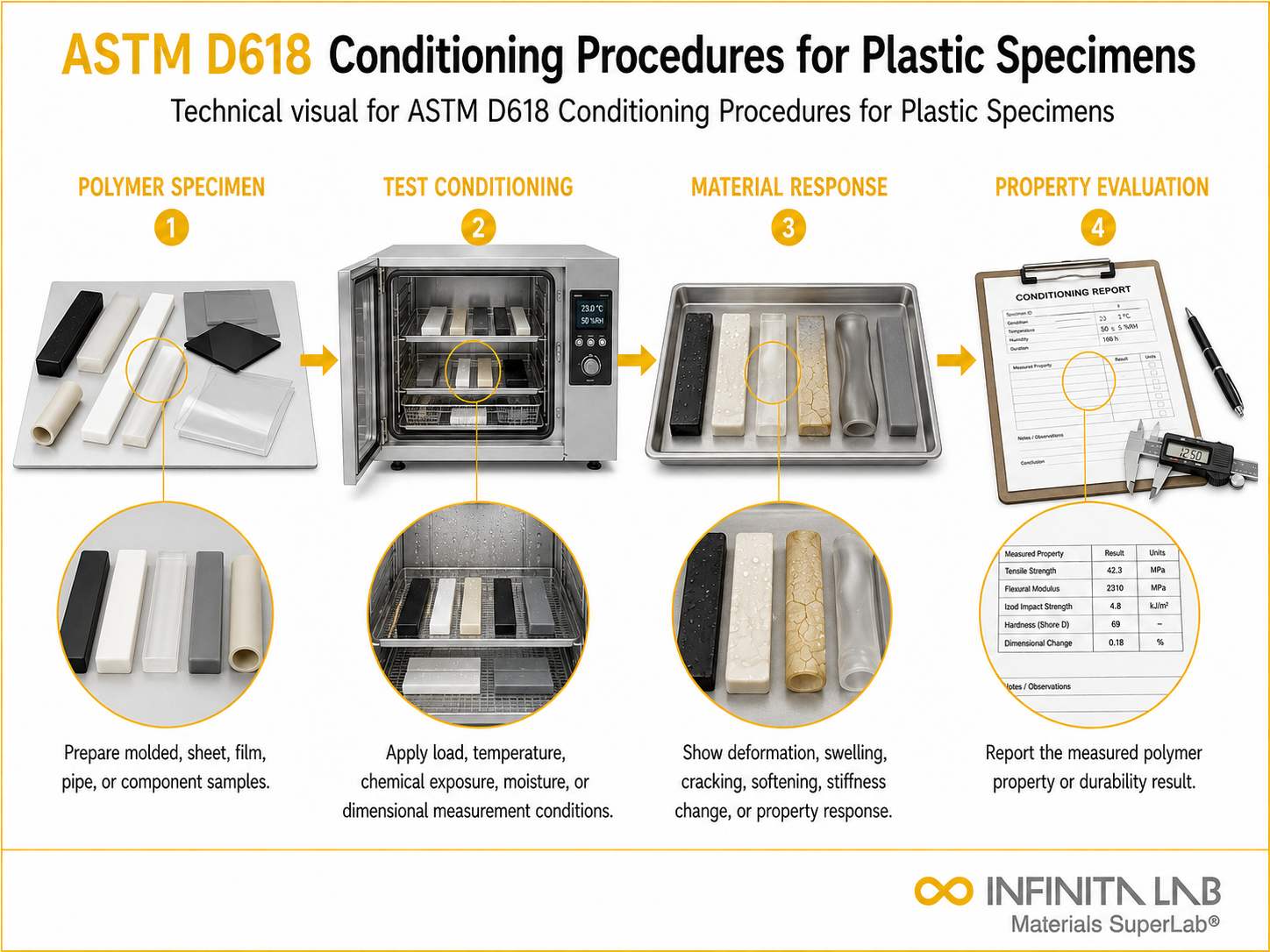
ASTM D618, Standard Practice for Conditioning Plastics for Testing, is not a test method itself but a standard practice that establishes the controlled temperature and humidity procedures a plastic specimen must undergo before mechanical, electrical, dimensional, or other physical testing. Because most plastics absorb and release moisture from the surrounding atmosphere, and because temperature history changes a polymer’s internal state, properties such as tensile strength, flexural modulus, dimensional stability, and electrical resistivity can shift measurably depending on how a specimen was stored and conditioned before it reached the test frame. ASTM D618 removes this variability by defining a standard conditioning atmosphere, most commonly 23°C and 50% relative humidity, held for a specified minimum duration before testing begins, along with alternate procedures such as oven conditioning, water immersion, and high-humidity exposure for materials or applications where an accelerated or non-ambient conditioning environment is required. Because true moisture equilibrium in many plastics can take weeks to reach, the practice also defines a practical minimum exposure period intended to bring specimens close enough to equilibrium, or to a defined, repeatable starting state, that results are comparable from batch to batch and from laboratory to laboratory. Infinita Lab’s accredited partner laboratory network performs ASTM D618 conditioning as the preparatory step ahead of tensile, flexural, impact, dielectric, and dimensional stability testing across the plastics industry, giving manufacturers, compounders, and quality teams confidence that the mechanical and electrical data generated downstream reflect the material itself rather than an uncontrolled moisture or thermal history. Precise, documented conditioning is a prerequisite for defensible test reports, product certification, specification compliance, and cross-laboratory data comparability.

Applications and Benefits of ASTM D618 Plastic Specimen Conditioning Testing
Scope
- ASTM D618 defines the standard conditioning procedures that plastic specimens must undergo before mechanical, electrical, dimensional, or other physical property testing.
- It recognises that temperature and relative humidity influence the physical and electrical properties of plastics in ways that materially affect test results.
- The practice specifies a standard laboratory atmosphere, commonly 23°C and 50% relative humidity, along with a minimum conditioning duration before testing.
- It also provides alternate conditioning procedures, including oven conditioning, water immersion, and high-humidity exposure, for specimens or specifications that call for a non-standard environment.
- Because full moisture equilibrium in many plastics can take weeks or longer to achieve, the practice defines a practical minimum exposure period intended to yield repeatable, comparable starting conditions rather than absolute equilibrium in every case.
- Downstream test methods across the plastics industry, including tensile, flexural, compressive, impact, dielectric strength, and dimensional stability testing, reference ASTM D618 as the required or recommended conditioning step before testing specimens.
- The practice covers a broad range of plastic materials, including thermoplastics, thermosets, and reinforced or composite plastics, where moisture and thermal history can affect measured properties.
- Industries that manufacture or specify plastic components use it, including automotive, electronics, packaging, construction, consumer goods, and industrial products.
- Conditioning under ASTM D618 supports quality control, incoming material verification, product qualification, specification compliance, and research and development testing programs.
- This practice underpins data comparability by controlling one of the largest sources of variability in plastics testing, allowing results from different laboratories or times to be compared with confidence.
Applications
- Conditioning specimens before tensile and elongation testing under standards such as ASTM D638.
- Conditioning specimens before flexural property testing under standards such as ASTM D790.
- Preparing specimens for impact resistance testing, including Izod and Charpy methods.
- Conditioning specimens before electrical and dielectric property testing, such as dielectric strength and volume resistivity measurements.
- Establishing a controlled starting state for dimensional stability and shrinkage evaluations.
- Supporting incoming raw material and finished part quality control programs for plastics manufacturers.
- Providing a documented, repeatable conditioning step for product qualification, specification compliance, and R&D testing programs.
Benefits
- Removes moisture and temperature history as an uncontrolled variable in plastics testing.
- Improves the comparability and repeatability of test results across laboratories and over time.
- Supports compliance with material specifications and industry or regulatory standards that reference ASTM D618.
- Provides a documented conditioning record that strengthens the defensibility of downstream test reports.
- Enables accurate comparison of materials from different suppliers, lots, or production runs.
- Reduces the risk of disputed or non-reproducible test results caused by inconsistent specimen preparation.
Our ASTM D618 Testing Procedure
Procedure A
Condition at 23°C, 50% RH for 40 h (≤7 mm) or 88 h (>7 mm).
1Procedures B & C
B: 50°C for 48 h, then desiccator cooling. C: Water immersion at 50°C for 48 h, cool to 23°C before testing.
2Procedure D
Condition at 23°C and 96% RH as specified.
3Compliance
Maintain humidity per ASTM E104 and use required specimen type and quantity.
4ASTM D618 Test Parameters and Requirements
| Parameter | Details |
|---|---|
| Applicable Materials | Plastic materials |
| Standard Laboratory Atmosphere | 23°C ± 1°C, 50% ± specified RH |
| Oven Conditioning Temperature | 50 ± 2°C |
| Water Conditioning Temperature | 50 ± 1°C |
| High Humidity Condition | 96 ± 1% RH at 23 ± 1°C |
| Specimen Thickness Criteria | ≤7 mm or >7 mm determines conditioning duration |
| Condition Notation Format | Time/Temperature/Humidity or immersion medium |
| Output | Condition designation and pre-test conditioning record |


- Environmental conditioning chamber – Provides a controlled, stable temperature and humidity environment for the specified conditioning period.
- Temperature and humidity data logger – Continuously records chamber conditions to verify compliance with the specified tolerances throughout conditioning.
- Calibrated hygrometer – Measures and verifies relative humidity within the conditioning environment.
- Calibrated thermometer/temperature sensor – Measures and verifies chamber temperature throughout the conditioning cycle.
- Desiccator – Used for dry conditioning options where specimens must be held at low or controlled minimal humidity.
- Specimen racks and holders – Support specimens within the chamber to ensure uniform air and moisture exposure on all surfaces.
- Analytical balance – Used where mass-based moisture uptake verification supports confirmation of conditioning completion.
Equipment and Instrumentation Used for ASTM D618 Testing
What You Receive: Test Report, Data, and Certification
- Documented conditioning certificate confirming the procedure, temperature, humidity, and duration applied to each specimen batch.
- Time-stamped chamber temperature and humidity logs covering the full conditioning period.
- Specimen identification and chain-of-custody records linking conditioned specimens to the downstream test report.
- A verification statement confirming that conditioning tolerances were met before specimen release for testing.
- Supporting documentation suitable for inclusion in product qualification files, specification compliance packages, and audit records.
- Clear turnaround timelines communicated for both standard and alternate conditioning procedures.
ASTM D618 Plastic Specimen Conditioning FAQs
The conditioning process reduces the effects of the environment by equalizing the moisture content and temperature of the polymer. This ensures that the results of the tensile, flexural, and impact tests are accurate and representative of the true physical state of the material.
While applied in a similar manner, composites often need longer exposure times to achieve equilibrium because of their complex internal structures. Controlled cycles also prevent the absorption of moisture from artificially lowering the glass transition temperature (Tg) during testing.
The most generally specified conditioning environment is 23 ± 2°C and 50 ± 10% relative humidity. However, alternative temperature and humidity conditions may be required depending on the material type and applicable test method.
ASTM D618 is normally applicable to most thermoplastic and thermosetting plastics used in laboratory testing. However, specific product standards may override these requirements.
If the specimens are not conditioned properly, then the results of strength, stiffness, and dimensional stability could be affected by the variations in moisture content and temperature.
ASTM D618 Procedure A conditions plastic specimens at 23 ± 2°C and 50 ± 10% relative humidity before testing. For specimens up to 7 mm thick, the standard procedure generally uses 40 hours of conditioning; thicker specimens require longer conditioning.
Plastic specimens are placed in a controlled environmental chamber where temperature and relative humidity are maintained at specified ASTM D618 conditions for the required conditioning period. The conditioned specimens are then tested to obtain more reproducible physical and electrical properties.
ASTM D618 is the Standard Practice for Conditioning Plastics for Testing. It establishes controlled temperature and humidity conditions for conditioning plastic specimens before and, where specified, during testing to improve consistency and comparability of results. The current active edition listed by ASTM is ASTM D618-21.
Why Choose Infinita Lab for Plastic Specimen Conditioning Testing
When your Plastic Specimen Conditioning results have to hold up - for compliance, a customer audit, or an engineering decision - ASTM D618 accuracy and an unbiased third-party report matter more than price. Infinita Lab routes your ASTM D618 plastic specimen conditioning testing to ISO/IEC 17025-accredited U.S. partner labs with hands-on method experience, so you get defensible data, transparent reporting, and turnaround times built around your project deadline - not ours.

Looking for a Trusted Partner for Accurate and Reliable Testing Services?
Send query us at hello@infinitalab.com or call us at (888) 878-3090 to learn more about our services and how we can support you.



Request a Quote
Submit your material details and receive testing procedures, pricing, and turnaround time within 24 hours.
 Quick Turnaround and Hasslefree process
 Confidentiality Guarantee
 Free, No-obligation Consultation
 100% Customer Satisfaction
