


ASTM D6116: Film Sheeting Blocking Testing Services
ASTM D6116 test technique determines how resistant leather is to blockage under certain temperatures, humidity, and pressure conditions. Wet blue is not tested with this procedure. The values stated in SI units should be considered standard. This standard does not contain any other units of measurement.
TRUSTED BY


Get ASTM D6116 compliant results — request your film sheeting blocking testing quote
- Overview
- Scope, Applications, and Benefits
- Test Process
- Specifications
- Instrumentation
- Results and Deliverables
What Is ASTM D6116 Film Sheeting Blocking?
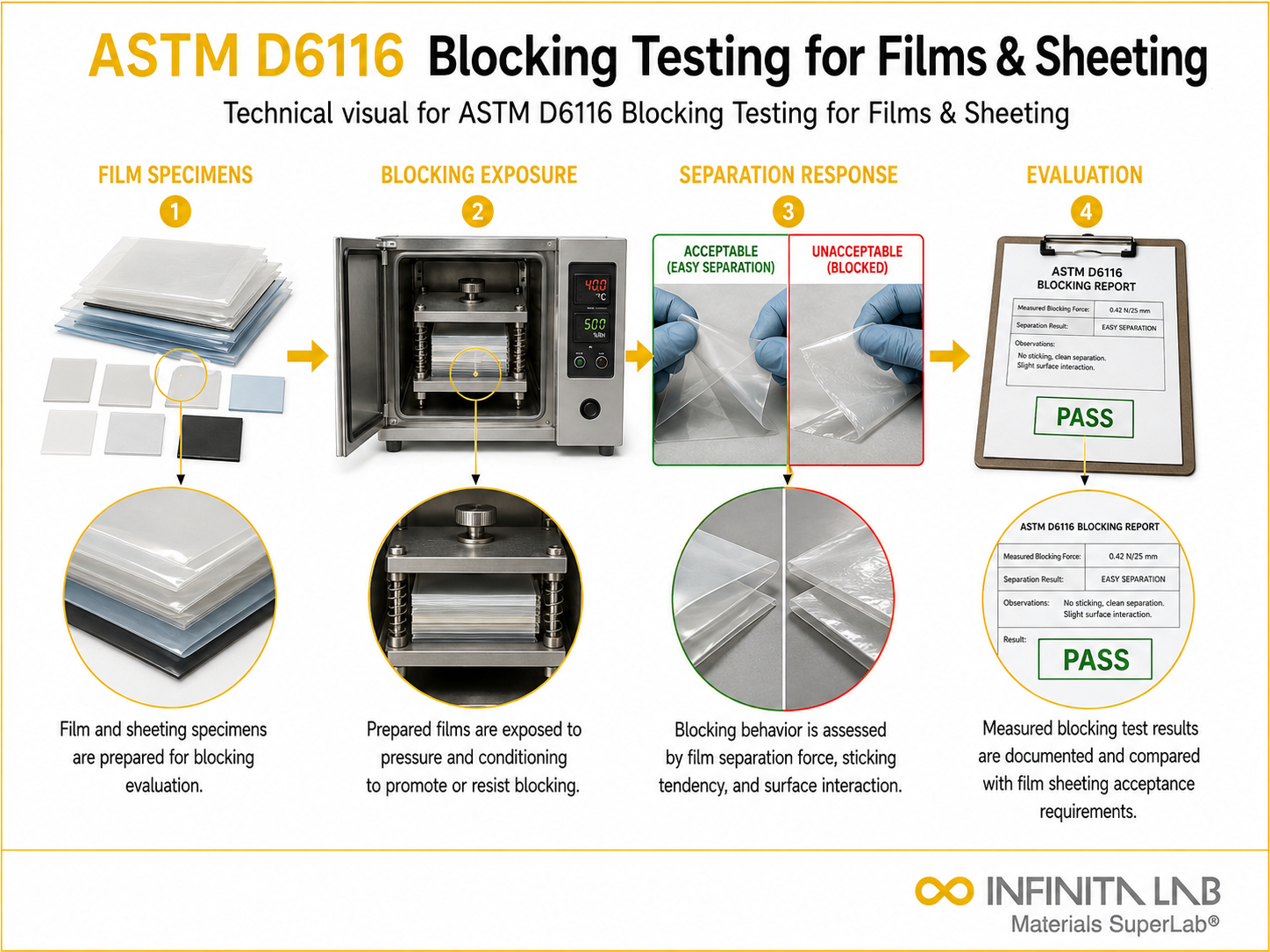
ASTM D6116 evaluates the blocking tendency of plastic films and sheets, which refers to the undesired adhesion between layers when stacked under pressure and temperature. Blocking can affect handling, processing, and end-use performance of materials.
This test method provides a controlled approach to measure the force required to separate two contacting surfaces after exposure to specified conditions. It is widely used in quality control and product development to ensure smooth unwinding, separation, and usability of plastic films.

Applications and Benefits of ASTM D6116 Film Sheeting Blocking Testing
Scope
This test method determines the blocking characteristics of plastic films and sheets by measuring the force required to separate two surfaces after controlled contact under defined temperature and pressure conditions.
Includes:
- Evaluation of adhesion between film layers
- Measurement of separation force
- Testing under controlled temperature and pressure
- Applicability to plastic films and sheet materials
- Assessment of surface treatment effects
Applications
- Packaging films and flexible materials
- Agricultural films and liners
- Industrial plastic sheets
- Printed and coated films
- Laminated film structures
- Polymer film manufacturing quality control
Benefits
- Ensures easy film separation during use
- Improves processing and handling efficiency
- Supports optimization of surface treatments
- Reduces production defects and downtime
- Enhances product consistency and quality
- Helps in selecting suitable materials for packaging
Our ASTM D6116 Testing Procedure
Specimen Preparation
Film samples are cut, aligned, and conditioned as per specified environmental conditions.
1Contact Conditioning
Specimens are placed in contact under defined pressure and temperature for a fixed duration.
2Separation Testing
The samples are separated using a testing machine to measure the required force.
3Data Recording
The blocking force is recorded and analyzed to determine material performance.
4ASTM D6116 Test Parameters and Requirements
| Parameter | Details |
|---|---|
| Property Measured | Blocking force |
| Material Type | Plastic films and sheets |
| Test Condition | Controlled temperature and pressure |
| Measurement Unit | Force (N or gf) |
| Contact Time | Defined duration |
| Specimen Configuration | Layered film samples |
| Equipment | Tensile or peel testing setup |
| Output | Force required for separation |


- Universal Testing Machine (UTM)
- Blocking test fixture or plates
- Temperature-controlled chamber
- Pressure application weights or device
- Cutting tools for specimen preparation
- Data acquisition system
Equipment and Instrumentation Used for ASTM D6116 Testing
What You Receive: Test Report, Data, and Certification
- Blocking force values
- Comparative material performance data
- Observations on adhesion behavior
- Quality assessment report
- Compliance with ASTM D6116
- Recommendations for material improvement
ASTM D6116 Film Sheeting Blocking FAQs
ASTM D6116 helps ensure packaging films do not stick together during storage or processing. Reliable blocking data prevents issues like tearing, misfeeding, or downtime, directly improving packaging line efficiency and product usability.
A high blocking force indicates strong adhesion between film layers, which can cause difficulties in separation during processing. This may lead to operational issues such as film damage, inconsistent feeding, or reduced production efficiency.
Blocking can disrupt automated processes by causing films to stick together, leading to jams, uneven feeding, and increased waste. This impacts productivity, increases downtime, and may result in higher operational costs.
Blocking is influenced by surface roughness, additives, temperature, pressure, humidity, and storage time. Smooth surfaces and high temperatures typically increase blocking, while anti-block additives help reduce adhesion between layers.
Testing frequency depends on product criticality, but it is commonly performed during formulation development, process validation, and routine quality checks to ensure consistent performance.
Why Choose Infinita Lab for Film Sheeting Blocking Testing
At the core of this breadth is our network of 2,000+ accredited laboratories across the USA, offering access to over 10,000 testing methods and analytical services. From advanced materials characterization (SEM, TEM, RBS, XPS) to mechanical, chemical, environmental, biological, and standardized ASTM/ISO-compliant testing, we deliver unmatched flexibility, specialization, and scale. You are never limited by geography, facility, or methodology — Infinita Lab connects you to the right expertise and testing solution, every time.

Looking for an Accredited Partner for ASTM D6116 Film Sheeting Blocking Testing?
Send query us at hello@infinitalab.com or call us at (888) 878-3090 to learn more about our services and how we can support you.



Request a Quote
Submit your material details and receive testing procedures, pricing, and turnaround time within 24 hours.
 Quick Turnaround and Hasslefree process
 Confidentiality Guarantee
 Free, No-obligation Consultation
 100% Customer Satisfaction
