


ASTM D6082: Standard For High Temperature Foaming Characteristics Of Lubricating Oils Testing Services
Accredited ASTM D6082 standard for high temperature foaming characteristics of lubricating oils testing from Infinita Lab, performed to the exact standard requirements - accurate, reproducible results with full documentation for compliance, R&D, and quality control programs.
TRUSTED BY


Get ASTM D6082 compliant results - request your standard for high temperature foaming characteristics of lubricating oils testing quote
- Overview
- Scope, Applications, and Benefits
- Test Process
- Specifications
- Instrumentation
- Results and Deliverables
What Is ASTM D6082 Standard For High Temperature Foaming Characteristics Of Lubricating Oils?
ASTM D6082, Standard Test Method for High Temperature Foaming Characteristics of Lubricating Oils, describes how to determine the foaming behavior of a lubricant at 150 °C. The current edition is D6082-23, developed under ASTM Committee D02 on Petroleum Products, Liquid Fuels, and Lubricants (Subcommittee D02.06). The 2022 edition is now listed as historical. The scope names transmission fluid and motor oil. Foaming at temperatures up to 93.5 °C is outside this method and is covered by ASTM D892 or IP 146, so D6082 picks up where D892 leaves off. It replaced the older D892 Sequence IV, which also ran hot.
The mechanics follow the same idea as D892. Oil sits at temperature in a graduated 1000 mL cylinder in a heated bath. Metered air bubbles through a calibrated porous diffuser stone for a fixed aeration period. The air rate is higher than in D892: instrument-maker documentation gives 200 ± 5 mL/min, against 94 mL/min for D892. The operator reads foam height when aeration ends, reads it again after a settling period, and records how long the foam takes to collapse. The sample has to reach test temperature within a set heating window. Operators also check diffuser stones, since a plugged stone changes the result.
The significance section explains why the test exists. Foam at operating temperature can cause poor lubrication, cavitation, and oil loss in high-speed gearing, high-volume pumping, and splash-lubricated systems. Still, the standard states that no correlation has been established between foam volume or collapse time and actual lubrication failure. Results are best used for comparison, screening, and empirical judgment in foam-sensitive applications. Values are in SI units. There’s a mercury hazard note too.

Applications and Benefits of ASTM D6082 Standard For High Temperature Foaming Characteristics Of Lubricating Oils Testing
Scope
ASTM D6082 determines the foaming tendency and foam stability of lubricating oils at high temperatures. It ensures that oils perform effectively under operating conditions.
The test evaluates:
- ASTM D6082 covers the procedure for determining the foaming characteristics of lubricating oils at 150 °C.
- Transmission fluid and motor oil are the products the scope specifically names.
- Foaming at temperatures up to 93.5 °C is excluded and is determined by ASTM D892 or IP 146 instead.
- It measures how readily an oil foams under controlled aeration, and how stable that foam is once the air stops.
- Foam height is read at the end of the aeration period and again after a settling period.
- Collapse time counts too, since persistent foam is the practical concern.
- The standard notes that foam at high temperature can lead to inadequate lubrication, cavitation and loss of lubricant.
- It states that a link between foam measurements and real lubrication failure has not been established, so relationships should be worked out empirically.
- SI units are regarded as the standard, and values in parentheses are for information only.
- A hazard note covers mercury and mercury-containing products, which matters for thermometer and apparatus choices.
Applications
- Screened finished engine oils and automatic or manual transmission fluids for foaming at elevated operating temperatures.
- Additive packages, especially antifoam and defoamer treatments, can be compared across candidate formulations.
- Quality control checks on production batches of lubricants that run hot in service.
- Oils intended for high-speed gearing, high-volume pumping, or splash lubrication get evaluated.
- Troubleshooting support when a field lubricant shows foam, aeration, or unexplained oil loss.
Benefits
- A repeatable view of foaming at a temperature far above what D892 reaches.
- Helps formulators judge whether an antifoam additive still works when the oil is hot.
- Comparison against a customer, OEM, or internal limit comes out as a clear pass or fail.
- Catches foam-prone batches before they reach equipment where aeration causes damage.
- One defined air rate and temperature keeps results easy to compare between samples.
- D892 data pairs naturally with it, showing how foaming changes between low and high temperature.
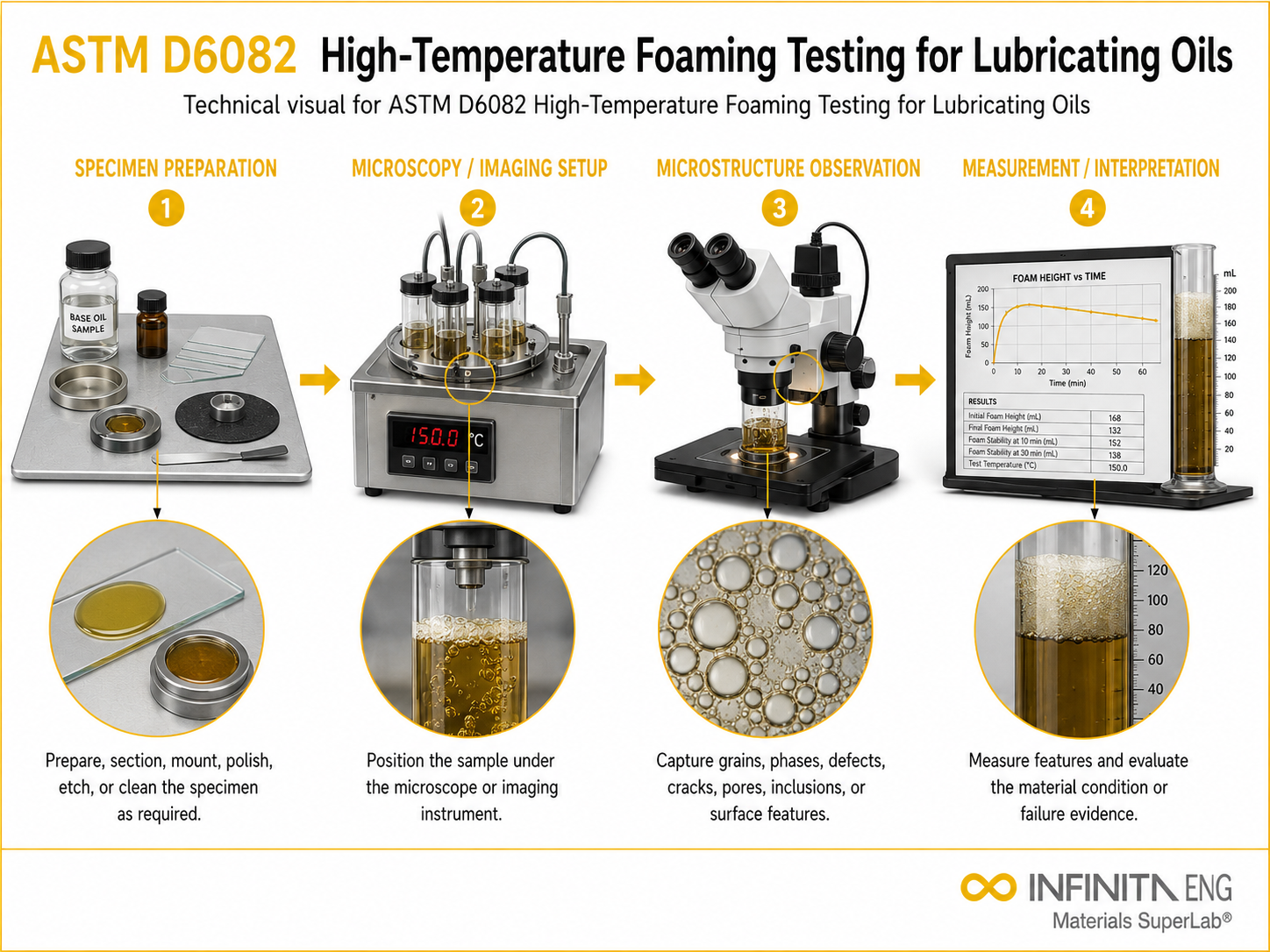
Our ASTM D6082 Testing Procedure
Sample Preparation
Lubricating oil sample is prepared and conditioned.
1Heating
Sample is heated to specified high temperature conditions.
2Air Injection
Air is passed through the oil to generate foam.
3Data Recording & Evaluation
Foam volume and stability are measured and analyzed.
4ASTM D6082 Test Parameters and Requirements
| Parameter | Details |
|---|---|
| Applicable Materials | Lubricating oils |
| Test Temperature | 150°C ± 1°C |
| Air Flow Rate | 200 mL/min ± 5 mL/min |
| Air Diffuser Type | Standard porous diffuser |
| Test Duration | 5 minutes blowing + 10 minutes settling |
| Sample Volume | 200 mL |
| Measured Outputs | Foam volume (mL), foam stability (mL after settling) |


- High-Temperature Foam Test Bath – Holds the test cylinders at 150 °C with tight temperature uniformity and an over-temperature cutoff.
- Graduated 1000 mL Test Cylinders – The oil sample goes in here, and foam height is read directly against the scale.
- Calibrated Diffuser Stones – Spread the incoming air into fine bubbles. They plug with use, so check pore size and permeability.
- Air Delivery System – A dry, controlled air supply with a flow meter or mass flow controller that holds the specified flow rate.
- Timing Sequencer or Stopwatch – Handles timing and alarms for aeration and settling, so readings happen on schedule.
- Calibrated Thermometer or Temperature Probe – Confirms the sample and bath temperature at 150 °C.
- Diffuser Test Apparatus – Stone permeability and conformance are verified before and between runs.
Equipment and Instrumentation Used for ASTM D6082 Testing
What You Receive: Test Report, Data, and Certification
- Foam height in mL at the end of the aeration period.
- Remaining foam height in mL after the settling period.
- Collapse behavior, including the time for the foam to disappear, where it is recorded.
- A statement of the test temperature, air rate, and method edition used.
- Formal test report with sample identification and any deviations noted, plus a pass or fail comparison against your stated limit where one applies.
ASTM D6082 Standard For High Temperature Foaming Characteristics Of Lubricating Oils FAQs
ASTM D6082 is a standard test method used to evaluate the high-temperature foaming characteristics of lubricating oils, determining their tendency to form and retain foam under elevated temperature conditions.
ASTM D6082 helps ensure lubricant performance by identifying foaming issues that can reduce lubrication efficiency, cause air entrainment, and lead to equipment wear or operational problems.
ASTM D6073 involves applying ink to a substrate and exposing it to controlled heat conditions, then assessing the degree of ink setting by measuring transfer or smearing under specified conditions.
The test requires a heatset tester, printing substrate, ink applicator, and evaluation tools to measure ink transfer and setting performance under controlled heating conditions.
Results are evaluated based on the degree of ink set, typically by comparing transfer or smudge levels, indicating how effectively the ink dries and adheres during heatset printing processes.
A measured sample is subjected to controlled agitation or air flow to generate foam. The foam height or volume is recorded, and its stability is evaluated by measuring how much foam remains after a specified settling time. The applicable procedure depends on the material being tested, such as surfactants, lubricating oils, or concrete foaming agents.
Why Choose Infinita Lab for Standard For High Temperature Foaming Characteristics Of Lubricating Oils Testing
When your Standard For High Temperature Foaming Characteristics Of Lubricating Oils results have to hold up - for compliance, a customer audit, or an engineering decision - ASTM D6082 accuracy and an unbiased third-party report matter more than price. Infinita Lab routes your ASTM D6082 standard for high temperature foaming characteristics of lubricating oils testing to ISO/IEC 17025-accredited U.S. partner labs with hands-on method experience, so you get defensible data, transparent reporting, and turnaround times built around your project deadline - not ours.

Need ASTM D6082 Standard For High Temperature Foaming Characteristics Of Lubricating Oils Testing You Can Rely On?
Send query us at hello@infinitalab.com or call us at (888) 878-3090 to learn more about our services and how we can support you.



Request a Quote
Submit your material details and receive testing procedures, pricing, and turnaround time within 24 hours.
 Quick Turnaround and Hasslefree process
 Confidentiality Guarantee
 Free, No-obligation Consultation
 100% Customer Satisfaction
