

What Is ASTM D5154 FCC Catalyst Micro Activity?
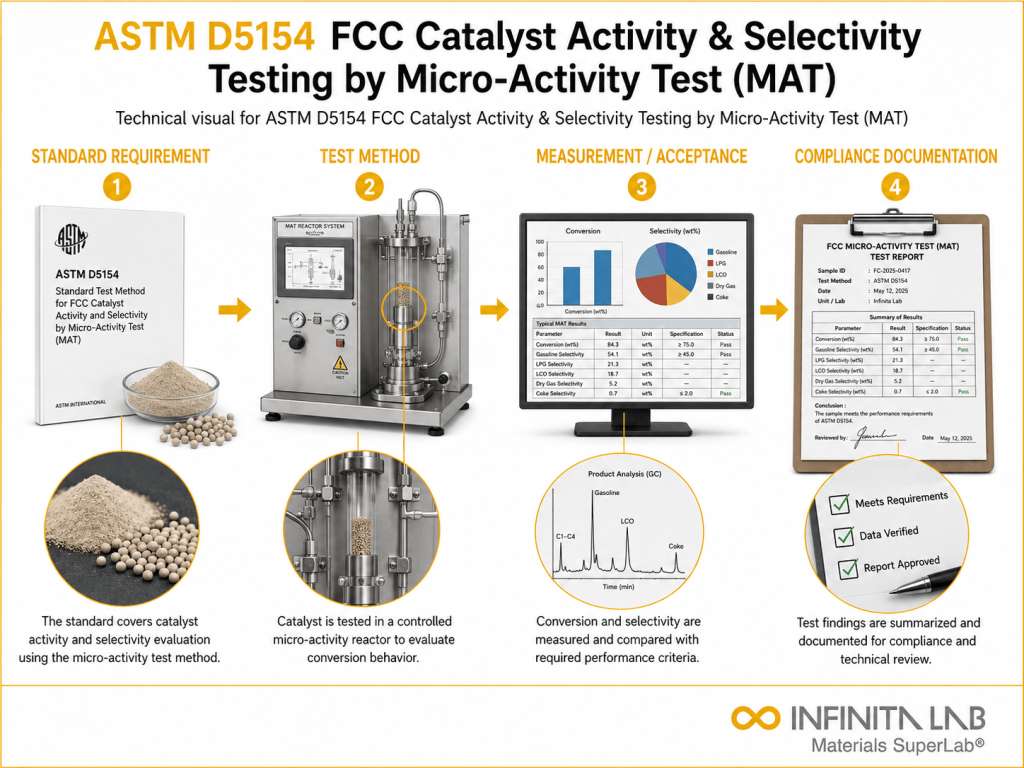
ASTM D5154/D5154M determines the activity and selectivity of Fluid Catalytic Cracking (FCC) catalysts using the Micro Activity Test (MAT). It measures how effectively a catalyst converts hydrocarbon feedstocks into lighter fractions under controlled laboratory conditions. The test simulates refinery cracking behavior on a small scale, providing reliable performance indicators.
This method is essential for evaluating catalyst efficiency, product yield distribution, and operational performance in refining processes. It supports catalyst development, quality control, and performance comparison. By analyzing conversion levels and selectivity, industries can optimize catalyst formulations and improve overall process efficiency.
Applications and Benefits of ASTM D5154 FCC Catalyst Micro Activity Testing
Scope
ASTM D5154/D5154M covers the determination of catalytic cracking performance using a fixed-bed microreactor under standardized conditions. It evaluates both conversion efficiency and product selectivity of FCC catalysts.
- Applicable to fresh and equilibrium FCC catalysts
- Measures conversion of feedstock into lighter hydrocarbons
- Evaluates selectivity toward desired products
- Simulates refinery cracking conditions at laboratory scale
- Supports catalyst comparison and performance monitoring
Applications
- Refinery catalyst performance evaluation
- Catalyst research and development
- Quality control of FCC catalysts
- Process optimization in petroleum refining
- Comparative analysis of catalyst formulations
- Feedstock impact studies on catalyst behavior
- Monitoring catalyst deactivation trends
Benefits
- Provides accurate catalyst activity data
- Enables optimization of product yield distribution
- Supports efficient refinery operations
- Reduces operational risks through testing
- Helps in selecting high-performance catalysts
- Improves process efficiency and profitability
Our ASTM D5154 Testing Procedure
Sample Preparation
Catalyst sample is conditioned and loaded into the microreactor with defined particle size.
1Reaction Execution
Hydrocarbon feed is passed over the catalyst at controlled temperature and flow conditions.
2Product Collection
Cracked products are collected and separated into gas, liquid, and coke fractions.
3Data Analysis
Conversion and selectivity are calculated based on product yields and feed composition.
4ASTM D5154 Test Parameters and Requirements
| Parameter | Details |
|---|---|
| Reactor Type | Fixed-bed microactivity test reactor |
| Catalyst Form | Powdered or sieved particles |
| Temperature Range | Typically around 500°C |
| Contact Time | Controlled catalyst-to-oil ratio |
| Feed Type | Standard hydrocarbon feedstock |
| Measurement Output | Conversion percentage and yield distribution |
| Selectivity Analysis | Gas, gasoline, and coke fractions |
| Pressure Conditions | Near atmospheric or specified |


- Microactivity test (MAT) reactor
- Furnace with temperature control
- Gas flow controllers
- Liquid feed injection system
- Product collection system
- Gas chromatograph (GC)
- Analytical balance
- Data acquisition system
Equipment and Instrumentation Used for ASTM D5154 Testing
What You Receive: Test Report, Data, and Certification
- Catalyst activity (conversion %)
- Product selectivity distribution
- Yield of gas, liquid, and coke
- Performance comparison data
- Detailed analytical report
- Graphical representation of results
ASTM D5154 FCC Catalyst Micro Activity FAQs
ASTM D5154/D5154M is used to evaluate the activity and selectivity of FCC catalysts. It measures how efficiently catalysts convert hydrocarbon feed into lighter products, helping refineries optimize catalyst performance and improve overall processing efficiency.
The Micro Activity Test is a laboratory-scale method that simulates catalytic cracking in refineries. It uses a fixed-bed reactor to measure catalyst performance, including conversion rates and product distribution under controlled conditions.
Temperature significantly affects cracking reactions. Maintaining a consistent temperature ensures reproducibility and accurate measurement of catalyst activity and selectivity during the test.
The test is conducted under controlled laboratory conditions, which may not fully replicate all variables in large-scale refinery operations. However, it still provides highly useful comparative data.
It allows researchers to evaluate new catalyst formulations quickly and efficiently. By analyzing activity and selectivity, developers can optimize catalyst composition for improved performance.
Catalyst activity testing services evaluate how effectively a catalyst converts feedstock into desired products under controlled conditions. According to ASTM D5154/D5154M, fluid catalytic cracking (FCC) catalysts are tested in a microactivity unit using gas oil feed. The reaction products are analyzed to determine feed conversion and product yields, helping compare catalyst activity and selectivity. These results support catalyst selection, process optimization, and quality control in petroleum refining.
Process Raman analyzers use laser light to measure molecular vibrations and generate spectra that provide information about chemical composition. In fluidized-bed catalytic cracking processes, Raman spectroscopy may support real-time monitoring of selected feedstocks, intermediates, or products when suitable measurement conditions and calibration are available. However, ASTM D5154/D5154M does not specify Raman analyzer testing; it evaluates FCC catalyst activity and selectivity through a controlled microactivity test and analysis of reaction products.
Why Choose Infinita Lab for FCC Catalyst Micro Activity Testing
When your FCC Catalyst Micro Activity results have to hold up - for compliance, a customer audit, or an engineering decision - ASTM D5154 accuracy and an unbiased third-party report matter more than price. Infinita Lab routes your ASTM D5154 FCC catalyst micro activity testing to ISO/IEC 17025-accredited U.S. partner labs with hands-on method experience, so you get defensible data, transparent reporting, and turnaround times built around your project deadline - not ours.

Looking for an Accredited Partner for ASTM D5154 FCC Catalyst Micro Activity Testing?
Send query us at hello@infinitalab.com or call us at (888) 878-3090 to learn more about our services and how we can support you.



