


ASTM D4169: Distribution Testing Services
ASTM D4169-22 transportation packaging test method determines the characteristics of shipping containers by observing their performance in different environments. The specimen is exposed to various hazards and its durability is checked. The final results of this method are displayed keeping in view the international standards and inch-pound units.
TRUSTED BY


Get ASTM D4169 compliant results — request your distribution testing quote
- Overview
- Scope, Applications, and Benefits
- Test Process
- Specifications
- Instrumentation
- Results and Deliverables
What Is ASTM D4169 Distribution?
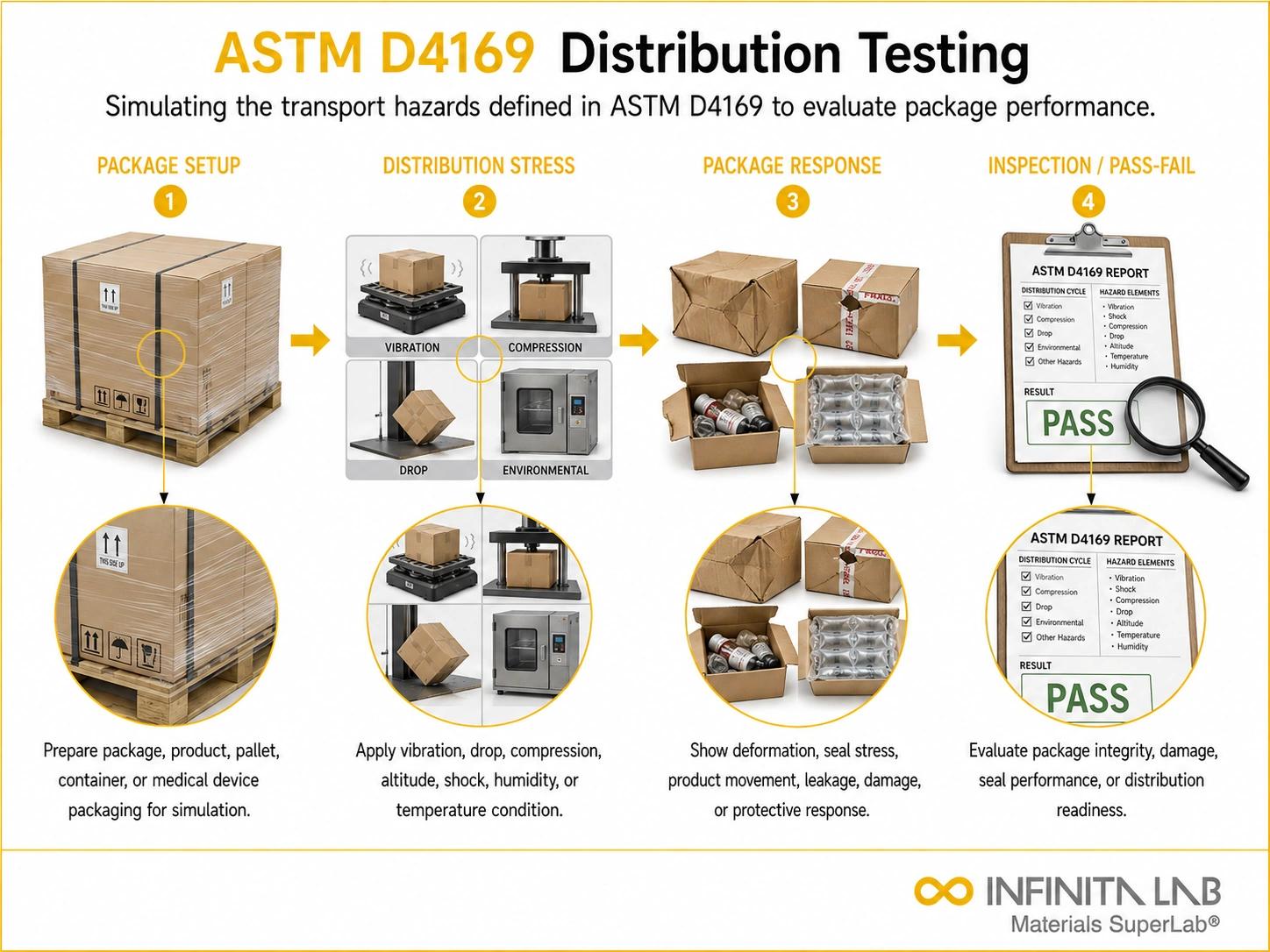
ASTM D4169 is the standard practice for performance testing of shipping containers and systems by subjecting them to a defined sequence of distribution hazards. Rather than testing a package against a single hazard, the standard simulates the cumulative set of stresses a package experiences as it moves through a real distribution environment – handling, stacking, vibration during transport, and impacts – applied in a logical sequence that mirrors the actual shipping cycle.
The test is built around Distribution Cycles (DCs), each representing a different distribution scenario such as truck shipment, parcel delivery, or air freight. The user selects the appropriate cycle and an Assurance Level (I, II, or III) that sets the test intensity based on the desired confidence and the value or fragility of the product. The package is then run through the sequence of test elements – compression, vibration, drop or impact, and others – defined for that cycle.
ASTM D4169 is the most widely used distribution simulation standard for general packaged products. It gives manufacturers and shippers an objective way to confirm that a package design will protect its contents through the distribution environment before committing to full production and shipment, reducing the risk of damaged goods, returns, and the cost of over-packaging.

Applications and Benefits of ASTM D4169 Distribution Testing
Scope
ASTM D4169 covers performance testing of shipping units by applying a sequence of distribution hazards representative of a chosen shipping scenario. The standard defines distribution cycles, assurance levels, and the test elements (called Schedules) that make up each cycle. Results are reported in inch-pound units.
Key aspects of the test scope include:
- Distribution Cycles (DC 1–18) – predefined sequences representing different shipping scenarios; DC 13 (general single-parcel shipment) and DC 12 (general truckload/LTL) are among the most commonly used
- Assurance Levels (I, II, III) – set the test intensity; Level I is most severe (highest confidence), Level II is standard, and Level III is least severe; selection depends on product value, fragility, and acceptable risk
- Test Schedules (A–J) – individual test elements applied within a cycle, including Schedule A (handling/manual and mechanical), Schedule C (stacking/compression), Schedule D (vibration), Schedule E (low pressure/high altitude), Schedule F (loose load vibration), and others
- Test elements – compression and stacking, random and fixed-displacement vibration, rotational and free-fall drop, horizontal impact, and concentrated/low-pressure hazards as defined by the chosen cycle
- Applicable units – shipping containers, unit loads, and packaged products of essentially any type intended for distribution
Applications
- Packaging design validation – confirming a new package design will survive the distribution environment before it goes into production, avoiding both under-protection (product damage) and over-protection (excess material cost)
- E-commerce and parcel shipping – testing single-parcel packages against parcel distribution cycles, where individual handling, drops, and conveyor sortation create a demanding hazard environment
- Consumer goods and electronics – verifying that retail and bulk packaging protects fragile or high-value products through truck, rail, and parcel distribution
- Unit load and palletized shipment testing – evaluating stacked and palletized loads against truckload and warehouse stacking hazards
- Package optimization and cost reduction – using test results to safely reduce packaging material where a design is shown to have excess margin, lowering material and shipping cost
- Supplier and design comparison – objective comparison of competing package designs or materials under an identical, repeatable hazard sequence
Benefits
- Simulates the full distribution environment, not just one hazard – real packages fail from the cumulative effect of handling, stacking, vibration, and impact; ASTM D4169 applies these in sequence so the test reflects what actually happens in shipping
- Assurance Levels let the test match the risk – the ability to select Level I, II, or III means the test intensity can be scaled to product value and acceptable risk rather than applying a single fixed severity to every product
- Repeatable and objective – the defined cycles and schedules make the test repeatable across labs and time, giving a consistent basis for comparing designs or qualifying production
- Reduces both damage cost and over-packaging cost – validating a design before production protects against the cost of field damage while also revealing where packaging can be safely reduced
- Widely accepted across industries – as the general distribution simulation standard, D4169 results are recognized by retailers, carriers, and regulated industries, supporting package qualification across multiple supply chains
Our ASTM D4169 Testing Procedure
Plan and Condition
Select the distribution cycle and assurance level, document the package, and condition it as required.
1Set Test Sequence
Define the handling, compression, vibration, and impact tests with the required parameters.
2Perform Testing
Run the package through each hazard test and inspect it between stages.
3Inspect and Report
Check the package and product for damage, compare results with acceptance criteria, and report the outcome.
4Equipment and Instrumentation Used for ASTM D4169 Testing
| Parameter | Details |
|---|---|
| Distribution Cycles | DC 1–18; selected to match the intended shipping scenario |
| Assurance Levels | Level I (most severe), Level II (standard), Level III (least severe) |
| Test Schedules | A (handling), C (stacking/compression), D (vibration), E (low pressure), F (loose load), and others |
| Hazard Elements | Compression, random/fixed vibration, rotational and free-fall drop, horizontal impact |
| Conditioning | Per ASTM D4332 (temperature/humidity) prior to testing |
| Specimen Types | Shipping containers, unit loads, palletized loads, packaged products |
| Acceptance Criteria | Product undamaged and package intact/functional after sequence (or per client spec) |


- Compression test machine for stacking/compression schedules
- Vibration table (random and fixed-displacement capable) with control system
- Drop tester/free-fall drop apparatus
- Incline or horizontal impact tester
- Altitude/low-pressure chamber (for Schedule E, where required)
- Temperature and humidity conditioning chamber (ASTM D4332)
- Calibrated scales for package and product weighing
Instrumentation Used for ASTM D4169 Distribution Testing
What You Receive: Test Report, Data, and Certification
- Distribution test report – distribution cycle, assurance level, sequence of schedules applied, and all test parameters (drop heights, compression loads, vibration spectra and durations)
- Pass/fail determination – final assessment of product condition and package integrity against the acceptance criteria
- Damage documentation – description and location of any product or package damage observed during and after the sequence
- Inter-stage observations – package condition recorded between test elements to identify at which stage any damage developed
- Photographic documentation – images of the package and product before, during, and after testing
- Package and product identification – package description, dimensions, weight, product weight, and lot information
ASTM D4169 Distribution FAQs
It helps determine whether packaging can protect its contents during handling, stacking, transportation, vibration and impact. Testing can reveal packaging weaknesses before products enter distribution.
The practice can be applied to individual shipping containers, palletised loads, crates and complete packaging systems. Test specimens should represent the packaging used for actual shipments.
The current ASTM catalogue lists ASTM D4169-23e1. The applicable revision should always be confirmed with the customer, regulator or testing laboratory before testing.
Selection is based on whether the package will travel by motor freight, air, rail, sea, parcel carrier or a combination of methods. Warehousing and mechanical handling must also be considered.
The level should reflect the product’s value, fragility, distribution environment and acceptable risk. Level II is commonly selected when no special severity requirement has been established.
Why Choose Infinita Lab for Distribution Testing?
At the core of this breadth is our network of 2,000+ accredited laboratories across the USA, offering access to over 10,000 testing methods and analytical services. From advanced materials characterization (SEM, TEM, RBS, XPS) to mechanical, chemical, environmental, biological, and standardized ASTM/ISO-compliant testing, we deliver unmatched flexibility, specialization, and scale. You are never limited by geography, facility, or methodology — Infinita Lab connects you to the right expertise and testing solution, every time.

Need ASTM D4169 Distribution Testing You Can Rely On?
Send query us at hello@infinitalab.com or call us at (888) 878-3090 to learn more about our services and how we can support you.



Request a Quote
Submit your material details and receive testing procedures, pricing, and turnaround time within 24 hours.
 Quick Turnaround and Hasslefree process
 Confidentiality Guarantee
 Free, No-obligation Consultation
 100% Customer Satisfaction
