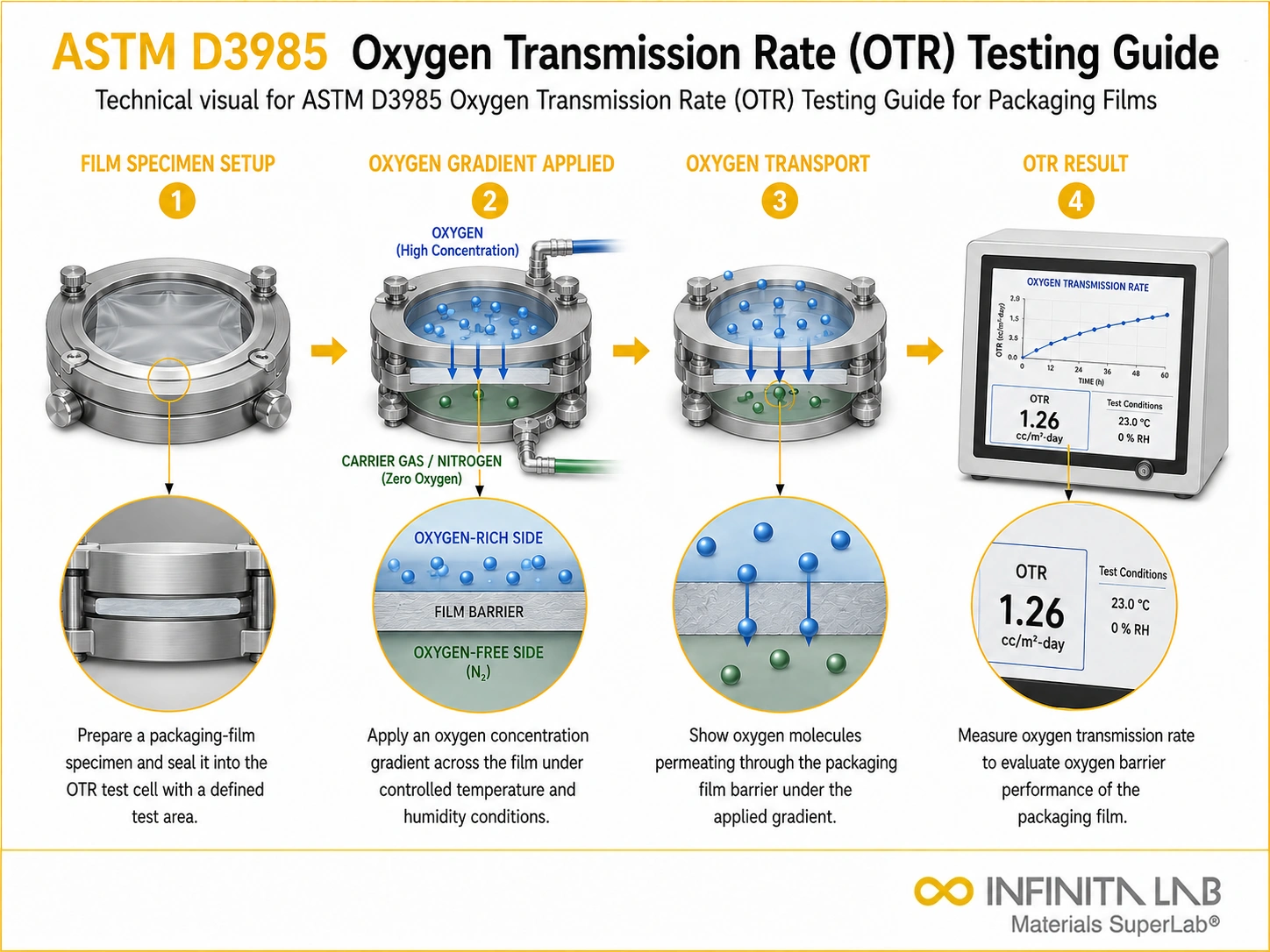


What Is ASTM D3985 Oxygen Transmission Rate Guide?
ASTM D3985 defines a standardized method for measuring the oxygen transmission rate (OTR) of plastic films, sheeting, and laminates using a coulometric sensor detection system. OTR is one of the most critical barrier properties for packaging materials used in food, pharmaceutical, and medical applications, where oxygen ingress causes oxidation, spoilage, or degradation of the packaged contents.
The test uses a diffusion cell in which the test film separates two chambers. One side is purged with nitrogen (or another carrier gas), while the other is exposed to oxygen at the specified partial pressure. After steady-state permeation is established, the oxygen that diffuses through the film is detected by a coulometric (electrochemical) sensor. The OTR is calculated as the volume of oxygen permeating through a unit area per unit time under specified conditions of temperature and relative humidity.

Applications and Benefits of ASTM D3985 Oxygen Transmission Rate Guide Testing
Scope
ASTM D3985 evaluates:
- Oxygen transmission rate (OTR) of plastic films and laminates
- Barrier performance at specified temperature and humidity
- Effect of relative humidity on OTR (for moisture-sensitive barriers)
- Comparative barrier performance of packaging materials
- Permeability coefficient of oxygen through the film
- Thickness-normalized oxygen permeability
Applications
- Food packaging films (snack, meat, dairy, coffee)
- Pharmaceutical blister and pouch packaging
- Medical device packaging
- Flexible laminate barrier evaluation
- Multilayer film barrier performance verification
- Active packaging oxygen scavenger evaluation
- Research and development in barrier polymer science
Benefits
- Provides critical packaging shelf-life data
- Enables selection of barrier films for oxygen-sensitive products
- Detects barrier degradation from converting or laminating processes
- Supports packaging design for target shelf-life
- Enables compliance with packaging specifications
- Provides data for product stability and shelf-life modeling
Our ASTM D3985 Testing Procedure
Specimen Preparation
Film specimens are cut and mounted in the diffusion cell; effective test area is defined.
1Cell Conditioning
Both cell chambers are purged; carrier gas (N₂) flows on the detection side.
2Oxygen Exposure
Test side is exposed to oxygen at the specified pressure and temperature.
3OTR Measurement
After steady-state is achieved, the coulometric sensor measures oxygen flux; OTR is calculated.
4ASTM D3985 Test Parameters and Requirements
| Parameter | Details |
|---|---|
| Test Principle | Coulometric detection of steady-state oxygen permeation |
| Test Conditions | 23°C, 0% RH (standard); other T/RH available |
| Applicable Materials | Plastic films, sheeting, and laminates |
| Output Units | cm³/(m²·day·atm) or cc/(100 in²·day) |
| Measured Outputs | OTR, oxygen permeability coefficient |


- Coulometric OTR analyzer (e.g., Mocon OX-TRAN)
- Diffusion test cells
- Certified gas supplies (O₂, N₂)
- Temperature and humidity control system
- Film thickness gauge
- Data acquisition software
Equipment and Instrumentation Used for ASTM D3985 Testing
What You Receive: Test Report, Data, and Certification
- Oxygen transmission rate (OTR) values
- Oxygen permeability coefficient (normalized to thickness)
- Test condition records (temperature, humidity)
- Statistical summary of results
- Compliance documentation
- Packaging barrier performance reports
ASTM D3985 Oxygen Transmission Rate Guide FAQs
ASTM D3985 measures oxygen transmission rate through plastic films and packaging materials. It evaluates barrier performance, helping determine shelf life, product protection, and suitability for oxygen-sensitive applications such as food and pharmaceuticals.
Key parameters include temperature, relative humidity, oxygen concentration, film thickness, and test area. Controlled conditions ensure accurate measurement of oxygen permeability through packaging materials.
The test measures oxygen transmission rate, typically expressed in cc/m²/day. Results indicate barrier effectiveness and ability of materials to protect contents from oxygen exposure.
ASTM D3985 applies to plastic films, laminates, and packaging materials used in food, medical, and industrial applications requiring controlled oxygen permeability.
ASTM D3985 results depend on controlled environmental conditions and sample preparation. They may not fully represent real-world storage conditions, requiring additional testing for varying humidity, temperature, or product interactions.
An oxygen transmission rate (OTR) tester measures how much oxygen passes through a packaging material over time. The specimen is sealed between two chambers, with oxygen on one side and a nitrogen carrier gas on the other. Oxygen permeating through the specimen is carried to a coulometric sensor, which measures the transmitted oxygen and determines the OTR. The results help evaluate barrier performance and packaging shelf life.
OTR testing evaluates the ability of packaging materials to resist oxygen transmission. A film, sheet, or laminate specimen is mounted in a test cell under controlled conditions. Oxygen passes through the material and is measured by a suitable sensor after reaching a steady transmission rate. The results are typically expressed as oxygen volume transmitted per unit area per day and help assess packaging protection for food, pharmaceuticals, and other products.
An ASTM D3985 OTR tester is an instrument used to measure the steady-state oxygen transmission rate through plastic films, sheets, laminates, and plastic-coated papers or fabrics using a coulometric sensor. The sample separates an oxygen-containing chamber from a nitrogen-purged chamber, and the sensor measures the oxygen that permeates through it. ASTM D3985-24 is the active edition listed by ASTM International and also supports determining oxygen permeance and, for homogeneous materials, the oxygen permeability coefficient.
Why Choose Infinita Lab for Oxygen Transmission Rate Guide Testing
When your Oxygen Transmission Rate Guide results have to hold up - for compliance, a customer audit, or an engineering decision - ASTM D3985 accuracy and an unbiased third-party report matter more than price. Infinita Lab routes your ASTM D3985 oxygen transmission rate guide testing to ISO/IEC 17025-accredited U.S. partner labs with hands-on method experience, so you get defensible data, transparent reporting, and turnaround times built around your project deadline - not ours.

Need ASTM D3985 Oxygen Transmission Rate Guide Testing You Can Rely On?
Send query us at hello@infinitalab.com or call us at (888) 878-3090 to learn more about our services and how we can support you.





