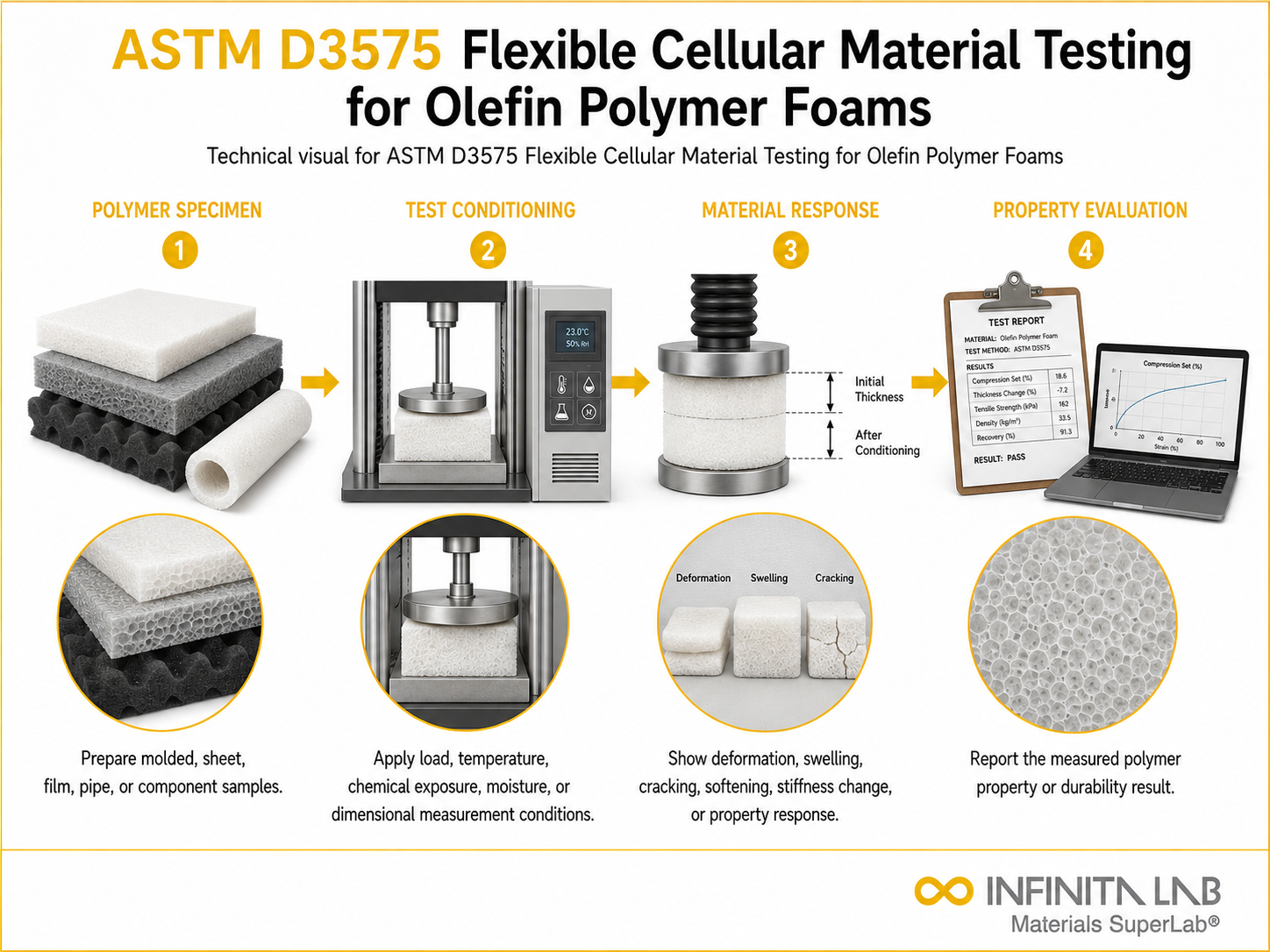


What Is ASTM D3575 Polyolefin Foam Flexible Cellular?
ASTM D3575, officially titled “Standard Test Methods for Flexible Cellular Materials Made from Olefin Polymers,” is the standard most people in the industry shorten to “D3575.” It isn’t one test. It’s a family of individual test methods, each tagged with a letter suffix, bundled under a single designation so a lab can pull whichever procedures a given foam actually needs.
Each suffix method spells out its own apparatus, specimen setup, and step-by-step procedure for one specific property: density, compression set, compression deflection, tensile strength and elongation, tear resistance, water absorption, buoyancy, thermal conductivity, thermal stability, flammability resistance, compressive creep. Nobody runs the whole alphabet on every sample. A lab selects the suffixes relevant to the foam’s end use, then tests only those.
Before any of that starts, specimens get conditioned under the standard laboratory atmosphere the standard specifies, so humidity and temperature don’t skew what gets measured later. Results come back in SI units, per the standard’s own requirement, which keeps numbers comparable across labs and across time.
Here’s the part that trips people up: D3575 defines procedures only. It doesn’t hand down pass/fail numbers for any property it covers. Acceptance criteria live elsewhere, either in ASTM D4819, the companion specification written for olefin foam products, or in whatever spec the purchaser and supplier agree to themselves. That separation is deliberate. The same suffix methods apply no matter which document ultimately judges the numbers, which is what lets one set of procedures serve research, quality control, and acceptance testing all at once.
The current active edition is D3575-20, maintained by ASTM Subcommittee D20.22 under Committee D20 on Plastics.

Applications and Benefits of ASTM D3575 Polyolefin Foam Flexible Cellular Testing
Scope
ASTM D3575 defines procedures for testing and classifying flexible olefin-based cellular materials based on their physical and performance properties.
- This standard applies to flexible, closed-cell foams made from olefin polymers, including polyethylene, polypropylene, and blends of those resins with other polymer systems.
- No pass/fail limits here. D3575 defines procedures only; acceptance criteria come from the purchaser’s own spec or from the companion standard, ASTM D4819.
- It’s built as a family of individual test methods, each tagged with a letter suffix, so a lab runs only the properties that matter for a given foam product.
- Suffix methods cover compression set, compression deflection, tensile strength and elongation, tear resistance, water absorption, density, buoyancy, thermal conductivity, thermal stability, flammability resistance, and compressive creep.
- Results are reported in SI units. Specimens are generally conditioned under standard laboratory atmosphere beforehand, so results stay comparable across labs.
- The data serves several purposes: research and development, ongoing quality control, acceptance or rejection against a spec, or other special arrangements agreed between supplier and purchaser.
- Because it’s procedure-focused rather than product-focused, the same protocol applies consistently no matter how different the formulations, densities, or cell structures are.
- Clients often request D3575 testing alongside other foam and polymer standards, especially when a full performance profile needs documenting for a customer file or regulatory submission.
Applications
- Protective packaging inserts for electronics, instruments, and other fragile goods
- Pipe, duct, and HVAC insulation sleeves and wraps built from closed-cell olefin foam
- Automotive interior padding, gaskets, and components that damp sound or vibration
- Marine and flotation products, where buoyancy and water resistance have to be predictable
- Padding for sporting goods and recreational equipment, mats and protective gear included
- Construction and building applications where thermal and moisture performance really matter
- Industrial sealing, cushioning, and vibration-isolation parts
Benefits
- Confirms how a foam performs under compression, tension, and sustained load before it ever ships
- Objective, repeatable data: the kind that actually supports material selection and supplier qualification calls
- Flags moisture sensitivity and buoyancy issues early, which matters a lot for marine, packaging, or outdoor use
- Gives production teams a consistent way to track batch-to-batch performance, not just a one-off snapshot
- Lets engineering validate design assumptions against real numbers instead of published averages
- Builds a documented, standard-referenced record that backs up customer confidence and regulatory filings
Our ASTM D3575 Testing Procedure
Sample Preparation
Foam specimens are cut to standard dimensions and conditioned before testing.
1Property Evaluation
Tests such as density, compression, and tensile strength are conducted.
2Load Application
Controlled forces are applied to measure deformation and mechanical response.
3Result Interpretation
Results are analyzed and compared with classification requirements.
4ASTM D3575 Test Parameters and Requirements
| Parameter | Details |
|---|---|
| Material Type | Olefin-based flexible foams |
| Properties | Density, compression, tensile strength |
| Density Units | kg/m³ |
| Compression | Compression set and deflection |
| Tensile Strength | Measured under strain |
| Structure | Closed-cell or open-cell foam |
| Conditioning | Standard temperature and humidity |
| Output | Material classification and properties |


- Compression testing machine with parallel plates: applies a controlled load for compression deflection and compression set measurements
- Universal tensile testing machine, which measures tensile strength and elongation at break on cut foam specimens
- Tear strength tester (determines resistance to tear propagation under the specified suffix method)
- Density and immersion apparatus: works out foam density and buoyancy characteristics via displacement
- Circulating-air oven for conditioning specimens and running thermal stability or heat-resistance tests
- Creep test fixture, fitted with a dial gauge or digital displacement sensor, tracks dimensional change under sustained compressive load over time
- Thermal conductivity testing equipment evaluates how heat moves through the foam structure
Equipment and Instrumentation Used for ASTM D3575 Testing
What You Receive: Test Report, Data, and Certification
- A detailed test report covering each suffix method performed, raw values and calculated values alike
- Data you can actually benchmark against a customer specification or ASTM D4819 requirements
- Mechanical property results: compression, tensile, and tear behavior
- Density, water absorption, and buoyancy figures, rounding out the physical property picture
- Documentation that supports quality control records, supplier qualification files, or regulatory submissions
- A clear record of test conditions, specimen preparation, and any deviations noted along the way
ASTM D3575 Polyolefin Foam Flexible Cellular FAQs
ASTM D3575 is used to evaluate the physical and mechanical properties of flexible cellular materials made from olefin polymers. It ensures materials meet performance requirements for cushioning, durability, and insulation, supporting consistent quality and reliable product performance across applications.
Density affects strength, cushioning ability, and durability. Higher density foams generally offer better load-bearing capacity and longevity, while lower density foams provide lighter weight and improved flexibility for specific applications.
Compression testing measures how foam behaves under load, including deformation and recovery. It helps determine the material’s ability to maintain shape and performance under repeated or sustained pressure.
Factors include sample preparation, environmental conditions, foam structure, and testing parameters. Proper control ensures accurate and repeatable results.
Tensile strength indicates the foam’s ability to resist stretching forces. It is important for applications where the material may be subjected to tension or deformation.
ASTM D3575 is the Standard Test Methods for Flexible Cellular Materials Made From Olefin Polymers. It covers testing of flexible closed-cell olefin materials, including properties used for quality control and material evaluation.
ASTM D3575 and ISO 7214 address the same subject matter, but ASTM notes that they differ in technical content; therefore, ISO 7214 is not a direct equivalent.
Foam testing evaluates properties such as density, compression, tensile strength, and dimensional stability using specified test procedures to assess material performance and consistency.
Why Choose Infinita Lab for Polyolefin Foam Flexible Cellular Testing
When your Polyolefin Foam Flexible Cellular results have to hold up - for compliance, a customer audit, or an engineering decision - ASTM D3575 accuracy and an unbiased third-party report matter more than price. Infinita Lab routes your ASTM D3575 polyolefin foam flexible cellular testing to ISO/IEC 17025-accredited U.S. partner labs with hands-on method experience, so you get defensible data, transparent reporting, and turnaround times built around your project deadline - not ours.

Need ASTM D3575 Polyolefin Foam Flexible Cellular Testing You Can Rely On?
Send query us at hello@infinitalab.com or call us at (888) 878-3090 to learn more about our services and how we can support you.





