


ASTM D3574 Flexible Urethane Foam Testing – Slab, Bonded & Molded
The ASTM D3574 contains several test methods applied to the slab, bonded, and molded flexible cellular products known as urethane foams. Urethane foam is an expanded cellular product that interacts with active hydrogen compounds, water, and isocyanates. The values stated in SI units are regarded as standard. Read more about ASTM D3574 Flexible Cellular Materials – Slab, Bonded, and Molded Urethane Foams below.
TRUSTED BY


Precision-driven testing for dimensional accuracy and compliance
- Overview
- Scope, Applications, and Benefits
- Test Process
- Specifications
- Instrumentation
- Results and Deliverables
Overview
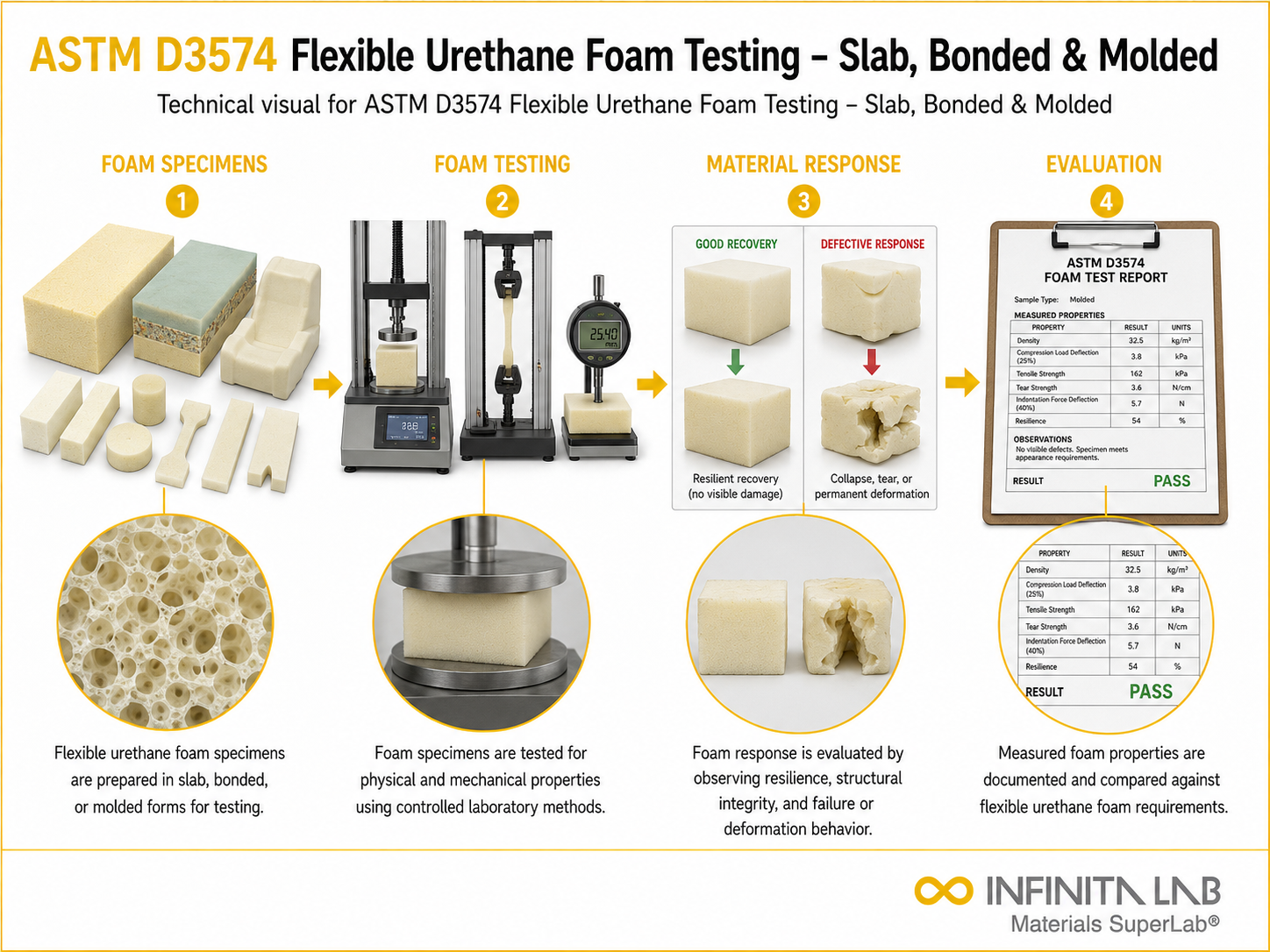
ASTM D3574 covers the testing of flexible cellular urethane foams, including slabstock, bonded, and molded forms. It defines methods to evaluate physical properties such as density, compression, tensile strength, and resilience under controlled laboratory conditions.
This standard is widely used to ensure consistent quality and performance of flexible foam materials. It supports product development, quality control, and material comparison, ensuring foams meet required specifications for cushioning, durability, and load-bearing performance.

Scope, Applications, and Benefits
Scope
ASTM D3574 establishes test procedures for determining key physical and mechanical properties of flexible urethane foams used in various applications.
- Applicable to slabstock, bonded, and molded urethane foams
- Measures density, compression, tensile, and resilience properties
- Includes multiple test methods under a single standard
- Suitable for quality control and product development
- Supports material comparison and specification compliance
- Evaluates durability and performance characteristics
- Used for both laboratory and industrial testing
Applications
- Furniture cushioning and mattresses
- Automotive seating and interiors
- Packaging and protective materials
- Acoustic and insulation products
- Consumer and industrial foam products
Benefits
- Provides comprehensive material characterization
- Ensures consistent foam quality
- Supports product design and optimization
- Enables comparison between foam types
- Improves durability and performance
Test Process
Sample Preparation
Foam specimens are cut to specified dimensions and conditioned.
1Property Testing
Tests such as density, compression, and tensile strength are performed.
2Load Application
Controlled loads are applied to evaluate deformation and recovery behavior.
3Result Analysis
Measured values are analyzed and compared with standard requirements.
4Technical Specifications
| Parameter | Details |
|---|---|
| Material Type | Flexible cellular urethane foams |
| Properties | Density, compression, tensile, resilience |
| Density Units | kg/m³ |
| Hardness | Indentation force deflection (IFD) |
| Compression | Compression set and deflection |
| Tensile Strength | Measured under controlled strain |
| Resilience | Ball rebound method |
| Conditioning | Standard temperature and humidity |


Instrumentation Used for Testing
- Compression testing machine
- Tensile testing machine
- Density measurement equipment
- Ball rebound tester
- Cutting and specimen preparation tools
Results and Deliverables
- Density and hardness values
- Compression and resilience properties
- Tensile strength and elongation
- Test conditions and observations
- Compliance statement with ASTM D3574
Frequently Asked Questions
ASTM D3574 is used to evaluate the physical and mechanical properties of flexible urethane foams. It ensures materials meet performance requirements for cushioning, durability, and load-bearing, supporting quality control, product development, and consistent manufacturing across various applications.
The standard applies to slabstock, bonded, and molded flexible urethane foams. These materials are commonly used in furniture, automotive, and industrial applications where cushioning and resilience are important performance characteristics.
Density affects the strength, durability, and cushioning performance of foam. Higher density foams generally offer better support and longer life, while lower density foams provide softer cushioning but may wear out faster.
IFD measures the force required to compress the foam to a specific percentage of its thickness. It indicates firmness and is critical for applications where comfort and support must be carefully balanced.
Factors include sample preparation, environmental conditions, foam composition, and testing parameters. Proper control of these factors ensures reliable and repeatable results.
Why Choose Infinita Lab for Advanced Materials Testing and Characterization?
At the core of this breadth is our network of 2,000+ accredited laboratories across the USA, offering access to over 10,000 testing methods and analytical services. From advanced materials characterization (SEM, TEM, RBS, XPS) to mechanical, chemical, environmental, biological, and standardized ASTM/ISO-compliant testing, we deliver unmatched flexibility, specialization, and scale. You are never limited by geography, facility, or methodology — Infinita Lab connects you to the right expertise and testing solution, every time.

Looking for a Trusted Partner for Accurate and Reliable Testing Services?
Send query us at hello@infinitlab.com or call us at (888) 878-3090 to learn more about our services and how we can support you.



Request a Quote
Submit your material details and receive testing procedures, pricing, and turnaround time within 24 hours.
 Quick Turnaround and Hasslefree process
 Confidentiality Guarantee
 Free, No-obligation Consultation
 100% Customer Satisfaction
