

Plasticizer Sorption - Overview
Plasticizer sorption behavior in PVC resins evaluates the rate and extent to which polyvinyl chloride (PVC) absorbs plasticizers under controlled conditions. This behavior directly influences flexibility, processability, and long-term performance of PVC-based materials in industrial applications.
The test under ASTM D3367 helps quantify plasticizer uptake characteristics, providing insights into resin compatibility, diffusion behavior, and equilibrium absorption. It is essential for optimizing formulation design and ensuring consistent material performance in plasticized PVC systems.

Scope, Applications, and Benefits
Scope
This testing method focuses on evaluating plasticizer absorption behavior of PVC resins under standardized laboratory conditions to understand compatibility and sorption kinetics.
It includes measurement of absorption rate, equilibrium uptake, and interaction behavior between PVC resins and different plasticizers.
- Measurement of plasticizer absorption rate in PVC resins
- Determination of equilibrium sorption capacity
- Evaluation of resin–plasticizer compatibility
- Analysis of diffusion and uptake behavior
- Assessment of formulation stability
- Comparison of different PVC resin grades
- Study of temperature-dependent sorption effects
- Evaluation of processing performance impact
Applications
- PVC compound formulation development
- Plasticizer selection for polymer systems
- Flexible PVC product manufacturing
- Cable and wire insulation materials
- Flooring and sheet materials
- Quality control in polymer processing
Benefits
- Optimizes PVC formulation performance
- Improves flexibility and processing control
- Ensures consistent material behavior
- Reduces formulation instability risks
- Enhances product durability
- Supports material compatibility assessment
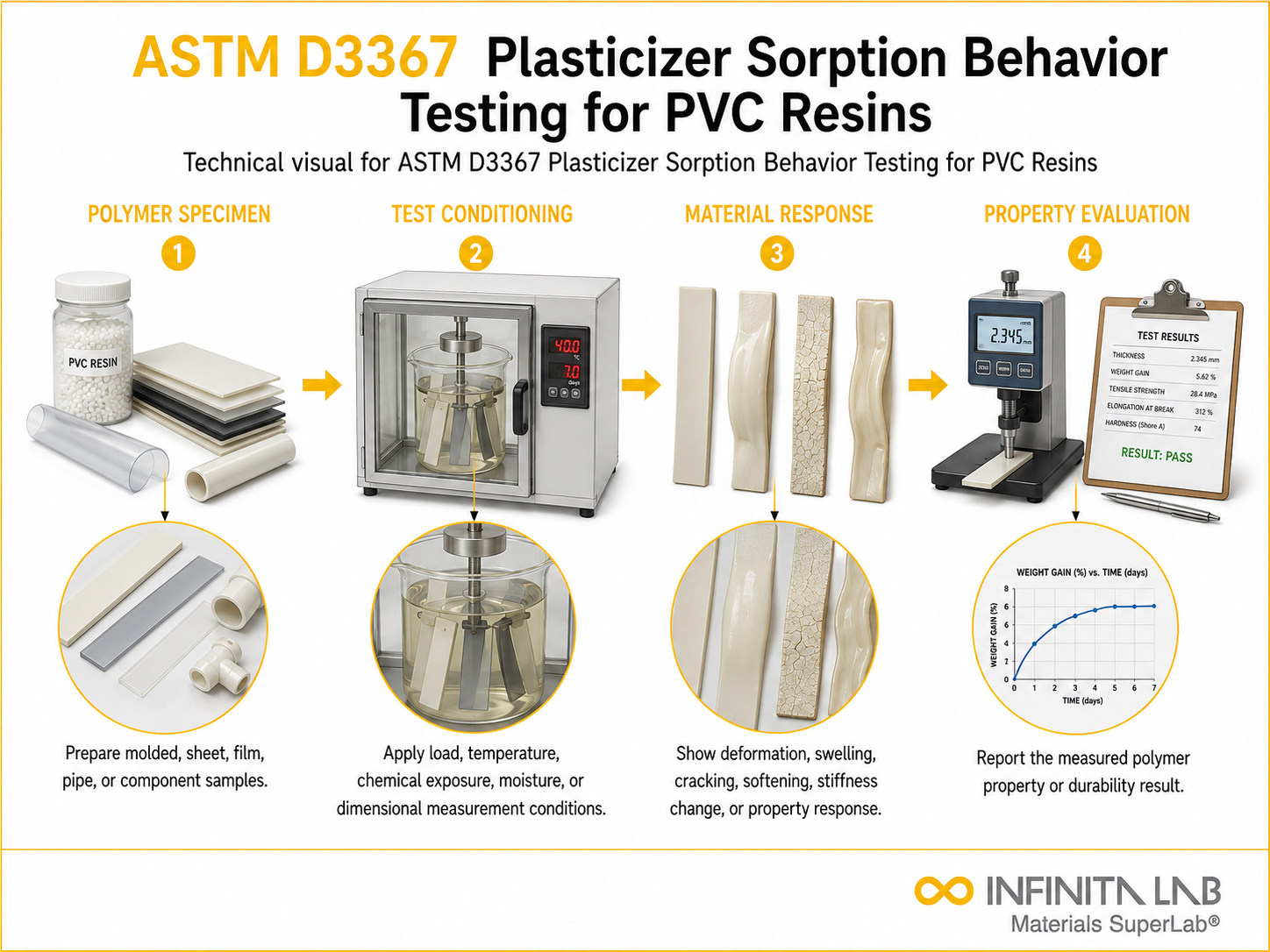
Plasticizer Sorption – Test Process
Sample Preparation & Conditioning
PVC resin samples are prepared and conditioned under controlled temperature to ensure consistent testing conditions.
1Plasticizer Exposure & Immersion
Samples are exposed to selected plasticizers under defined conditions to initiate absorption.
2Sorption Measurement & Monitoring
Plasticizer uptake is measured over time to evaluate absorption rate and equilibrium behavior.
3Data Analysis & Reporting
Results are analyzed to determine sorption characteristics and resin compatibility performance.
4Plasticizer Sorption – Technical Specification
| Parameter | Details |
|---|---|
| Standard | ASTM D3367 |
| Test Method | Gravimetric sorption analysis |
| Measurement Type | Plasticizer absorption and uptake rate |
| Sample Type | PVC resins |
| Loading Type | Controlled plasticizer immersion |
| Units | % mass increase, g/g absorption |
| Test Conditions | Controlled temperature and exposure time |


- Analytical balance
- Temperature-controlled bath
- Glass immersion containers
- Drying oven
- Desiccator
- Timing and monitoring system
Instrumentation Used for Testing
Results and Deliverables
- Plasticizer absorption rate data
- Equilibrium sorption values
- Compatibility assessment of PVC resins
- Diffusion behavior analysis
- Comparative resin performance report
- Detailed ASTM D3367 compliance report
Frequently Asked Question
ASTM D3367 determines how PVC resins absorb plasticizers under controlled conditions, helping evaluate compatibility, diffusion behavior, and equilibrium uptake. This information is essential for optimizing flexible PVC formulations and ensuring consistent processing and end-use performance.
Plasticizer sorption directly influences flexibility, elongation, and processing characteristics of PVC. Higher or uneven absorption can lead to variations in softness, mechanical strength, and long-term stability, making controlled sorption essential for predictable product performance.
Diffusion controls the rate at which plasticizer molecules penetrate PVC resin particles. Faster diffusion leads to quicker softening, while slower diffusion may indicate poor compatibility or dense resin structure affecting processing efficiency.
Absorption rate depends on resin particle size, porosity, temperature, plasticizer type, and molecular compatibility. These factors collectively influence how quickly and efficiently plasticizers are incorporated into the PVC matrix.
Good compatibility ensures uniform distribution of plasticizer within PVC, preventing migration, exudation, or phase separation. Poor compatibility can lead to inconsistent mechanical properties and reduced product lifespan.
Why Choose Infinita Lab for Advanced Materials Testing and Characterization?
At the core of this breadth is our network of 2,000+ accredited laboratories across the USA, offering access to over 10,000 testing methods and analytical services. From advanced materials characterization (SEM, TEM, RBS, XPS) to mechanical, chemical, environmental, biological, and standardized ASTM/ISO-compliant testing, we deliver unmatched flexibility, specialization, and scale. You are never limited by geography, facility, or methodology — Infinita Lab connects you to the right expertise and testing solution, every time.

Looking for a Trusted Partner for Accurate and Reliable Testing Services?
Send query us at hello@infinitalab.com or call us at (888) 878-3090 to learn more about our services and how we can support you.





