


ASTM D2287: Non Rigid Vinyl Chloride Compound Testing Services
Standard Classification ASTM D 2287 The non-rigid vinyl chloride polymer and copolymer classes covered by this classification system standard have a resin content of at least 90% vinyl chloride. The remaining 10% can be made up of other resins mechanically combined with polyvinyl chloride or its copolymers, one or more monomers copolymerized with vinyl chloride.
TRUSTED BY


Get ASTM D2287 compliant results — request your non rigid vinyl chloride compound testing quote
- Overview
- Scope, Applications, and Benefits
- Test Process
- Specifications
- Instrumentation
- Results and Deliverables
What Is ASTM D2287 Non Rigid Vinyl Chloride Compound?
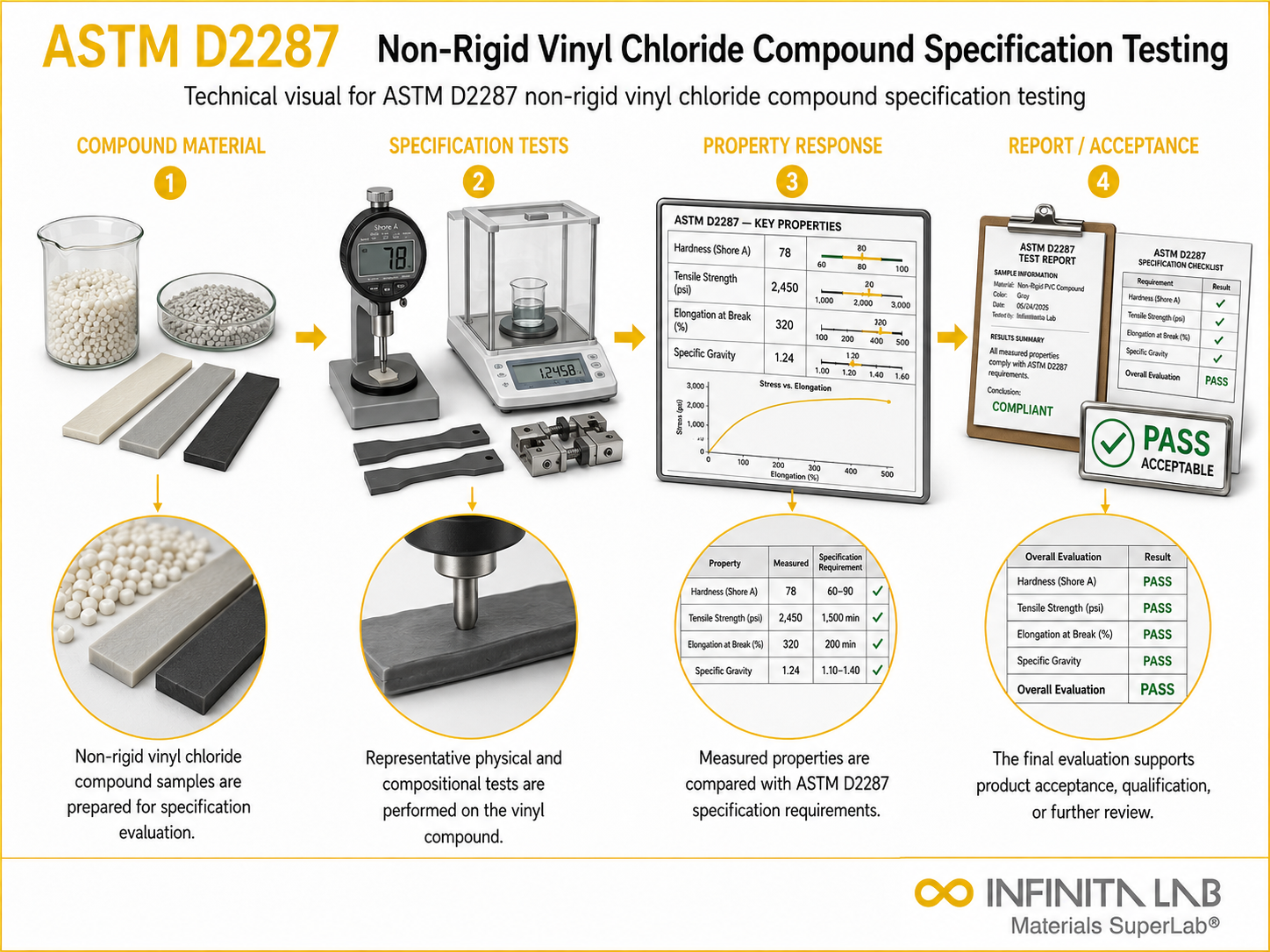
ASTM D2287 covers the evaluation of non-rigid vinyl chloride (PVC) materials, focusing on their physical and mechanical properties under controlled conditions. These materials are widely used in flexible applications where softness, elasticity, and durability are critical performance requirements.
The test assesses properties such as tensile strength, elongation, and flexibility to determine material suitability for intended applications. It ensures consistency in production quality and helps manufacturers verify that non-rigid PVC compounds meet specified performance and safety criteria.

Applications and Benefits of ASTM D2287 Non Rigid Vinyl Chloride Compound Testing
Scope
This test focuses on determining the mechanical and physical performance characteristics of non-rigid vinyl chloride materials to ensure compliance with ASTM D2287 requirements and suitability for flexible applications.
- Evaluation of tensile strength and elongation properties
- Assessment of flexibility and deformation behavior
- Verification of material consistency and uniformity
- Testing of flexible PVC compounds and sheets
- Comparison of material performance across batches
Applications
- Flexible tubing and hoses
- Cable insulation and sheathing
- Synthetic leather and films
- Medical and consumer flexible products
- Packaging materials
- Automotive interior components
Benefits
- Ensures consistent material performance
- Supports quality control in production
- Validates flexibility and durability
- Helps in material selection and design
- Reduces risk of product failure
- Improves compliance with industry standards
Our ASTM D2287 Testing Procedure
Sample Conditioning
Specimens are conditioned under controlled temperature and humidity to stabilize material properties before testing.
1Specimen Preparation
Standardized test samples are cut and prepared according to ASTM D2287 dimensional requirements.
2Mechanical Testing Execution
Tensile and elongation properties are measured using a universal testing machine under controlled loading conditions.
3Result Calculation & Evaluation
Measured values are analyzed and compared with specification limits for compliance determination.
4ASTM D2287 Test Parameters and Requirements
| Parameter | Details |
|---|---|
| Standard | ASTM D2287 for non-rigid vinyl chloride materials |
| Method | Uniaxial tensile testing for flexible PVC compounds |
| Measurement Type | Tensile strength and elongation behavior |
| Sample Type | Non-rigid PVC sheets, films, or molded specimens |
| Loading Type | Controlled tensile loading until failure |
| Units | MPa (strength), % elongation, N (force) |


- Universal testing machine (UTM)
- Extensometer
- Sample cutting tools
- Conditioning chamber
- Thickness gauge
- Vernier caliper
Equipment and Instrumentation Used for ASTM D2287 Testing
What You Receive: Test Report, Data, and Certification
- Tensile strength values
- Elongation at break (%)
- Stress–strain behavior analysis
- Compliance with ASTM D2287
- Detailed test report
- Material performance evaluation
ASTM D2287 Non Rigid Vinyl Chloride Compound FAQs
ASTM D2287 evaluates mechanical properties of non-rigid vinyl chloride materials, particularly tensile strength and elongation. It ensures that flexible PVC products meet performance requirements for durability, flexibility, and structural integrity in various applications.
Tensile testing determines how the material behaves under stretching forces. It provides critical data on strength and flexibility, helping ensure the material can withstand mechanical stresses during use without failure.
Elongation at break indicates how much a material can stretch before failure. Higher elongation values reflect better flexibility and ductility, which are essential for applications requiring repeated bending or deformation.
Factors include plasticizer content, formulation, processing conditions, temperature, and aging. Variations in these parameters can significantly influence strength and flexibility characteristics.
Stress–strain curves provide detailed insight into material behavior under load, including elasticity, yield point, and failure characteristics, enabling comprehensive evaluation of performance.
Why Choose Infinita Lab for Non Rigid Vinyl Chloride Compound Testing
At the core of this breadth is our network of 2,000+ accredited laboratories across the USA, offering access to over 10,000 testing methods and analytical services. From advanced materials characterization (SEM, TEM, RBS, XPS) to mechanical, chemical, environmental, biological, and standardized ASTM/ISO-compliant testing, we deliver unmatched flexibility, specialization, and scale. You are never limited by geography, facility, or methodology — Infinita Lab connects you to the right expertise and testing solution, every time.

Need ASTM D2287 Non Rigid Vinyl Chloride Compound Testing You Can Rely On?
Send query us at hello@infinitalab.com or call us at (888) 878-3090 to learn more about our services and how we can support you.



Request a Quote
Submit your material details and receive testing procedures, pricing, and turnaround time within 24 hours.
 Quick Turnaround and Hasslefree process
 Confidentiality Guarantee
 Free, No-obligation Consultation
 100% Customer Satisfaction
