

What Is ASTM D1945 Natural Gas Gc Analysis?
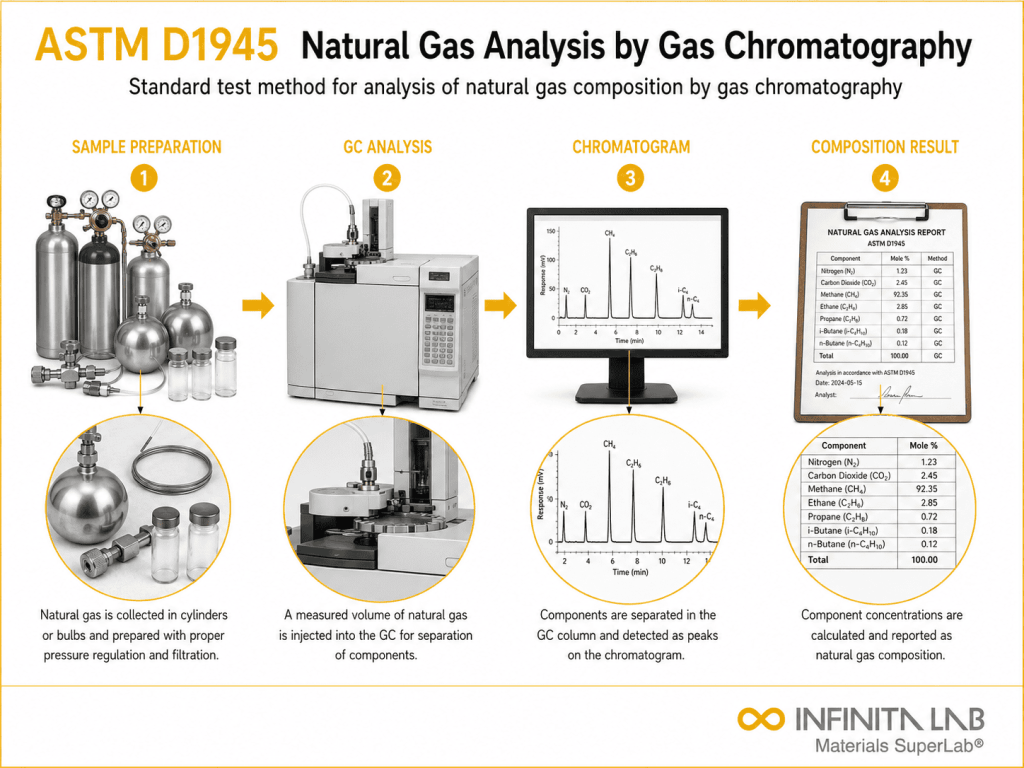
ASTM D1945 outlines a standardised gas chromatographic method for determining the chemical composition of natural gas and similar gaseous fuel mixtures. The analysis identifies and quantifies individual hydrocarbon components, as well as non-hydrocarbon constituents such as nitrogen, carbon dioxide, and hydrogen sulfide.
The method uses a gas chromatograph equipped with appropriate columns and detectors to separate gas mixture components. Each component is identified by its retention time and quantified by peak area or peak height relative to calibration standards. Results are used to calculate key gas properties such as heating value, relative density, and compressibility factor.
ASTM D1945 is widely used by natural gas producers, pipeline operators, and utilities for custody transfer, quality verification, and process monitoring.
Applications and Benefits of ASTM D1945 Natural Gas Gc Analysis Testing
Scope
ASTM D1945 evaluates the chemical composition of natural gas and similar gaseous mixtures using gas chromatography. The method is widely used to determine the concentration of hydrocarbons from C1 (methane) through C6+ fractions, along with key non-hydrocarbon gases such as nitrogen, carbon dioxide, hydrogen sulfide, helium, and oxygen. The results are reported as the relative mole percent of each component, which is essential for calculating important fuel properties such as heating value, Wobbe index, and relative density.
ASTM D1945 evaluates:
- Hydrocarbon composition (C1 through C6+)
- Non-hydrocarbon content (N₂, CO₂, H₂S, He, O₂)
- Relative mole percent of each component
- Calculated heating value from composition data
- Wobbe index and relative density
- Compliance with pipeline gas quality specifications
Applications
- Natural gas custody transfer
- Pipeline quality monitoring
- LNG and CNG composition verification
- Gas processing plant operations
- Refinery gas analysis
- Utility and distribution companies
- Research and development
Benefits
- Ensures compliance with gas quality standards
- Supports accurate billing in custody transfer
- Identifies out-of-specification gas streams
- Enables process optimisation in gas plants
- Provides data for safety and environmental reporting
- Reduces equipment damage from off-spec gas
Our ASTM D1945 Testing Procedure
Sample Collection
Gas sample is collected in an appropriate container or sampling cylinder.
1Instrument Calibration
GC is calibrated with certified reference gas standards.
2Injection & Separation
Sample is injected and components are separated on chromatographic columns.
3Identification & Quantification
Components are identified by retention time and quantified against standards.
4ASTM D1945 Test Parameters and Requirements
| Parameter | Details |
|---|---|
| Test Principle | Gas chromatographic separation and detection |
| Detector Types | Thermal conductivity detector (TCD) |
| Applicable Materials | Natural gas and similar gaseous fuels |
| Output Units | Mole percent (%) |
| Measured Outputs | Component composition, calculated heating value, relative density |


- Gas chromatograph with TCD
- Certified reference gas standards
- Sampling cylinders and valves
- Data acquisition and integration software
- Pressure regulators and flow controllers
- Temperature-controlled column oven
Equipment and Instrumentation Used for ASTM D1945 Testing
What You Receive: Test Report, Data, and Certification
- Mole percent composition report
- Calculated gross and net heating values
- Relative density and Wobbe index
- Chromatogram with peak identification
- Compliance documentation
- Calibration records and traceability data
ASTM D1945 Natural Gas Gc Analysis FAQs
ASTM D1945 is a standard test method used for the analysis of natural gas and similar gaseous mixtures by gas chromatography (GC). It determines the chemical composition of hydrocarbons and non-hydrocarbon gases present in the sample.
The test measures hydrocarbon components from methane (C1) through hexanes and heavier fractions (C6+), along with gases such as nitrogen (N₂), carbon dioxide (CO₂), hydrogen sulfide (H₂S), oxygen (O₂), helium (He), and hydrogen (H₂).
This test is essential for pipeline gas quality verification, custody transfer, fuel performance evaluation, and process control in gas production and distribution industries.
ASTM D1945 uses gas chromatography (GC), where the gas sample is separated into individual components and quantified using a detector system.
Yes, the composition data obtained from the test is commonly used to calculate the higher heating value (HHV), lower heating value (LHV), and Wobbe index of the gas sample.
ASTM D1946-90 is a standard practice for determining the chemical composition of reformed gases and similar gaseous mixtures using gas chromatography. A gas sample is introduced into a chromatograph, where its individual components are separated using a suitable chromatographic column. The detector measures the response of each component, and the resulting peak areas or heights are compared with those of a reference gas mixture of known composition. The analysis identifies and quantifies components such as hydrogen, oxygen, nitrogen, carbon monoxide, carbon dioxide, methane, ethane, and ethylene. The results help determine gas composition, calorific value, and relative density.
Why Choose Infinita Lab for Natural Gas Gc Analysis Testing
When your Natural Gas Gc Analysis results have to hold up - for compliance, a customer audit, or an engineering decision - ASTM D1945 accuracy and an unbiased third-party report matter more than price. Infinita Lab routes your ASTM D1945 natural gas gc analysis testing to ISO/IEC 17025-accredited U.S. partner labs with hands-on method experience, so you get defensible data, transparent reporting, and turnaround times built around your project deadline - not ours.

Need ASTM D1945 Natural Gas Gc Analysis Testing You Can Rely On?
Send query us at hello@infinitalab.com or call us at (888) 878-3090 to learn more about our services and how we can support you.



