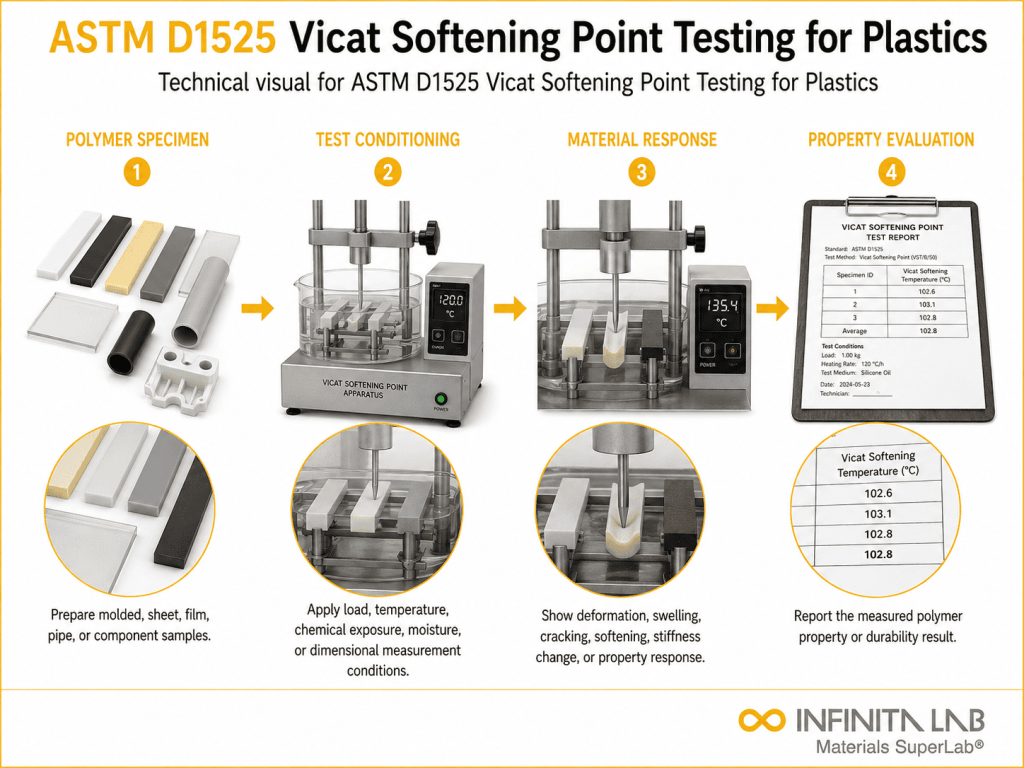


What Is ASTM D1525 Vicat Softening Point Plastics?
The Vicat Softening Point test determines the temperature at which a plastic material begins to soften under a defined load, providing a standardized measure of heat resistance. ASTM D1525 applies a flat-ended needle to a plastic specimen under specific force conditions while the temperature is raised at a controlled rate until the needle penetrates 1 mm into the surface.
This test is widely used in material selection, quality control, and product development to compare the thermal behavior of thermoplastics. It helps engineers and manufacturers understand how a plastic material will perform under elevated temperature conditions, ensuring suitability for end-use applications where heat exposure is a concern.
Applications and Benefits of ASTM D1525 Vicat Softening Point Plastics Testing
Scope
ASTM D1525 covers the determination of the Vicat softening temperature of thermoplastic materials using a needle indenter under controlled heating and load conditions. The test is applicable to molded, extruded, or sheet forms of thermoplastics and provides a single-point temperature reference rather than a complete thermal profile.
The standard covers:
- Two load conditions: 10 N and 50 N
- Two heating rates: 50°C/h and 120°C/h
- Specimen forms including molded plaques, sheets, and cut samples
- Materials with Vicat softening points between 20°C and 220°C
- Both amorphous and semi-crystalline thermoplastics
Applications
- Thermoplastic resin qualification and incoming material inspection
- Comparison of heat resistance between polymer grades or formulations
- Quality control in plastic compounding and extrusion
- Evaluation of filled, reinforced, or flame-retardant plastic compounds
- Material selection for automotive interior and under-hood plastic components
- Assessment of plastic pipes, fittings, and profiles for elevated temperature use
- Performance validation of plastic packaging materials
- Polymer blend and alloy development in R&D environments
- Regulatory and standards compliance testing for plastic components
Benefits
- Provides a simple, reproducible single-point measure of thermal softening
- Low specimen preparation complexity with multiple acceptable forms
- Enables direct comparison across grades, suppliers, and formulations
- Recognized globally and aligns with ISO 306 for international reporting
- Short test duration allows high-throughput quality control screening
- Applicable to a broad range of thermoplastic materials and product forms
- Supports material certification and datasheet generation
Our ASTM D1525 Testing Procedure
Specimen Preparation
Standard-sized plastic specimen is prepared with smooth surface and uniform thickness.
1Load Application
A specified load is applied through a flat-ended needle onto the specimen.
2Controlled Heating
Temperature is increased at a constant rate until penetration occurs.
3Vicat Determination
Temperature at 1 mm needle penetration is recorded as the Vicat softening point.
4ASTM D1525 Test Parameters and Requirements
| Parameter | Details |
|---|---|
| Load Options | Commonly 10 N or 50 N applied load |
| Heating Rate | Typically 50°C/h or 120°C/h |
| Penetration Depth | Standard 1 mm penetration criteria |
| Specimen Thickness | Generally 3–6 mm |
| Temperature Range | Ambient to ~300°C depending on material |
| Needle Type | Flat-ended steel needle |
| Medium | Oil bath or air heating system |
| Result Unit | Temperature in °C |


- Vicat softening point apparatus
- Temperature-controlled oil bath or heating chamber
- Flat-ended penetration needle
- Load application system (weights)
- Temperature measurement sensors (thermocouples)
Equipment and Instrumentation Used for ASTM D1525 Testing
What You Receive: Test Report, Data, and Certification
- Vicat softening temperature (°C)
- Test conditions (load and heating rate)
- Sample identification details
- Observation of deformation behavior
- Compliance statement with ASTM D1525
ASTM D1525 Vicat Softening Point Plastics FAQs
ASTM D1525 is used to determine the Vicat softening temperature of plastics, which indicates the temperature at which a material begins to soften under a specified load. It helps evaluate thermal resistance and suitability for high-temperature applications.
Vicat softening temperature represents the point at which a plastic material softens enough for a needle to penetrate under load. It provides a comparative measure of heat resistance and helps determine service temperature limits.
Heating rate affects how quickly the material reaches softening conditions. Standard rates such as 50°C/h or 120°C/h ensure consistent and comparable results across different materials and testing laboratories.
Vicat softening temperature measures softening under penetration, while heat deflection temperature measures deformation under bending load. Both provide thermal performance data but differ in testing approach and application relevance.
ASTM D1525 helps identify materials suitable for high-temperature environments by providing critical softening data. This ensures proper material selection, improved product performance, and reduced risk of thermal failure.
Vicat testing determines the temperature at which a thermoplastic material softens under a specified load. A flat-ended needle is placed on the specimen while the temperature increases at a controlled rate. The temperature at which the needle penetrates to the specified depth is recorded as the Vicat softening temperature.
The Vicat softening point test measures the heat resistance of thermoplastic materials under a defined load. A specimen is heated in a controlled bath while a loaded needle presses against its surface. When the needle reaches the specified penetration depth, the corresponding temperature is recorded, helping compare the thermal performance of different plastics.
ASTM D1525 specifies the test method for determining the Vicat softening temperature of plastics. A specimen is subjected to a specified load through a flat-ended needle while being heated at a controlled rate. The temperature at which the needle penetrates 1 mm into the specimen is recorded to evaluate its heat-softening characteristics.
Why Choose Infinita Lab for Vicat Softening Point Plastics Testing
When your Vicat Softening Point Plastics results have to hold up - for compliance, a customer audit, or an engineering decision - ASTM D1525 accuracy and an unbiased third-party report matter more than price. Infinita Lab routes your ASTM D1525 vicat softening point plastics testing to ISO/IEC 17025-accredited U.S. partner labs with hands-on method experience, so you get defensible data, transparent reporting, and turnaround times built around your project deadline - not ours.

Need ASTM D1525 Vicat Softening Point Plastics Testing You Can Rely On?
Send query us at hello@infinitalab.com or call us at (888) 878-3090 to learn more about our services and how we can support you.



