


ASTM C770: Glass Stress Optical Coefficient Testing Services
Accredited ASTM C770 glass stress optical coefficient testing from Infinita Lab, performed to the exact standard requirements - accurate, reproducible results with full documentation for compliance, R&D, and quality control programs.
TRUSTED BY


Get ASTM C770 compliant results - request your glass stress optical coefficient testing quote
- Overview
- Scope, Applications, and Benefits
- Test Process
- Specifications
- Instrumentation
- Results and Deliverables
What Is ASTM C770 Glass Stress Optical Coefficient?
ASTM C770 determines the stress-optical coefficient of glass, which relates mechanical stress to optical birefringence. This property is essential for understanding how stress affects light transmission and optical performance in glass materials.
This method is widely used in optical glass, display technologies, and precision components. It helps evaluate stress-induced optical distortion and ensures material suitability for high-performance optical applications.

Applications and Benefits of ASTM C770 Glass Stress Optical Coefficient Testing
Scope
ASTM C770 evaluates the relationship between applied stress and resulting optical birefringence in glass. The test determines the stress-optical coefficient used for stress analysis and optical design.
The test evaluates:
- Stress-optical coefficient of glass
- Optical birefringence under stress
- Relationship between stress and optical behavior
- Internal stress effects on transparency
- Suitability for optical applications
Applications
- Optical and precision glass components
- Display panels and screens
- Fiber optics and photonics
- Scientific and laboratory glass
- Glass used in imaging systems
- Quality control in glass manufacturing
Benefits
- Provides accurate stress-optical property data
- Helps detect internal stress in glass
- Supports optical design and engineering
- Assists in improving product performance
- Enables comparison of glass materials
Our ASTM C770 Testing Procedure
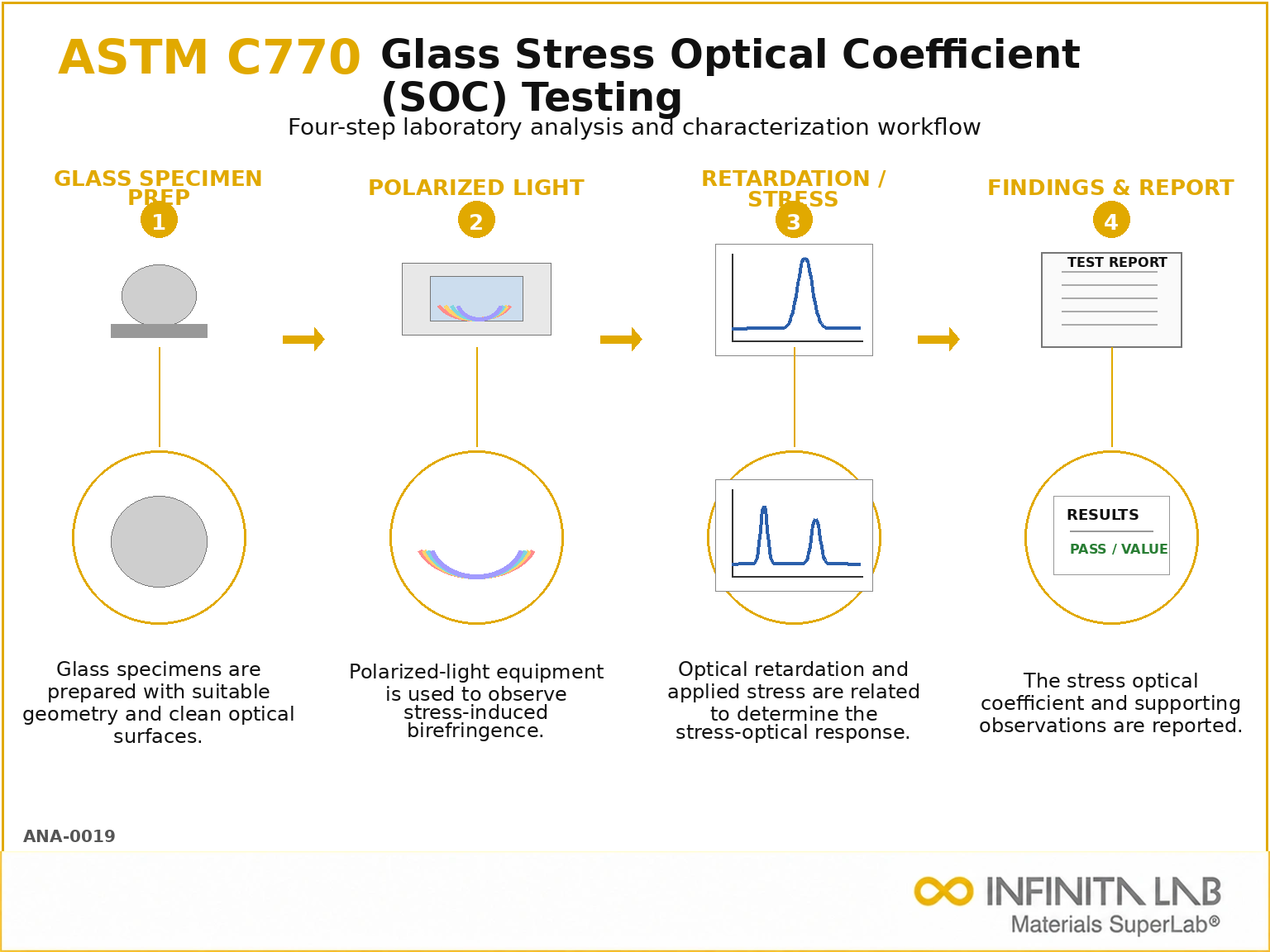
Sample Preparation
Glass specimens are prepared with uniform thickness and smooth surfaces.
1Stress Application
Controlled mechanical stress is applied to the specimen.
2Optical Measurement
Birefringence is measured using polarized light techniques.
3Data Recording & Evaluation
Stress-optical coefficient is calculated from measured values.
4ASTM C770 Test Parameters and Requirements
| Parameter | Details |
|---|---|
| Applicable Materials | Optical and structural glass |
| Specimen Thickness | ~1 mm to 10 mm |
| Stress Range | ~0.1 MPa to 50 MPa |
| Measurement Method | Polarized light analysis |
| Wavelength Range | ~400 nm to 700 nm |
| Measured Outputs | Stress-optical coefficient (Pa⁻¹ or Brewsters) |


- Polariscope or photoelastic setup
- Light source (monochromatic or white light)
- Load application system
- Optical measurement system
- Sample preparation tools
- Data acquisition system
Equipment and Instrumentation Used for ASTM C770 Testing
What You Receive: Test Report, Data, and Certification
- Stress-optical coefficient values
- Birefringence measurements
- Stress distribution analysis
- Optical performance evaluation
- Test condition summary
- ASTM compliance report
ASTM C770 Glass Stress Optical Coefficient FAQs
Understanding the mechanical behavior of glass under stress is critical in applications requiring its optical and structural integrity, including safety glass or optical components.
The stress-optical coefficient is determined using Procedure A-fiber, Procedure B-rectangular beam, and Procedure C-glass disc methods. All involve the measurement of optical retardation under conditions of stress.
Procedure B tests the optical retardation of a rectangular glass beam in four-point bending, while procedure A uses a glass fiber in uniaxial tension. Procedure B gives a distribution of bending stress.
The stress-optical coefficient helps predict how the glass will respond to different stress conditions. This is particularly helpful in designing glass components in safety-critical applications such as structural glass and optical devices.
Fine annealing in Procedure B is crucial in eliminating any internal stresses in the glass beam, ensuring it responds predictably to bending forces, thus giving better measurements of the stress-optical coefficient.
ASTM C770 determines the stress-optical coefficient of glass, which is used to calculate stress through photoelastic analysis. A glass specimen is subjected to controlled tension, bending, or compression while optical retardation is measured using a polarimeter. The results help evaluate residual stresses caused by annealing or tempering and support glass quality control.
Why Choose Infinita Lab for Glass Stress Optical Coefficient Testing?
When your Glass Stress Optical Coefficient results have to hold up - for compliance, a customer audit, or an engineering decision - ASTM C770 accuracy and an unbiased third-party report matter more than price. Infinita Lab routes your ASTM C770 glass stress optical coefficient testing to ISO/IEC 17025-accredited U.S. partner labs with hands-on method experience, so you get defensible data, transparent reporting, and turnaround times built around your project deadline - not ours.

Looking for an Accredited Partner for ASTM C770 Glass Stress Optical Coefficient Testing?
Send query us at hello@infinitalab.com or call us at (888) 878-3090 to learn more about our services and how we can support you.



Request a Quote
Submit your material details and receive testing procedures, pricing, and turnaround time within 24 hours.
 Quick Turnaround and Hasslefree process
 Confidentiality Guarantee
 Free, No-obligation Consultation
 100% Customer Satisfaction
