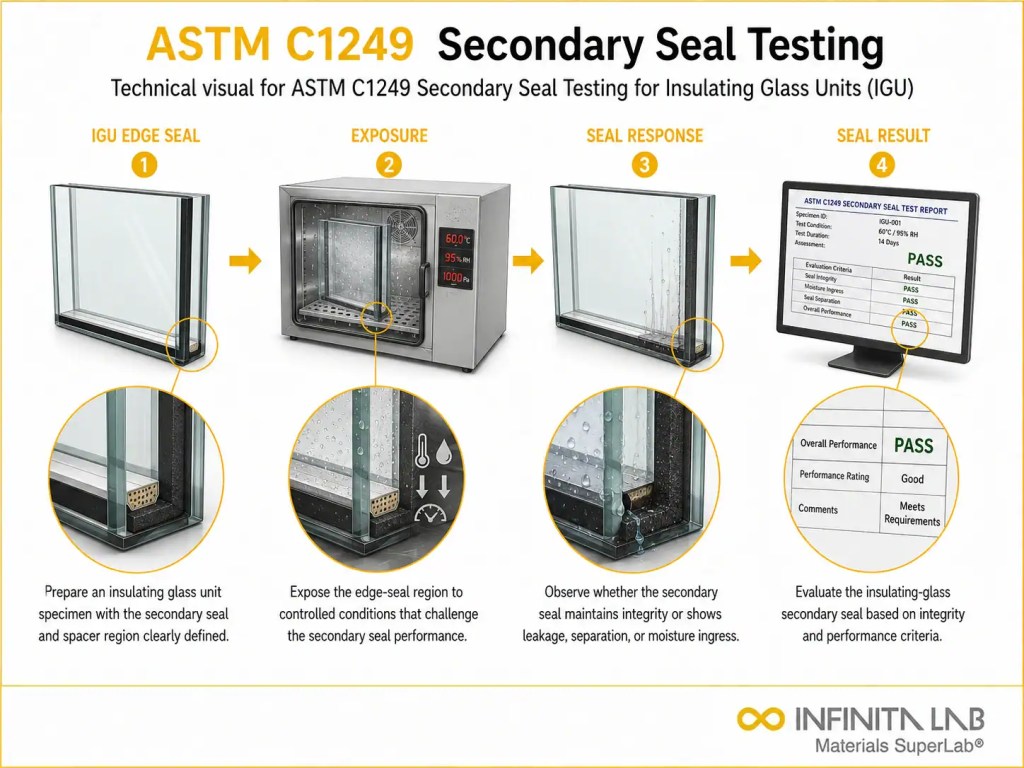


What Is ASTM C1249 Insulating Glass Secondary Seal?
ASTM C1249 specifies requirements for secondary sealants used in sealed insulating glass units (IGUs), ensuring durability, structural integrity, and resistance to environmental exposure. The standard evaluates sealant performance under mechanical stress and climatic conditions to maintain long-term sealing effectiveness.
This standard is widely used in the construction and glazing industry where insulating glass units are exposed to temperature fluctuations, moisture, and mechanical loads. ASTM C1249 ensures reliable sealing performance, preventing gas leakage, moisture ingress, and loss of insulation efficiency.
Applications and Benefits of ASTM C1249 Insulating Glass Secondary Seal Testing
Scope
ASTM C1249 covers performance testing of secondary sealants used in insulating glass units. It includes procedures for evaluating durability, adhesion, and resistance to environmental stresses to ensure long-term performance.
Includes:
- Testing of secondary sealants in IGUs
- Evaluation of adhesion and cohesion properties
- Resistance to environmental and mechanical stresses
- Durability assessment under cyclic conditions
- Standardized testing and reporting procedures
Applications
- Architectural glazing systems
- Commercial and residential windows
- Curtain wall systems
- Double and triple glazed units
- Energy-efficient building envelopes
- Skylights and façade systems
Benefits
- Ensures long-term sealing performance
- Prevents moisture and gas leakage
- Enhances thermal insulation efficiency
- Improves durability of IGUs
- Supports compliance with building standards
- Reduces maintenance and failure risks
Our ASTM C1249 Testing Procedure
Sample Preparation
Insulating glass units with applied secondary sealant are prepared for testing.
1Environmental Conditioning
Samples are subjected to temperature and humidity cycles to simulate service conditions.
2Mechanical Stress Application
Units are exposed to pressure or load cycles to evaluate sealant performance.
3Evaluation & Inspection
Sealants are inspected for failure, leakage, or degradation after testing.
4ASTM C1249 Test Parameters and Requirements
| Parameter | Details |
|---|---|
| Sealant Type | Structural and moisture-resistant sealants |
| Test Method | Environmental and mechanical durability testing |
| Conditioning | Temperature and humidity cycling |
| Adhesion Requirement | Strong bonding to glass and spacer materials |
| Durability | Resistance to long-term environmental exposure |
| Leakage Resistance | Prevention of gas and moisture ingress |
| Mechanical Performance | Resistance to stress and pressure cycles |


- Environmental test chamber
- Pressure cycling equipment
- Humidity control system
- Inspection tools
- Leak detection equipment
- Data acquisition system
Equipment and Instrumentation Used for ASTM C1249 Testing
What You Receive: Test Report, Data, and Certification
- Sealant performance report
- Leakage and failure analysis
- Environmental test data
- Inspection and evaluation report
- Compliance certification as per ASTM C1249
- Test summary and documentation
ASTM C1249 Insulating Glass Secondary Seal FAQs
ASTM C1249 is used to evaluate the performance of secondary sealants in insulating glass units, ensuring durability, adhesion, and resistance to environmental and mechanical stresses for long-term sealing effectiveness in glazing applications.
Insulating glass units are multi-pane window systems with sealed air or gas spaces between glass layers, designed to improve thermal insulation and energy efficiency in buildings.
The secondary seal provides structural strength and protects the primary seal, preventing moisture ingress and gas leakage, which are critical for maintaining insulation performance.
Compliance ensures long-term sealant performance, improved insulation efficiency, reduced maintenance, and enhanced durability of glazing systems.
The test subjects insulating glass units to cyclic environmental conditions including temperature variations, humidity exposure, and mechanical stress, replicating real-life service environments to assess sealant durability and long-term performance reliability.
Interferometric testing uses light waves to measure small differences in optical path length. The light beam is split into reference and measurement beams, which recombine to produce interference patterns. These patterns are analyzed to evaluate dimensional accuracy, surface flatness, and optical quality.
Interferometer surface measurement directs light onto a test surface and compares the reflected beam with a reference beam. The resulting interference patterns are analyzed to create a surface profile and measure flatness, height variations, and surface irregularities with high precision.
Why Choose Infinita Lab for Insulating Glass Secondary Seal Testing
When your Insulating Glass Secondary Seal results have to hold up - for compliance, a customer audit, or an engineering decision - ASTM C1249 accuracy and an unbiased third-party report matter more than price. Infinita Lab routes your ASTM C1249 insulating glass secondary seal testing to ISO/IEC 17025-accredited U.S. partner labs with hands-on method experience, so you get defensible data, transparent reporting, and turnaround times built around your project deadline - not ours.

Looking for an Accredited Partner for ASTM C1249 Insulating Glass Secondary Seal Testing?
Send query us at hello@infinitalab.com or call us at (888) 878-3090 to learn more about our services and how we can support you.



