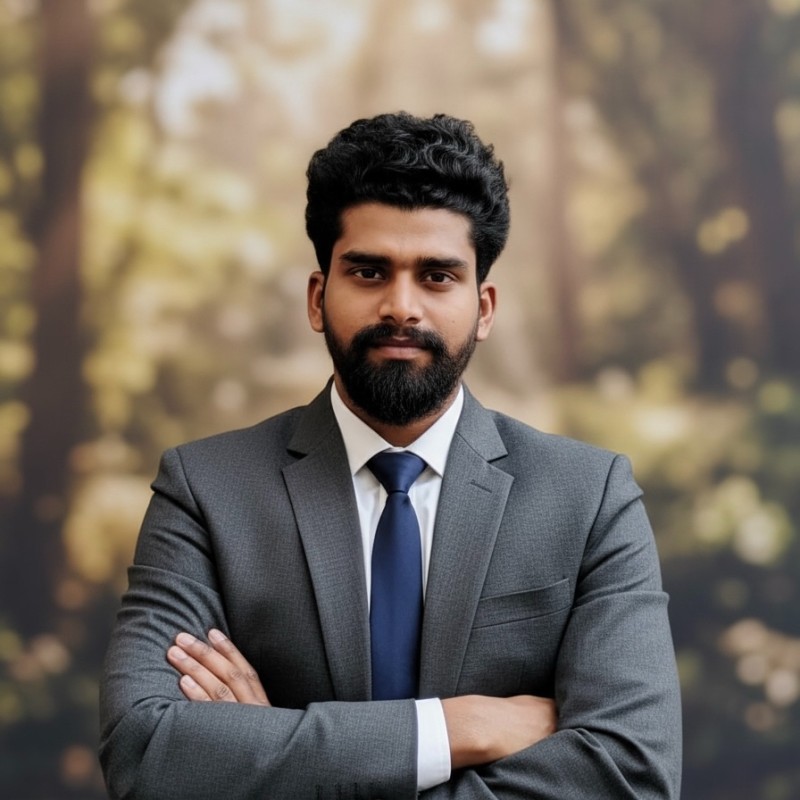
Author Bio
The Question Rakshit’s Work Answers
There is one question Rakshit Singh Manhas helps engineers, manufacturers, and R&D teams answer: will this material survive the environment it was designed for? It is a deceptively simple question, and it is the question that sits underneath almost every non-trivial testing program — whether the environment is the vacuum and thermal cycling of low Earth orbit, the corrosive salt-fog of a marine platform, the radiation field of a reactor containment structure, the high-cycle vibration of a launch vehicle, the repeated thermal shock of a power-electronics package on an EV inverter, or the long-duration UV exposure of a building envelope.
Rakshit’s work sits at the intersection of three things: technical testing, project management, and clear engineering communication. The first two get a program done. The third is what makes the data usable — what turns a lab report into a decision an engineer can defend to a program manager, a regulator, an investor, or a customer audit team.
Areas of Materials Testing Expertise
In 2+ years at Infinita Lab, Rakshit has managed materials testing projects across seven-plus industries — aerospace, semiconductor, automotive, medical device, energy, advanced manufacturing, and adjacent regulated sectors — moving teams from uncertainty to defensible data through:
- SEM and SEM/EDS analysis for surface morphology, fracture-surface investigation, contamination identification, and elemental mapping at the micron scale. The right first call for most field-failure root-cause work — and a less expensive starting point than TEM when the resolution requirement is in the micron rather than the atomic-scale regime.
- Mechanical testing across tensile, compressive, flexural, hardness, impact, fatigue, and fracture toughness — on metals, polymers, composites, ceramics, thin films, and coated systems.
- Thermal analysis — DSC, TGA, DMA, TMA — for glass transition, decomposition, cure kinetics, viscoelastic behavior, thermal expansion, and oxidation onset characterization.
- Failure analysis workflows that combine visual inspection, microscopy, elemental analysis, and mechanical or environmental testing into a single root-cause narrative — the kind of evidence package that holds up in a customer audit, a warranty negotiation, or a litigation context.
- Corrosion testing under ASTM B117 salt spray, ASTM G85 cyclic corrosion, electrochemical methods (potentiodynamic polarization, EIS), galvanic testing, and application-specific protocols for marine, aerospace, and chemical-process environments.
- Flammability and fire performance under UL 94, ASTM E84, FAR 25.853, NFPA standards, and related aerospace and building-product fire frameworks.
- Environmental testing — temperature, humidity, thermal shock, vibration, altitude, and combined-environment cycling — including MIL-STD-810 method sequences and IEC 60068 procedures.
- Materials characterization for development-stage formulations, qualification samples, and supplier-conformance evaluations — including XRD for phase identification, FTIR for compositional fingerprinting, and optical microscopy with image analysis for microstructure quantification.
Specialized Interest — Space Materials and Extreme Environments
Rakshit is especially interested in space materials and the testing workflows that make high-risk space hardware possible: heat shields and thermal protection systems, outgassing per ASTM E595, lunar regolith simulants and abrasion testing, radiation shielding and TID/SEE characterization, thin films and protective coatings, composite structures for launch and on-orbit applications, and the qualification logic that connects a coupon test to a flight-rated decision. The space-materials community has unusually high standards for evidence — small mass budgets, single-flight unit economics, no in-field repair option, and consequences of failure that justify the cost of getting the qualification right. The testing discipline required to support it is the same discipline that helps less-extreme programs run cleanly.
How Rakshit Helps Clients at Infinita Lab
Rakshit’s role is to make sure three things happen on every program he leads:
- The right test method gives a defensible answer. Method selection is the first place a testing program goes wrong. A wrong-method result is worse than no result — it costs a customer time, credibility, and the program-manager trust they need for the next funding cycle.
- The data turns into a decision. Lab data is an input, not an output. Rakshit’s reports are written so the engineer reading them can act on Monday morning — with clear method citation, conditions, replicates, uncertainty, and a narrative that connects what was measured to what the program needed to know.
- The project runs to schedule. Project management is not paperwork. It is the operational discipline that keeps a multi-method, multi-lab program from slipping a milestone — chain-of-custody discipline on samples, status visibility for the customer, and proactive escalation when a partner laboratory’s queue is at risk of moving.
How Rakshit Thinks About Testing Programs
The pattern Rakshit returns to in customer conversations is the chain that runs from the customer’s question to the method that answers it: what is the environment the material has to survive, what are the failure modes that environment activates, which characterization techniques would detect those failure modes earliest, and what does the resulting evidence package have to support downstream. Every step in that chain has trade-offs. Naming them out loud — instead of letting them stay hidden inside a quote — is what makes the difference between a transactional engagement and a working partnership.
Connect with Rakshit
Engineers validating a material, investigating a failure, selecting a test method, or working out what the data actually means can reach Rakshit through LinkedIn or through Infinita Lab intake. He is especially happy to compare notes on space-materials qualification, thermal protection systems, vacuum and outgassing testing, radiation effects characterization, and failure-analysis casework where the evidence is ambiguous and the stakes are not.
Professional Experience
Senior Associate
3Infinita Lab