


Optical Anisotropy Architectural Glass Testing Services
Optical Anisotropy in Architectural Glass refers to directional changes in refractive index caused by residual stresses in glass. It can lead to birefringence, visual distortion, stress patterns, or rainbow-like effects. Testing helps assess glass quality, uniformity, and appearance for architectural applications.
TRUSTED BY


Get compliant results — request your optical anisotropy architectural glass testing quote
- Overview
- Scope, Applications, and Benefits
- Test Process
- Specifications
- Instrumentation
- Results and Deliverables
What Is Optical Anisotropy Architectural Glass?
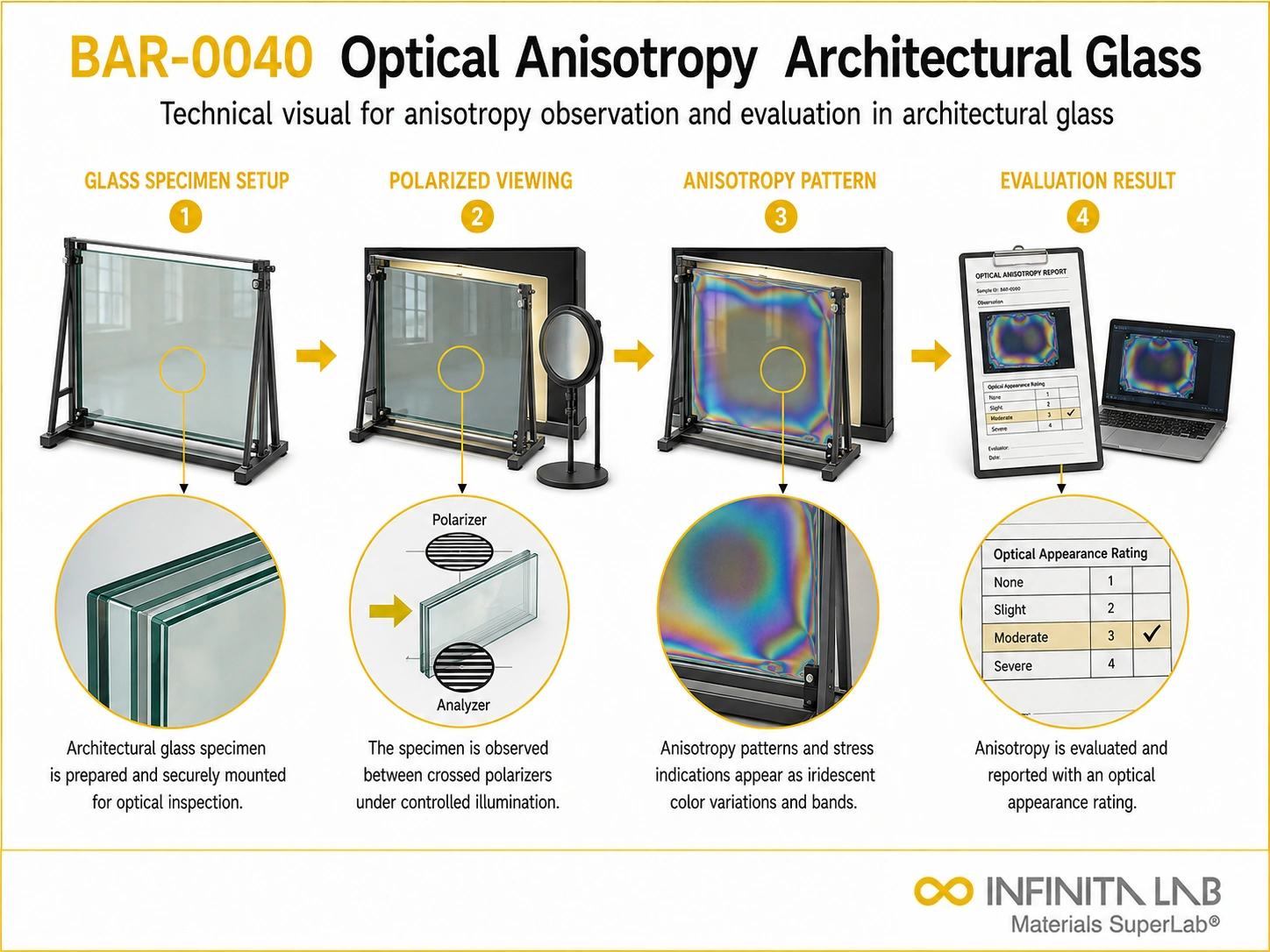
Optical anisotropy in architectural glass refers to direction-dependent variation in refractive index, caused primarily by residual stresses locked into the glass during thermal processing — most commonly heat strengthening or toughening. When polarised light passes through a glass panel with these internal stress gradients, it splits into two components travelling at different speeds. This is birefringence, and under polarised viewing conditions, it becomes visible as colored iridescence or patterned distortion across the glass surface.
The effect is an inherent consequence of the tempering process and cannot be eliminated. However, its severity varies significantly with tempering line settings, glass thickness, glass type, and coating. For most standard applications, the effect is minor and goes unnoticed. For high-end architectural facades, curtain walls, and glazed interiors where visual clarity and aesthetic uniformity matter, it can be a significant quality concern.
Measuring and quantifying optical anisotropy gives glass manufacturers, processors, and architects a way to evaluate the severity of the effect, compare it against acceptable thresholds, and make informed decisions about glass selection and specification before installation.

Applications and Benefits of Optical Anisotropy Architectural Glass Testing
Scope
Optical anisotropy testing involves measuring and characterising birefringence in tempered, heat-strengthened, and other thermally processed architectural glass. The testing quantifies the retardation values across the glass surface — expressed in nanometers (nm) — which correspond to the stress gradients responsible for the visible anisotropy effect. Measurements are taken using polarimetric or photoelastic methods under controlled illumination conditions.
The evaluation covers:
- Tempered glass — the primary source of optical anisotropy due to rapid quenching during the tempering process, which creates compressive surface stresses and tensile core stresses
- Heat-strengthened glass — lower stress levels than fully tempered glass, but anisotropy is still measurable and relevant for critical visual applications
- Laminated glass with tempered plies — anisotropy from individual plies is retained in the laminate and can be compounded by interlayer effects
- Coated and low-e glass — optical coatings can interact with polarised light and influence the visibility and measurement of anisotropy
- Insulating glass units (IGUs) — assessment of anisotropy in assembled units where multiple glass plies and coatings are present
Relevant industry references include EN 14179, ASTM standards for glass evaluation, and guidance documents from the Glass and Glazing Federation (GGF) and the European float glass manufacturers.
Applications
- Architectural facades and curtain walls — high-visibility glass installations where iridescence or patterning would be aesthetically unacceptable to architects or building owners
- Interior glazing and partitions — office environments and commercial interiors where glass is viewed under artificial lighting at multiple angles, making anisotropy more noticeable
- Structural glass applications — glass floors, balustrades, and canopies where both visual quality and stress distribution need to be understood
- Glass manufacturing and processing QC — tempering line optimisation to minimise anisotropy without compromising mechanical performance
- Product development and specification — glass manufacturers developing new products or coatings that need to be evaluated for anisotropy before going to market
- Dispute resolution — objective measurement data to assess whether anisotropy observed on an installed facade falls within expected or agreed limits
Benefits
- Quantifies what is otherwise a subjective visual complaint — gives a measurable retardation value instead of relying on observer opinion to assess severity
- Supports pre-installation decision-making — knowing the anisotropy level of a glass batch before it goes up on a building avoids costly post-installation disputes
- Helps optimize tempering parameters — retardation maps across the glass panel show where stress gradients are concentrated, giving processors actionable data to adjust furnace and quench settings
- Enables like-for-like comparison — standardized measurement allows different glass products, suppliers, or processing conditions to be compared on a consistent basis
- Relevant across the full supply chain — useful to float glass manufacturers, tempering processors, glazing contractors, and architects, each at a different stage of the project
Our Testing Procedure
Sample Setup
The glass specimen is placed under controlled polarized illumination, and key details such as dimensions, glass type, coating, and processing history are recorded.
1Polarimetric Measurement
Polarized light is passed through the glass to measure retardation values across selected points or the full surface.
2Retardation Mapping
The data is used to create a retardation map, identifying areas with higher stress or optical anisotropy.
3Reporting
Results are analyzed against reference limits, and a report is provided with retardation values, stress distribution, and overall assessment.
4Test parameters and requirements
| Parameter | Details |
|---|---|
| Test Type | Sustained / steady-state acceleration (centrifugal) |
| Acceleration Range | Typically 1 g to 500+ g, depending on equipment and requirement |
| Loading Axis | Single-axis or multi-axis sequential per test plan |
| Test Duration | As specified, seconds to several hours for endurance profiles |
| Applicable Standards | MIL-STD-202, MIL-STD-810, IEC 60068-2-7, customer-specific plans |
| Specimen Types | Components, PCBs, assemblies, structural parts, material coupons |
| Monitored Parameters | Dimensional change, functional performance, and electrical continuity |
| Reported Output | Peak g achieved, hold duration, failure mode, and location if applicable, pre/post functional status |
| Test Environment | Ambient unless otherwise specified |


- Digital polarimeter or photoelastic scanning system
- Polarized light source (transmission setup)
- Glass support frame or light table
- Image acquisition and analysis software
- Vernier calipers or a tape measure for specimen dimensioning
Equipment and Instrumentation Used for Testing
What You Receive: Test Report, Data, and Certification
- Retardation map — full-surface or grid-based visual map showing optical retardation distribution across the glass panel in nm
- Peak and average retardation values — numerical summary of maximum, minimum, and mean retardation across the measured area
- Assessment against thresholds — comparison of results against applicable reference limits or client-specified acceptance criteria
- Specimen records — glass type, dimensions, coating, processing history, and any visual observations noted during testing
- Photographic documentation — images of the glass under polarized light showing the visible anisotropy pattern alongside the measurement data
Optical Anisotropy Architectural Glass FAQs
Electronics, automotive parts, aerospace components, sensors, batteries, packaging systems, and mechanical assemblies often require acceleration testing.
Acceleration testing measures response to force or motion loading, while vibration testing focuses on repeated oscillations over a frequency range.
Yes. Some tests are designed to expose failure limits, while others confirm that the product can survive defined acceleration levels without damage.
Yes, many aerospace components require acceleration testing to confirm they can withstand launch, flight, maneuvering, or emergency load conditions.
Yes. It can help evaluate how products respond to handling, shipping, impact, and movement during transit.
Why Choose Infinita Lab for Optical Anisotropy Architectural Glass Testing
At the core of this breadth is our network of 2,000+ accredited laboratories across the USA, offering access to over 10,000 testing methods and analytical services. From advanced materials characterization (SEM, TEM, RBS, XPS) to mechanical, chemical, environmental, biological, and standardized ASTM/ISO-compliant testing, we deliver unmatched flexibility, specialization, and scale. You are never limited by geography, facility, or methodology — Infinita Lab connects you to the right expertise and testing solution, every time.

Looking for an Accredited Partner for Optical Anisotropy Architectural Glass Testing?
Send query us at hello@infinitalab.com or call us at (888) 878-3090 to learn more about our services and how we can support you.



Request a Quote
Submit your material details and receive testing procedures, pricing, and turnaround time within 24 hours.
 Quick Turnaround and Hasslefree process
 Confidentiality Guarantee
 Free, No-obligation Consultation
 100% Customer Satisfaction
