


Hydrogen Embrittlement Testing Services
Read more about hydrogen embrittlement the embrittling procedure and other advantages and disadvantages.
TRUSTED BY


Get compliant results — request your hydrogen embrittlement testing quote
- Overview
- Scope, Applications, and Benefits
- Test Process
- Specifications
- Instrumentation
- Results and Deliverables
What Is Hydrogen Embrittlement?
Hydrogen Embrittlement is a critical phenomenon in durability engineering where metals, particularly high-strength steels, become brittle and crack due to the absorption of hydrogen. The presence of hydrogen reduces ductility and load-bearing capacity, often leading to sudden and unexpected failure under stress.
This issue is widely studied in the materials, automotive, aerospace, and energy industry, where components are exposed to hydrogen environments during manufacturing, processing, or service. Durability engineering focuses on identifying susceptibility, preventing hydrogen ingress, and ensuring long-term reliability of materials under mechanical and environmental stress conditions.

Applications and Benefits of Hydrogen Embrittlement Testing
Scope
Hydrogen embrittlement evaluation focuses on understanding material susceptibility, crack initiation, and propagation under hydrogen exposure.
It helps assess durability, reliability, and failure risks in critical components.
- Hydrogen absorption assessment
- Crack initiation and propagation study
- Material susceptibility evaluation
- Stress-corrosion interaction analysis
- Environmental exposure testing
- Failure analysis and prevention
- Quality control and validation
Applications
- High-strength steel components
- Automotive fasteners and springs
- Aerospace structural parts
- Oil and gas pipelines
- Hydrogen storage systems
Benefits
- Prevents unexpected material failure
- Improves component durability
- Enhances safety and reliability
- Supports material selection
- Reduces maintenance and downtime
- Enables performance optimization
- Ensures compliance with standards
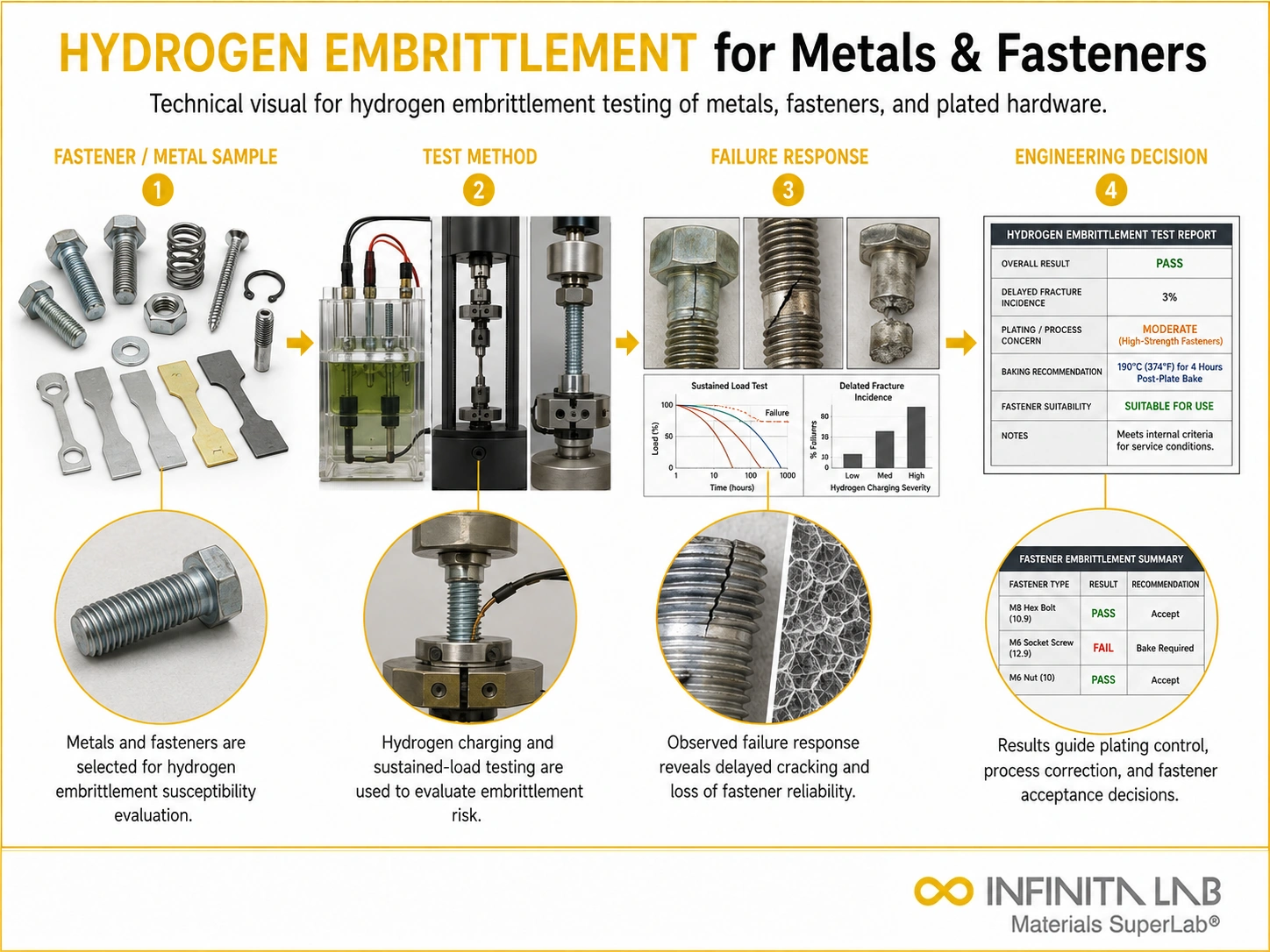
Our Testing Procedure
Sample Preparation
Specimens are prepared and cleaned to avoid contamination before hydrogen exposure.
1Hydrogen Charging
Samples are exposed to hydrogen through electrochemical or gaseous methods.
2Mechanical Loading
Loaded under stress to evaluate cracking susceptibility in hydrogen presence.
3Evaluation
Crack formation and failure behavior are analyzed to assess embrittlement.
4Test parameters and requirements
| Parameter | Details |
|---|---|
| Material Type | High-strength steels and alloys. |
| Hydrogen Source | Electrochemical or gaseous hydrogen. |
| Measured Parameter | Crack initiation and propagation. |
| Stress Condition | Constant or cyclic loading. |
| Environment | Controlled hydrogen exposure conditions. |
| Temperature Range | Ambient or elevated temperatures. |
| Sample Condition | Clean and defect-free specimens. |
| Detection Method | Microscopic and mechanical analysis. |


- Universal Testing Machine (UTM)
- Electrochemical charging setup
- Hydrogen gas chamber
- Microscopes (SEM/optical)
- Crack detection systems
- Environmental chambers
Equipment and Instrumentation Used for Testing
What You Receive: Test Report, Data, and Certification
- Embrittlement susceptibility assessment
- Crack initiation and propagation data
- Mechanical performance reduction analysis
- Failure mode evaluation
- Comparative material performance
- Test documentation
- Final technical report
Hydrogen Embrittlement FAQs
Hydrogen embrittlement is a material degradation phenomenon where metals absorb hydrogen, leading to reduced ductility and strength, which can cause sudden cracking or failure under stress even at relatively low loads.
It can cause unexpected and catastrophic failure in critical components, especially in high-strength materials, making it a major reliability and safety concern in demanding environments.
Signs include sudden brittle fracture, delayed cracking, reduced ductility, and failure without significant plastic deformation.
In some cases, hydrogen can be removed through processes like baking, but severe damage or cracking is usually irreversible.
Testing helps identify susceptible materials, evaluate risks, and ensure safe design and long-term durability of components in hydrogen-related environments.
Why Choose Infinita Lab for Hydrogen Embrittlement Testing?
At the core of this breadth is our network of 2,000+ accredited laboratories across the USA, offering access to over 10,000 testing methods and analytical services. From advanced materials characterization (SEM, TEM, RBS, XPS) to mechanical, chemical, environmental, biological, and standardized ASTM/ISO-compliant testing, we deliver unmatched flexibility, specialization, and scale. You are never limited by geography, facility, or methodology — Infinita Lab connects you to the right expertise and testing solution, every time.

Looking for an Accredited Partner for Hydrogen Embrittlement Testing?
Send query us at hello@infinitalab.com or call us at (888) 878-3090 to learn more about our services and how we can support you.



Request a Quote
Submit your material details and receive testing procedures, pricing, and turnaround time within 24 hours.
 Quick Turnaround and Hasslefree process
 Confidentiality Guarantee
 Free, No-obligation Consultation
 100% Customer Satisfaction
